
As South Africa (SA) celebrates Women’s Month in August, it is worth reflecting on the growing role women play in business and investing. Investing was once regarded as the domain of men. That has changed substantially; women are now the primary decision-makers around wealth in a growing share of households, alongside their roles as entrepreneurs, executives, business owners, and professionals. At the same time, one of the largest intergenerational wealth transfers in history is underway, and women are expected to control an increasingly significant share of global wealth in the years ahead.
Figure 1: Financial wealth controlled by women, US$trn
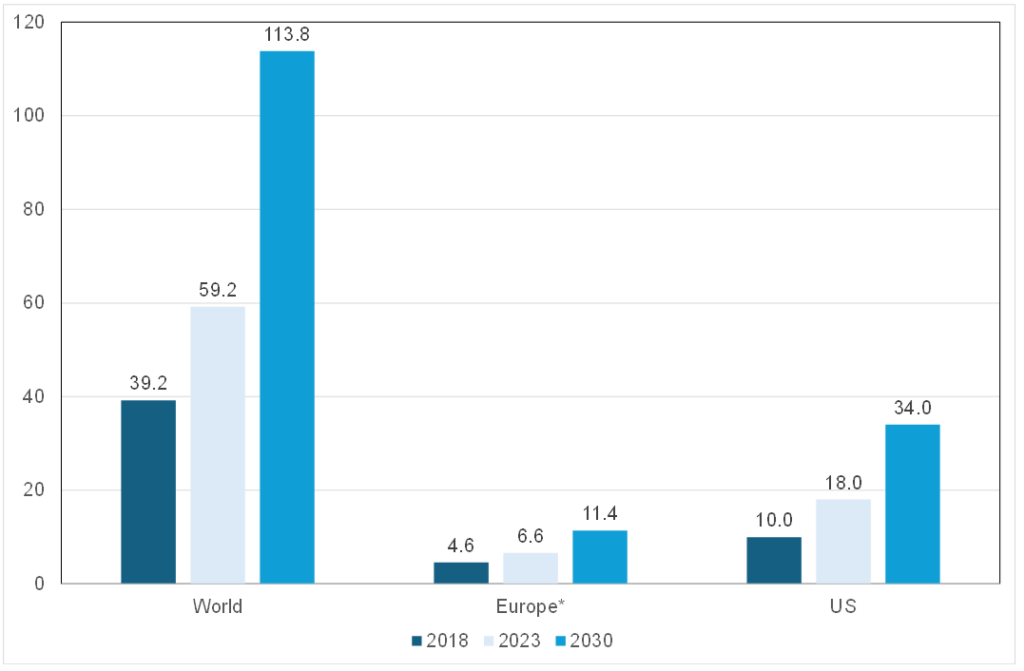
Source: McKinsey, Ceruli Associates, Anchor Capital
*Austria, Denmark, Finland, France, Germany, Italy, the Netherlands, Norway, Spain, Sweden, Switzerland, and the UK.
The global picture
The scale of this shift in wealth is well documented. McKinsey estimates that women in the US and Europe control roughly one-third of retail financial assets, rising from 29% a decade ago, with that share projected to reach 40% to 45% by 2030. Globally, women held an estimated US$59trn in assets under management by 2023. According to Norselab, female-controlled wealth grew 51% between 2018 and 2023, outpacing the 43% growth in overall global financial wealth over the same period.
The South African context
SA’s household structures have evolved alongside this trend. According to the Statistics South Africa (Stats SA) 2025 General Household Survey, female-headed households now account for 42.6% of the total, rising to 47.6% in rural areas. This represents close to 6.1mn homes where women carry primary financial responsibility. Female labour force participation increased to 55.8% in 2024, up from 50.9% in 2014, according to Stats SA.
Women are also increasingly advancing into leadership and ownership roles across historically male-dominated sectors. Data from the Department of Trade, Industry and Competition (DTIC) show women own c. 22% of businesses and occupy 47% of senior management positions nationally. This is ahead of the 34% global average reported in Grant Thornton’s 2025 Women in Business report. Female-owned businesses generated an estimated R175bn in revenue in 2024. Further data from Grant Thornton andthe South African Supplier Diversity Council (SASDC) show women hold 35% of CEO and 52.7% of CFO positions locally, with 65% of female-owned businesses led by Black women, and 36.9% of top management roles at state-owned enterprises (SOEs) filled by women.
How does this impact women investors?
The growing role of women as wealth creators, investors and financial decision-makers brings several considerations that may be particularly relevant to women’s financial planning. These include longer life expectancy, a greater likelihood of career interruptions related to caregiving, greater involvement in multi-generational financial support (including children, parents and extended family), and the need to navigate both domestic and offshore investment exposure in a relatively concentrated local market.
The conversation has therefore shifted from simply encouraging women to participate in markets to recognising their increasingly important role as wealth creators, investors and stewards of family legacies. The underlying principles of successful investing (patience, diversification, disciplined asset allocation and a long-term perspective) remain universal and apply equally regardless of gender.
Financial journeys, however, are not universal. Women generally live longer, are more likely to experience caregiving-related career interruptions and more often play a central role in supporting multiple generations within extended family structures. These realities can have meaningful implications for financial planning, particularly around retirement adequacy, liquidity, wealth transfer and estate planning.
Addressing these considerations is less about designing separate investment solutions for women and more about ensuring that any financial advice properly reflects an individual’s circumstances, responsibilities and objectives. For some women, this may mean planning for a longer retirement horizon; for others, balancing near-term family responsibilities with long-term wealth creation, structuring an inheritance, building a business or determining the appropriate level of offshore exposure. The right investment strategy should ultimately be shaped by the individual, rather than by gender alone.
Past financial experiences can also shape risk perceptions long after the circumstances that caused them have passed. A period of financial stress, a significant market loss or an unexpected change in personal circumstances can leave a lasting imprint on how an investor assesses risk. Sound financial planning therefore needs to account not only for an investor’s objectives and circumstances, but also for how experience may influence their judgement and behaviour.
The behavioural finance perspective
Behavioural finance research adds some interesting insights. Women are generally more likely to adopt longer investment horizons, trade less frequently and demonstrate greater patience during periods of market volatility. These attributes matter because avoiding costly mistakes (selling during market downturns, attempting to time markets, taking on excessive risk) is often as important to long-term outcomes as identifying strong opportunities.
Overconfidence can also be costly. Investors who trade more frequently incur higher transaction costs and may be more prone to poor timing, particularly during periods of increased volatility. The lower trading frequency often observed among women (Does gender make a difference for traders) therefore may be more than a behavioural curiosity: over long periods, avoiding unnecessary transactions and impulsive decisions can contribute meaningfully to investment outcomes.
Research also indicates that men tend to report higher levels of investment confidence, while women are more likely to seek advice and conduct additional research before making investment decisions. This is not necessarily a disadvantage. Confidence and competence are not the same thing, and research suggests that part of the observed gender gap in financial literacy reflects confidence rather than knowledge alone. In a US Federal Reserve analysis entitled Question design and the gender gap in financial literacy, the authors found that women are significantly more likely than men to select “don’t know” when answering financial literacy questions. A study by the National Bureau of Economic Research (Fearless Woman: Financial Literacy and Stock Market Participation) estimates that differences in confidence account for around one-third of the gender gap in financial literacy.
This matters because waiting to feel fully informed or confident can itself become a barrier to investing. A disciplined, advice-led approach can help investors move from uncertainty to informed action, while allowing time and compounding to do their work.
Research also suggests that women tend to adopt a more holistic view of wealth, defining success less by portfolio performance alone and more by what that performance enables, including financial independence, retirement security, family support, pursuing entrepreneurial ambitions, or creating a lasting legacy. This reframes many financial questions as planning questions rather than product questions: retirement readiness, generational wealth preservation, the role of offshore exposure, liquidity needs relative to growth objectives and the timing and structure of wealth transfer and estate planning.
This broader perspective can change how investors think about preserving wealth. Capital set aside for a legacy is not necessarily capital that should remain untouched indefinitely; in some circumstances, using wealth to support children, ageing parents, entrepreneurial ambitions or other family objectives may be entirely consistent with the purpose for which it was built. Good planning considers not only how wealth is preserved and transferred, but when and how it should be used.
None of this implies that women require fundamentally different portfolios. Rather, it underscores that investment decisions are never made in isolation from an individual’s circumstances and that demographic assumptions are a poor substitute for personalised advice. A 30-year-old entrepreneur and a 60-year-old retiree may have entirely different objectives, irrespective of gender. Investment strategy should therefore be built around the individual, not the demographic.
The Anchor Capital approach
At Anchor Capital, the growing influence of women in wealth management has shaped how we think about advice. We start from the premise that investment strategies should reflect real lives, not only markets. This means understanding each client’s circumstances, priorities and long-term goals, and building portfolios that balance growth with flexibility, supported by disciplined investment processes and close client relationships.
Women’s investment needs often reflect distinct life paths: longer time horizons, evolving liquidity requirements and responsibilities that extend to supporting children, ageing parents or wider family structures. While women are, on average, more cautious about investment risk than men, this does not necessarily translate into overly conservative portfolios. Many women pursue moderate to growth-oriented strategies, with their approach to risk often reflecting their goals, time horizons and broader financial responsibilities rather than short-term market noise. In this context, caution can be a feature of sound decision-making rather than a limitation, particularly when it supports disciplined investing, adherence to long-term plans and avoidance of unnecessary portfolio turnover.
Recognising this evolution as a fundamental transformation in how wealth is created and managed, Anchor Capital launched the Women’s Wealth Within initiative in 2025, creating a platform for women to engage more confidently with financial planning and investment decisions through education, insight and open dialogue. Our approach is built on partnership: clients create wealth through their work, businesses, and vision; we protect it through thoughtful structuring and tax-aware planning, and we grow it through disciplined, strategically aligned investing and asset allocation aligned with their individual goals.
Looking to the future
The rise of women investors reflects one of the more significant structural shifts underway in global wealth management, and it will continue to shape how capital is invested, protected and transferred across generations.
Women do not require different portfolios simply by virtue of being women. Still, they do benefit from financial advice that recognises the realities of longer life expectancies, evolving career paths, multi-generational wealth planning responsibilities and increasingly complex financial lives. The opportunity is not simply to build separate investment solutions, but to ensure women have access to the same standard of thoughtful, sophisticated, personalised advice that evolves with them, and helps translate financial ambition into lasting generational wealth.
Women do not necessarily need different portfolios. They may, however, approach financial decisions differently, and good advice should understand why.