

South Africa’s (SA) labour market weakened in 2Q26, highlighting the economy’s ongoing struggle to create jobs at a pace sufficient to absorb the growing labour force. The rise in unemployment reflects fragile domestic demand, weak business confidence, and persistent structural constraints that continue to weigh on employment growth. At the same time, the increase in cost pressures following the Middle East conflict has added another headwind to the economic outlook.
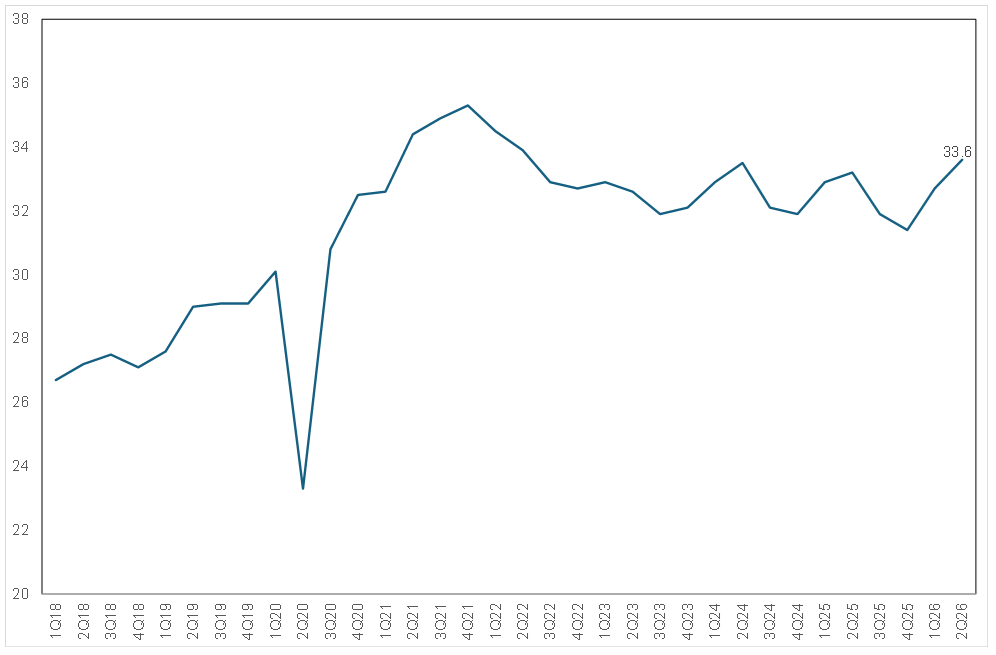
Statistics South Africa’s (Stats SA) latest Quarterly Labour Force Survey (QLFS) shows that SA’s official unemployment rate increased to 33.6% in 2Q26 from 32.7% in the previous quarter. The number of unemployed individuals rose by 345,000 to 8.5mn, while employment declined by 16,000 to 16.7mn. At the same time, the labour force expanded by 329,000 people, reflecting increased participation in the job market.
Figure 1: Unemployment rate trend, YoY % change
Source: Stats SA, Anchor Capital
Figure 2: Unemployment rate, 2Q26

Source: Stats SA, Anchor Capital
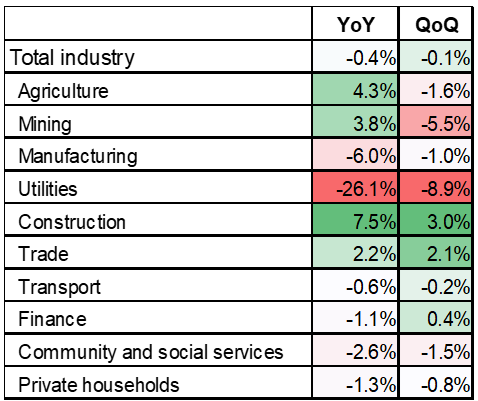
Employment weakness was relatively broad-based across the economy, with total employment declining by 0.4% YoY and 0.1% QoQ. Performance across industries was mixed. Construction was the strongest-performing sector, with employment growth of 7.5% YoY and 3.0% QoQ, while trade employment rose by 2.2% YoY and 2.1% QoQ. Agriculture and mining also posted annual employment growth of 4.3% and 3.8%, respectively, although both sectors shed jobs compared with the previous quarter.
Utilities remained the weakest-performing sector, with employment falling by 26.1% YoY and 8.9% QoQ, while manufacturing employment contracted by 6.0% YoY and 1.0% QoQ. Community and social services, one of the economy’s largest employers, recorded a decline of 2.6% YoY and 1.5% QoQ, contributing materially to overall weakness. Employment in transport, finance and private household sectors also declined on both an annual and a quarterly basis.
Figure 3: Employment by industry, 2Q26 % change
Source: Stats SA, Anchor Capital
Formal job losses, rising youth unemployment and growing informality highlight persistent structural weaknesses
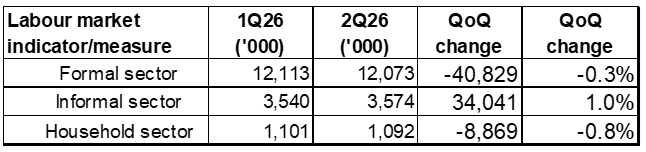
Employment trends across sectors further illustrate this weakness. Formal sector employment declined by 41,000 jobs to 12.1mn, while household employment fell by 9,000. In contrast, informal sector employment increased by 34,000 to 3.6mn. The continued expansion of informal employment relative to formal employment suggests that an increasing number of workers are relying on less secure sources of income as opportunities in the formal economy remain limited.
Figure 4: Employment sectoral changes
Source: Stats SA, Anchor Capital
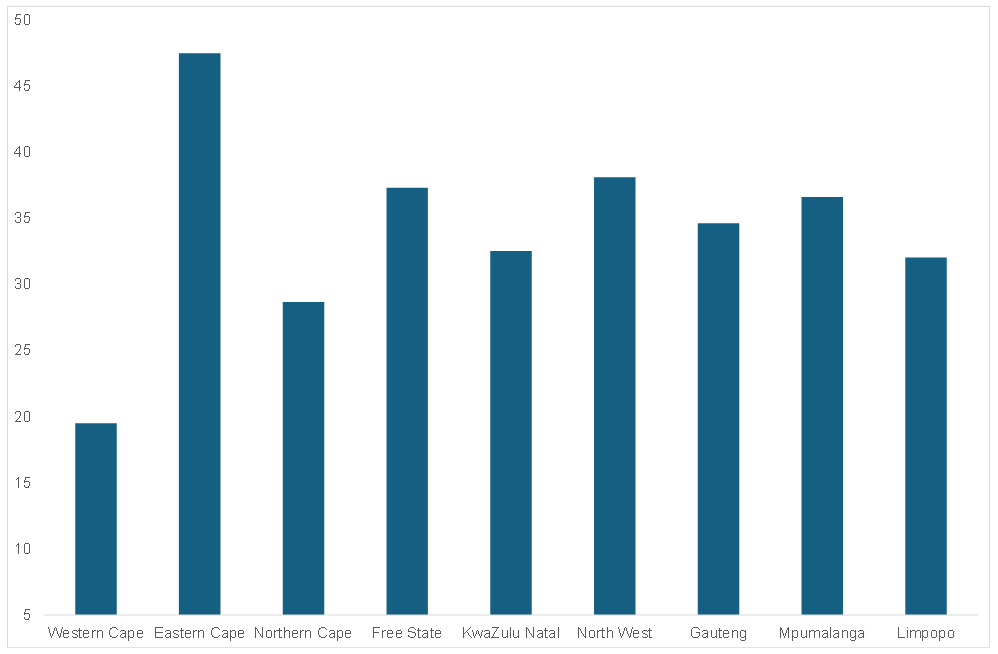
Provincial labour market outcomes remain highly uneven. The Eastern Cape recorded the highest unemployment rate at 47.5%, followed by the Northwest at 38.1%. By contrast, the Western Cape remained the best-performing province, with an unemployment rate of 19.5%, significantly below the national average. These disparities highlight differences in economic activity, investment attraction, infrastructure quality, and labour market opportunities across provinces.
Figure 5: Unemployment rate by province, %
Source: Stats SA, Anchor Capital
Outlook
The latest labour market data are consistent with earlier signals from the Quarterly Employment Statistics, which showed formal sector employment declining by 0.8% in 1Q26. Taken together, these indicators suggest that the post-pandemic labour market recovery has largely run its course, with weak economic growth and persistent structural constraints once again limiting employment creation.
Importantly, the increase in unemployment was not primarily driven by widespread job losses. Rather, it reflected the economy’s inability to absorb a growing number of job seekers. The working-age population also continued to grow, rising by 121,000 QoQ to 42.3mn.
The economy has struggled to sustain economic growth above 2% in recent years, well below the pace typically required to generate meaningful job creation. Infrastructure constraints, low levels of private-sector investment, and political uncertainty continue to limit the economy’s capacity to grow and absorb new labour-market entrants.
The employment outlook therefore remains challenging heading into 2H26. Global geopolitical tensions, including developments in the Middle East, uncertainty surrounding US trade and tariff policy, and the ongoing conflict in Ukraine, continue to weigh on business confidence and economic activity globally. These external headwinds, compounded by SA’s domestic structural constraints and rising inflationary pressures, are likely to limit the pace of employment growth.
Youth unemployment remains one of the country’s most pressing socioeconomic challenges. The number of unemployed individuals aged 15 to 34 increased by 264,000 during the quarter to 5mn, while youth employment declined by 40,000. As a result, the youth unemployment rate rose to 47.4%, meaning that nearly one in every two economically active young people remains without work. Given the scale and persistence of the challenge, youth unemployment is likely to feature prominently in political discourse as parties position themselves ahead of the local government elections later this year.