

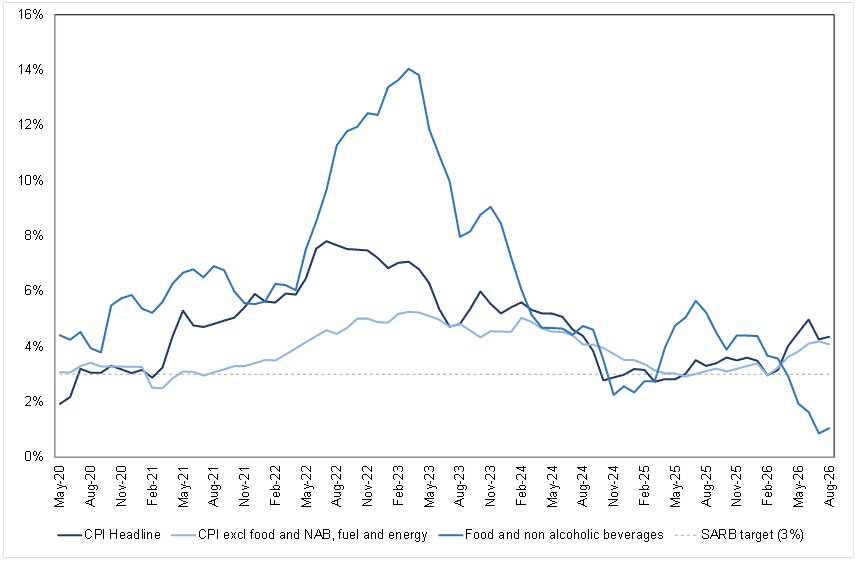
August inflation came in marginally softer than expected, with headline inflation, as measured by the Consumer Price Index (CPI), printing at 4.4% and core inflation at 4.1%, both 0.1 ppts below consensus. However, the inflation outlook has become more challenging, particularly given higher oil prices and emerging risks to food inflation.
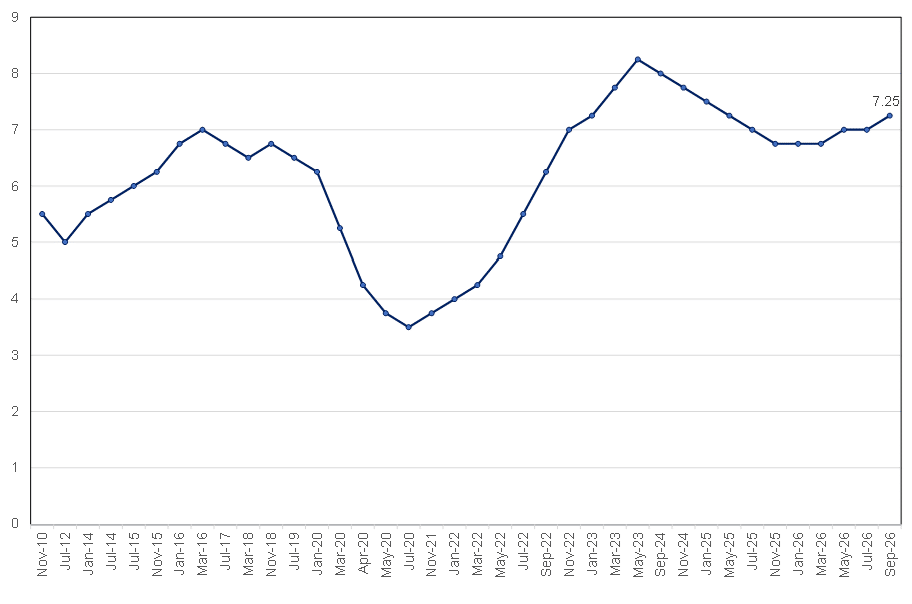
Against this backdrop, the South African Reserve Bank’s (SARB) Monetary Policy Committee (MPC) raised the repo rate by 25 bpts to 7.25% at its meeting on 23 September, in line with market expectations. The decision was unanimous and follows the MPC’s decision to leave rates unchanged in July, when two members voted in favour of an increase.
We believe the decision signals that the MPC is prioritising the credibility of its new 3% inflation target, even as the domestic growth outlook remains weak. The increase takes the monetary policy stance to a modestly restrictive setting.
Headline inflation edged up slightly from 4.3% in July, while core eased from 4.2%. On a monthly basis, both headline and core inflation were unchanged, following increases of 0.2% and 0.5%, respectively, in July. Although headline inflation remains relatively contained, it is still above the upper end of the SARB’s 2%-4% tolerance band and materially above its 3% target. The composition of inflation remains important: subdued goods and food inflation continue to provide some offset, while services, housing and transport costs remain comparatively elevated.
Figure 1: SA inflation, YoY % change
Source: Stats SA, Anchor Capital
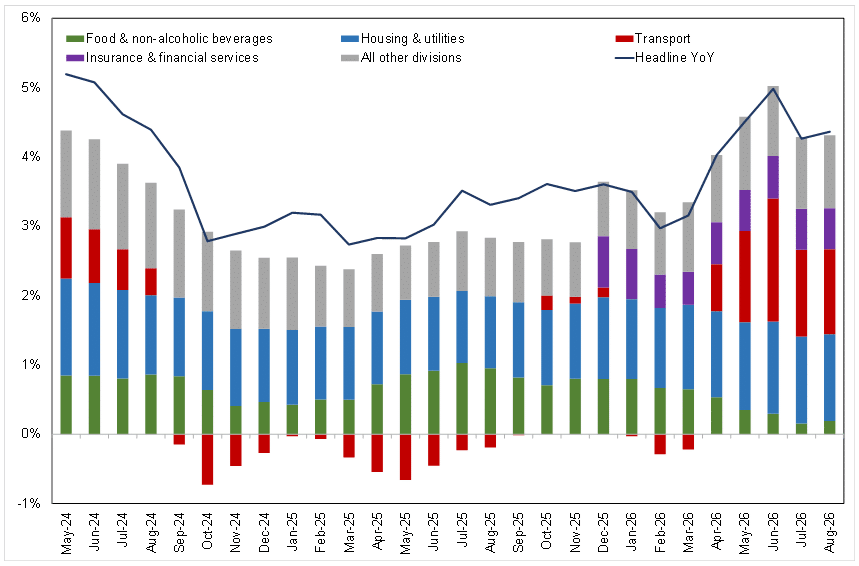
Key drivers of headline inflation were housing and utilities and transport. Housing and utilities were recorded at 5.2%, the same rate as July, due to electricity inflation remaining high at 7.4% YoY (though it eased from 8.3% in July). On a monthly basis, electricity prices declined by 0.8% after jumping 7.0% in July on the annual municipal tariff adjustments. Water and municipal services inflation rose to 7.2% from 6.4%, with prices up 0.8% MoM following a 6.0% increase in July. Rental inflation remained steady, with actual rentals at 4.1% and owners’ equivalent rent at 4.0%, both unchanged MoM.
Annual transport inflation printed at 8.8%, slightly lower than 8.9% in the previous month. Fuel inflation eased marginally to 20.0% from 20.6% in July, as pump prices fell by 1.3% MoM, following a sharper 7.8% decline in July. Passenger transport inflation remained elevated at 11.6% (July: 11.8%), reflecting the pass-through of higher fuel costs to taxi and bus fares. Passenger fares edged down 0.2% MoM after falling 0.9% in July.
Figure 2: Contributors to August headline inflation, YoY % change
Source: Stats SA, Anchor Capital
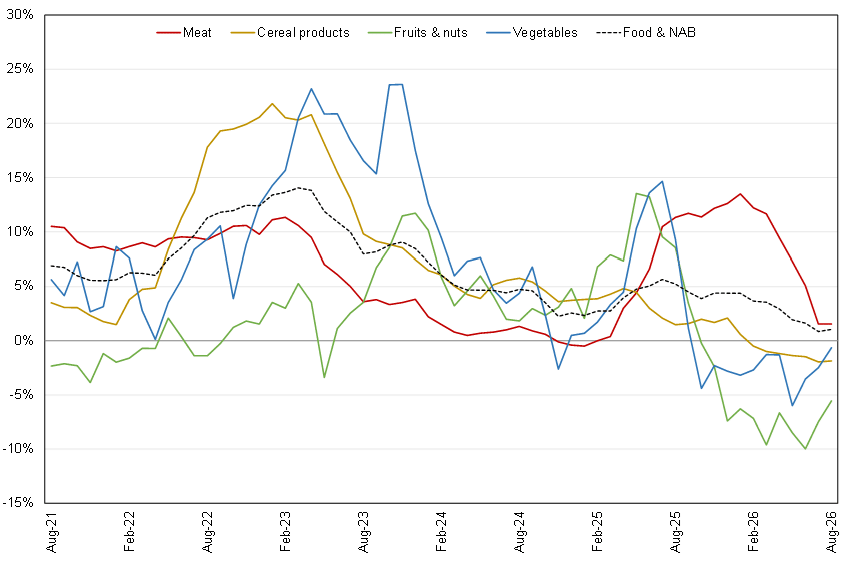
Food and non-alcoholic beverages inflation remains low at 1.1% and has kept headline inflation contained. Annual food inflation edged up to 0.7% in August from 0.6% in July. Cereal prices continued to decline, although the pace of deflation eased slightly to 1.9% from 2.0%. Meat inflation was broadly unchanged at about 1.5%. Fruit and nut prices (−5.5%) and vegetable prices (−0.6%) remained in deflation, albeit at a much slower pace than in July (−7.5% and −2.5%, respectively).
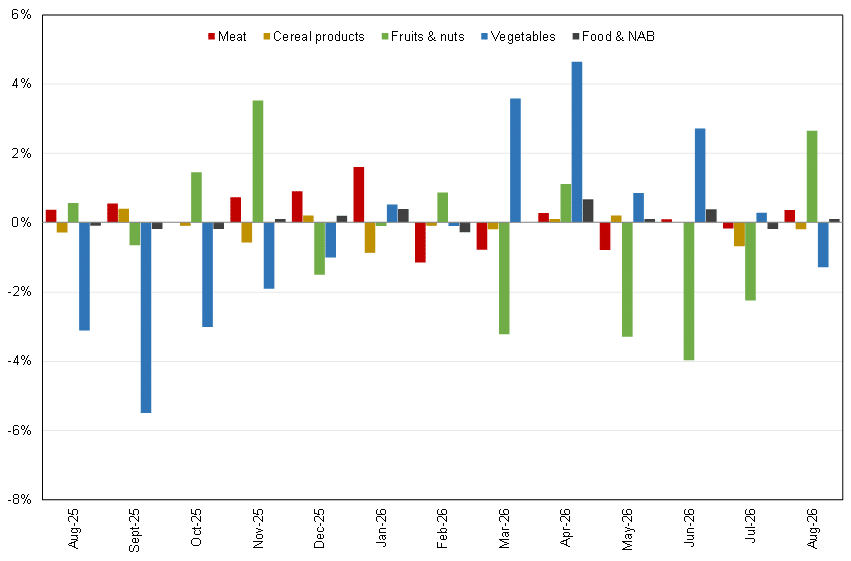
There are, however, early signs that food disinflation is starting to fade. On a monthly basis, food and non-alcoholic beverage prices rose 0.1% in August after falling 0.2% in July. Higher meat prices were the main driver, rising 0.4% after a 0.2% decline in July, while fruit and nut prices rebounded 2.7% after falling 2.2%. Vegetable prices moved the other way, falling 1.3% after a marginal 0.3% increase in July.
Figure 3: Food inflation: Meat, cereals, fruit and vegetables inflation, MoM % change
Source: Stats SA, Anchor Capital
Figure 4: Food: Meat, cereals, fruit and vegetables inflation, YoY % change
Source: Stats SA, Anchor Capital
Insurance and financial services inflation was steady at 5.7% YoY and flat MoM. Insurance rose 5.9% and financial services 4.8%.
Restaurants and accommodation inflation rose to 5.7% from 5.3% in July, driven by a sharp pick-up in accommodation costs to 5.8% from 2.7%. This more than offset a slight moderation in restaurant and catering prices to 5.7% from 5.9%. On a monthly basis, the category rose 0.6%, broadly in line with July’s 0.7% increase, with accommodation up 1.8% and restaurants advancing by 0.2%.
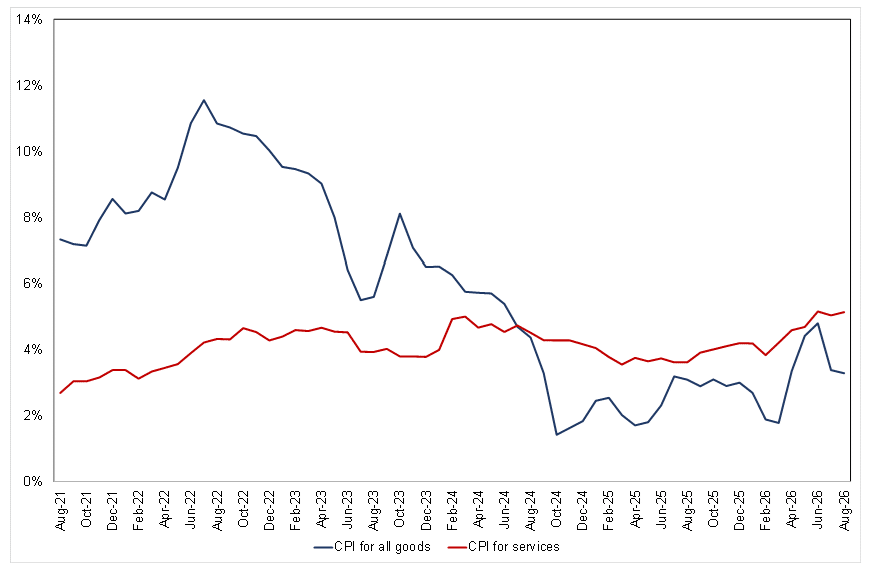
Figure 5: SA goods and services inflation YoY % change
Source: Stats SA, Anchor Capital
Core goods inflation remained subdued in August at 3.3% (3.4% in July), although the pace of deflation in several categories eased. Durable goods prices fell 0.4% YoY, a smaller decline than July’s 0.6%, and unchanged MoM after rising 0.3% in July. Household textiles, appliances and equipment remained in deflation at 2.2% (July: 2.3%), with prices down 0.5% MoM after a 0.1% increase.
Information and communication equipment prices dropped by 6.4% YoY, a slower rate of decline than July’s 7.4%, and edged down 0.1% MoM after falling 0.7% in July. Vehicle price inflation was steady at 0.8% YoY, with prices flat MoM after rising 0.3% in July. Clothing and footwear inflation eased to 1.1% from 1.2%, with prices unchanged MoM following a 0.1% rise. Alcoholic beverage inflation slowed to 3.3% from 3.4%, as prices fell 0.1% MoM after rising 0.2% in July, led by declines in spirits (−0.4%) and wine (−0.2%).
In contrast, services inflation edged up to 5.1% YoY from 5.0% in July, offsetting some of the softness in core goods, although monthly services inflation slowed to 0.1% from 0.3%.
Insurance inflation was steady at 5.9%, with prices unchanged MoM after a 0.3% decline in July. Restaurant inflation eased to 5.7% from 5.9%, with prices up 0.2% MoM following July’s 0.4% rise. Rental inflation was steady at about 4%, with actual rentals at 4.1% and owners’ equivalent rent at 4.0%.
Monetary policy: Inflation credibility takes precedence
Figure 6: The history of the SARB MPC’s repo rate changes, %
Source: SARB, Anchor Capital
The SARB’s MPC statement retained its reference to persistent oil price pressure, reflecting the view that the oil shock poses a more durable risk to inflation. The Brent crude assumption was raised to an average of US$90/bbl for 2026, from US$82/bbl, and to US$80/bbl for 2027, from US$75/bbl.
The SARB raised its 2026 headline inflation forecast to 4.4%, from 4.0% previously, and to 4.0% for 2027, from 3.8%. Its 2028 forecast increased to 3.2% from 3.1%.
The near-term profile has shifted particularly sharply. Headline inflation is now projected to peak at 5.4% in 4Q26, against 4.3% in the July forecast, and to remain at 5.3% in 1Q27. Fuel CPI is expected to rise 40.0% YoY in 4Q26, compared with 10.3% previously. Inflation then falls quickly as the fuel shock unwinds, easing to 3.9% by 2Q27 and 3.1% by 4Q27, when base effects take fuel inflation to -18.1% YoY. This leaves headline inflation back at around the 3% target towards the end of 2027.
On growth, the SARB lowered its 2026 GDP forecast to 1.2% from 1.4%. It kept the 2027 and 2028 forecasts unchanged at 1.7% and 1.9%, respectively.
Beyond the near term, the path implies easing as inflation converges to target. If the policy rate averages 6.34% in 4Q27 and 5.98% in 4Q28, it implies roughly 90 bpts of rate cuts from current levels by end-2027 and around 125 bpts by end-2028.
Outlook
The path of oil prices will be critical to the inflation outlook. Brent fell below US$100/bbl on 22 September, after rising to US$108/bbl on 15 September. The latest pullback reflects a partial unwinding of the geopolitical risk premium on signals that the US–Iran conflict could be moving towards a negotiated settlement. However, with spot prices still close to US$100/bbl, the SARB’s US$80/bbl assumption for 2027 depends on de-escalation materialising, which makes oil an upside risk to the inflation forecast should negotiations stall or tensions intensify.
Global food price pressures have emerged. The FAO Food Price Index rose 1.9% to 133.3 points in August. While domestic food inflation remains low for now, it is expected to rise gradually from current levels. Higher fuel and fertiliser costs should filter into input prices, and El Niño-related weather conditions remain a risk to food production. The rand firmed modestly to around R16.34/US$1 from roughly R16.39/US$1 ahead of the announcement. By matching the US Federal Reserve’s (Fed) 25-bpt increase, the hike restores the repo–fed funds differential at around 325 bpts, preserving the rand’s carry buffer. The rand has remained relatively stable since the Fed’s move, but the risks remain skewed towards weakness. The Fed has turned more hawkish, and a further increase would compress the spread, raise the risk of renewed rand depreciation and exacerbate imported inflation.
Inflation expectations offer some relief, but not enough to change the SARB’s course. The Bureau of Economic Research’s (BER) third-quarter survey showed five-year expectations easing to 4.0% from 4.1%, and trade union expectations reversing much of the increase that concerned the MPC in July. Expectations nonetheless remain above the 3% target. The survey was also conducted before the September fuel price increase and the expected record October adjustment, so the fourth-quarter survey, due before the November meeting, will be an important test.
Looking ahead, we expect the SARB to leave rates on hold at its November meeting. The growth backdrop is weak, with the economy contracting by 0.2% in 2Q26. However, a combination of record fuel prices, sticky core inflation, rising food inflation risks, rand vulnerability and a more hawkish Fed is likely to delay the resumption of monetary easing.
A further rate hike would become more likely if October CPI exceeds 5%, core accelerates, or the rand weakens sharply on a further Fed hike. Conversely, a durable US–Iran settlement that reduces oil prices would bring the first cut forward.