
April was a month steeped in contradictions. Global equity markets remained broadly resilient (MSCI World +9.4% MoM/+5.2% YTD), despite continued elevated geopolitical risk from the US/Israel/Iran conflict, a persistently high oil price (Brent crude averaged US$107/bbl in April, surging to an intraday high of c. US$126/bbl on 30 April), rising bond yields and re-emerging inflation concerns. At the centre of this tension is a growing divergence between macro headwinds and corporate fundamentals. A blowout 1Q26 US earnings season (led by technology and AI-linked companies) continued to anchor investor sentiment and support risk appetite. At the same time, intermittent optimism around potential de-escalation in the Middle East conflict and more resilient-than-expected US economic data helped stabilise markets through periods of volatility.
A hawkish US Federal Reserve (Fed) left rates unchanged amid concerns about inflation rising further as the oil price continues to climb. US macroeconomic data released in April were mixed. March headline inflation rose 3.3% YoY vs February’s 2.4%, while core inflation, which strips out food and energy, increased 2.6% YoY from 2.5% previously. March’s core personal consumption expenditure (PCE), excluding food and energy, the Fed’s preferred inflation gauge, rose 3.2% YoY, unchanged from February. Consumer spending, accounting for over two-thirds of US economic activity, was 0.9% up in March (boosted by higher inflation) after advancing by 0.6% in February. 1Q26 GDP expanded at a 2% annualised pace, up from 0.5% in 4Q25 but lower than an initial 2.2% estimate.
US equities continued to lead global markets, with the three major US indices ending April well above where they began 2026. The S&P 500 (+10.4% MoM/+5.3% YTD) and the Nasdaq (+15.3% MoM/+7.1% YTD) notched new record closing highs and recorded their strongest monthly performances in six years. The Dow soared 7.1% MoM and is now up 3.3% YTD. The US stock market seemed to be looking past the war because of the resilience in US 1Q26 corporate profits, while investor enthusiasm for the AI boom also helped the rally.
European equity markets were less sanguine than the US (Euro Stoxx 50 +5.0% MoM/+0.5% YTD) but recovered meaningfully from their March losses on the back of resilient corporate earnings and policy stability from the European Central Bank (ECB). Still, sentiment remained sensitive to energy price volatility given Europe’s structural dependence on imported energy. France’s CAC rose 3.8% MoM (-0.4% YTD), and Germany’s DAX jumped 7.1% MoM (-0.8% YTD). On the data front, March eurozone inflation printed at 2.6%, the highest since July 2024, and a sharp acceleration from February’s 1.9%, driven largely by higher energy costs.
UK equity markets remained resilient, with modest gains (FTSE 100 +2.0% MoM/+4.5% YTD). March UK inflation rose 3.3% YoY, up from February’s 3.0% print, with the main driver being transport costs (+4.7% YoY). Core inflation edged down marginally to 3.1% from 3.2% previously. At its April meeting, the Bank of England (BoE) held rates steady at 3.75%.
China’s equity markets recorded a broadly positive month, although it was also marked by some meaningful volatility. The major indices ended higher with the Shanghai Composite up 5.7% MoM (+3.6% YTD), while Hong Kong’s Hang Seng rose by 4.0% MoM (+0.6% YTD). Policy remained accommodative as the country’s Politburo adopted a pro-growth stance, emphasising technological self-reliance, increased domestic demand, and stabilisation of the property sector to combat China’s economic challenges. April manufacturing activity remained in expansionary territory, with the official manufacturing PMI standing at 50.3 in April vs March’s 50.4 print. Non-manufacturing PMI, which includes services and construction, printed at 49.4 from 50.1 in March. The 50-point mark separates expansion from contraction.
Japan was another standout performer with the benchmark Nikkei soaring 16.1% in April (+17.8% YTD), driven by strong momentum in tech and AI-related counters. At its April meeting, the Bank of Japan (BoJ) left rates unchanged, flagging rising energy costs as a risk to corporate profits and real household incomes. Japan headline inflation rose to 1.5% in March from February’s 1.3%, remaining below the BoJ’s 2% target for a second consecutive month.
The oil price recorded extraordinary swings throughout April as the US and Iran continued to deliver contradictory messages regarding the Strait of Hormuz (through which c. one-fifth of global oil supply passed daily before 28 February), energy inventories in Asia and Europe were near depletion, and structural supply uncertainties in the Gulf continued. Brent crude (-3.7% MoM/+87.4% YTD) started the month at US$118/bbl, traded in a volatile US$100-US$126/bbl range and ended at c. US$114/bbl. The UAE announced that it was leaving OPEC, which is expected to weaken the cartel and has also sown the seed of doubt on what other members might do.
Outside of oil, commodity performance was mixed. Gold (-1.1% MoM/+6.9% YTD), a non-yielding asset, came under pressure as a firmer US dollar and rising bond yields proved more alluring to investors than traditional safe-haven assets. Platinum group metals (PGMs) had a dramatic month, with platinum recording a partial recovery (+1.7MoM/-3.5%YTD) as automakers increased their purchases of platinum for catalytic converters, and demand in Asian jewellery markets started to recover. However, towards the month-end, there was some late-selling on the back of surging energy costs tied to the prolonged closure of the Strait of Hormuz. Palladium fared better (+3.6% MoM/-5.4% YTD) despite suffering a late-month pullback.
The JSE was almost completely defined by the trajectory of the Middle East conflict and its knock-on effects on oil prices, the rand, and commodity markets. While the South African (SA) equity market faced similar macro headwinds to the US, the JSE lacks a large tech sector to offset external shocks, leaving it more sensitive to the commodity cycle, currency movements and global risk sentiment. The local bourse entered the month reeling from its worst rout in c. 18 years. Nevertheless, it recovered somewhat towards the second week of April, with the final week of the month proving difficult as broad-based weakness in resources and financials counters weighed on sentiment, with investors retreating from risk assets, and commodity prices remaining volatile. The FTSE JSE All Share Index (ALSI; +1.0% MoM/-0.6% YTD) rose modestly but remained materially below its February highs with a confluence of factors weighing on sentiment. Resources were the worst performers (Resi-10 -2.7% MoM/+2.7% YTD), while the SA Listed Property Index recorded good gains (+4.4% MoM/-1.2% YTD). Financials firmed (Fini-15 +2.6% MoM/+1.7% YTD), as did industrials (Indi-25 +2.6% MoM/-6.9% YTD). The rand gave up some ground following the Fed’s decision to keep US rates on hold, but MoM, the local unit strengthened 1.6% (-0.7% YTD) against the greenback.
SA headline inflation edged up to 3.1% YoY in March from 3.0% in February, in line with consensus expectations. However, the March data should be viewed as a pre-shock snapshot, with the energy picture still positive when the March inflation measurements were taken. This dynamic is set to reverse. As a net importer of refined petroleum, SA is highly exposed to rising global oil prices – rising fuel costs feed into transport and logistics, with broader second-round effects across food, manufacturing, and services. April fuel price increases, which the government tried to mitigate by reducing the fuel levy, will begin to filter into upcoming inflation prints.
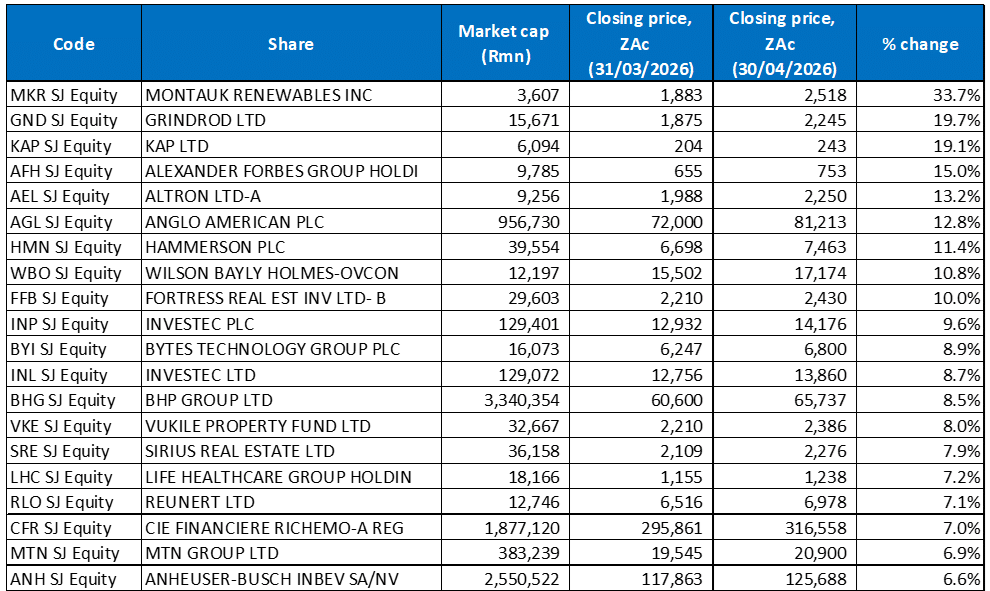
Figure 1: The 20 best-performing shares in April 2026, MoM % change
Source: Bloomberg, Anchor Capital
April’s best-performing shares did not include any gold and PGM miners, with Anglo American, the only miner, featuring among the 10 best-performing shares. Arguably, Anglo’s performance was due to it pivoting away from those commodities that weighed most on the JSE last month (it is undergoing a major restructuring focusing on a leaner portfolio dominated by copper, iron ore, and crop nutrients). The JSE winners included SA Inc recovery plays, infrastructure-linked companies, UK-exposed rand hedges and listed property, with April a clear rotation away from the precious metals counters that had driven the JSE’s outperformance through much of 2025 and early 2026.
Montauk Renewables, which specialises in the management, recovery and conversion of biogas into renewable natural gas, has been a JSE laggard for some time now. However, in April, this outlier, which is also listed on the Nasdaq, was the best-performing share, soaring 33.7% MoM. The surge was likely driven by a combination of factors, including soaring oil prices (which meaningfully improve the economics of renewable natural gas as an alternative fuel source), while the bigger geopolitical backdrop around energy security may have led investors to look for clean energy plays on the local bourse. Earlier in April, Montauk said its 1Q26 results will be released on 7 May.
Logistics and port terminals operator Grindrod (+19.7% MoM) was April’s second-best-performing share. Its share price gains were likely built on positive momentum from its March FY25 results release, which showed a double-digit rise in revenue (+12% YoY) to R5.5bn, while its headline earnings per share (HEPS) rose to ZAc179.8. The Group said that its performance was underpinned by the Matola terminal achieving a record 9.9mn tonnes p.a., which represents a 22% YoY surge in volumes.
Diversified industrials Group, Kap Ltd (+19.1% MoM) entered the month carrying a depressed valuation (its share price was down 6% in March), positioning it for a recovery trade. Kap focuses on manufacturing and logistics with major operations in timber products, automotive components, polymers, etc. Its businesses are leveraged to SA Inc., and any improvement in sentiment towards the domestic names tends to benefit it disproportionately. The move also likely reflected a combination of value re-rating and improving operational visibility heading into its next earnings cycle.
Financial services Group Alexander Forbes, Altron Ltd -A-, and Anglo American Plc recorded MoM gains of 15.0%, 13.2%, and 12.8%, respectively. In April, Alexander Forbes benefitted from two tailwinds – continued strength in the SA equity and bond markets, especially relative to the carnage in March, and the business having resilient, rand-denominated cash flows with low commodity exposure. Given the broad-based selling in mining counters during the month, quality financial services names like Alexander Forbes tend to attract rotational buying from investors who are reducing their exposure to resource stocks.
Altron (+13.2% MoM), one of the JSE’s most credible domestic tech plays, operates across managed services, digital transformation, its own platforms (including vehicle recovery business Netstar) and its fintech and healthtech businesses. April’s performance was underpinned by continued strong momentum from a late-February trading statement where Altron flagged a significant jump in earnings. Its FY25 HEPS is expected to rise by more than 30% to ZAc203 vs ZAc156 in FY24. In a month where tech was the dominant global theme (driven by robust US tech earnings), Altron benefitted from investor appetite for SA-listed tech exposure, a scarce commodity on the JSE.
Anglo American’s April gain was even more impressive considering that its 1Q production update, released on 28 April, sent the share price c. 5% lower on the day, after it showed a 31% YoY drop in steelmaking and coal production due to disruptions at its Moranbah North mine and adverse weather conditions. This was despite reporting a strong operating performance for the three months and reaffirming production and cost guidance across its commodities. Still, the driver seemed to be its ongoing strategic transformation after having divested its PGM business (via the Valterra demerger in 2025). Anglo is repositioning as a focused copper, premium iron ore, and crop nutrients group and the planned merger with Teck Resources to create the world’s fifth-largest copper producer is on track for a late 2026 to early 2027 close. With copper increasingly framed as the critical mineral of the energy transition, the re-rating story seemed to remain compelling to investors.
UK-focused retail property Group, Hammerson Plc (+11.4% MoM), owns a portfolio of premium UK shopping centres including Brent Cross, Bullring, and Bicester Village. This category has proven more resilient than secondary retail in the post-COVID-19 pandemic environment. The stock also benefitted from rand weakness, as its sterling-denominated earnings translate into more rand per share.
Construction and engineering group, Wilson Bayley Holmes-Ovcon (WBHO; +10.8%), operates domestically and across sub-Saharan Africa and Australia. April’s performance likely reflected improving sentiment around SA infrastructure delivery under the Government of National Unity, as well as continued strong order books in Australia, where it has built a meaningful and growing presence. WBHO is also a beneficiary of the broader energy infrastructure buildout, given its exposure to roads, mining infrastructure, and building projects tied to commodity capex.
Fortress Real Estate Investments -B- (+10.0% MoM) has a portfolio spanning logistics, retail, and Eastern European property assets via its stake in NEPI Rockcastle. The share price has benefitted from a recovery in SA real estate investment trust (REIT) sentiment after March’s sharp selloff in listed property. With loadshedding concerns materially reduced, logistics property (Fortress’s strongest segment) continues to attract robust tenant demand driven by the e-commerce and distribution sectors. Its NEPI Rockcastle exposure also provided a tailwind, as central and eastern European property markets continue to show resilience.
Finally, Investec was up 9.6% MoM, rounding out April’s ten best-performing shares. Investec’s gains reflected the recovery in UK financial stocks (supported by the BoE’s unchanged rate stance), resilient UK economic data, and improving sentiment toward SA financial services names as the month progressed. Investec’s dual-listed structure means rand weakness can provide an earnings tailwind when UK pound sterling profits are converted. Its premium client franchise also gives it a degree of earnings resilience that more cyclically exposed domestic counters lack.
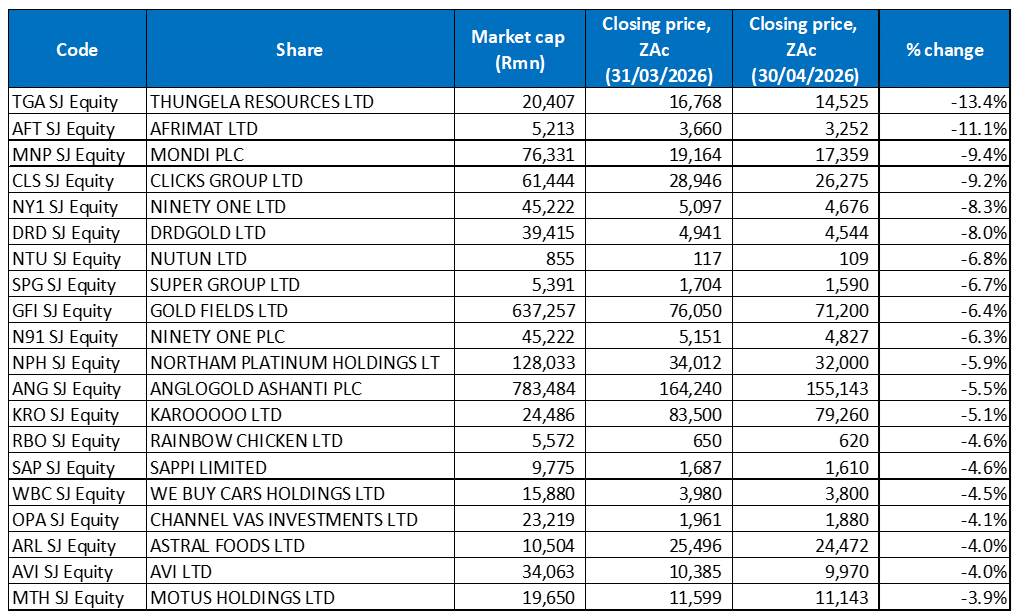
Figure 2: The 20 worst-performing shares in April 2026, MoM % change
Source: Bloomberg, Anchor Capital
Resource shares dominated the losers’ board, with most of the twenty worst-performing shares coming from the mining sector, as gold miners, PGM producers, and coal exporters accounted for seven out of the ten worst performers. This as investors rotated out of the commodity complex that had been driving JSE returns throughout last year and into domestic economy recovery plays, rand hedges and infrastructure adjacent names. After recording a 51.0% increase in March (last month’s second-best-performing share), Thungela Resources (-13.4%) was April’s worst performer. In March, the company reported a full-year loss of R7.1bn (resulting in an R8.8bn asset impairment), and HEPS fell by 125% YoY to R6.47. However, the share price performance in March was rescued by Europe’s initial scramble back to coal following Iran’s closure of the Strait, resulting in a sharp rise in coal prices (up c. 20% vs pre-war), and strengthening demand. But thermal coal remains under secular pressure from the global energy transition, ESG-driven capital withdrawal, and weakening benchmark prices. As a pure-play coal exporter with limited diversification, Thungela has nowhere to hide when the commodity cycle turns.
Thungela was followed by diversified open-pit mining Group, Afrimat (-11.1% MoM), which has operations across industrial minerals, bulk commodities (including iron ore) and construction materials. Afrimat’s exposure to the SA economy and commodity price cycles has made it vulnerable, especially in a month characterised by risk-off sentiment toward resources and emerging market assets. The stock has also been in a broader downtrend as investors question the durability of Chinese iron ore demand, given that country’s ongoing property sector difficulties.
In third place, Mondi’s decline (-9.4% MoM) was more company-specific, driven by a poor 1Q26 trading update released on 24 April. The packaging and paper Group said that market conditions remained challenging after it reported 1Q EBITDA of EUR212mn – essentially flat QoQ and well below market expectations. CEO Andrew King acknowledged that “lower selling prices and, more recently, cost pressures linked to escalating geopolitical tensions weighed on underlying EBITDA,” with oil-driven input cost inflation squeezing margins across its corrugated packaging and flexible packaging divisions. Mondi also announced the closure of a further three converting plants as management took restructuring action.
Mondi was followed by Clicks Group (-9.2% MoM), Ninety One Ltd (-8.3% MoM) and DRD Gold (-8.0% MoM). In its results for the six months ended 28 February 2026, Clicks reported a revenue advance of 7.6% YoY to R26.73bn while HEPS rose 8% YoY to ZAc652.8. However, its share price came under pressure as its outlook for the rest of the year disappointed, with FY26 earnings growth of only between 4% and 9% YoY, below market expectations. More fundamentally, local consumers remain under significant pressure, and higher fuel prices driven by the oil shock will translate directly into lower discretionary spending and increased pressure on household budgets, which eventually flows through to retail pharmacy, health and beauty volumes.
As a pure-play gold surface tailings retreatment company, DRDGold’s fortunes are almost entirely determined by the gold price. The stock was always going to be vulnerable to a reversal once gold prices retreated from their January record of US$5,595/oz. Gold fell c. 12% in March and remained volatile through April, pulling back to around US$4,620 by month-end. For a single-commodity producer like DRDGold, that type of price volatility translates directly into share price moves.
Nutun Ltd (formerly Transaction Capital), Super Group, Gold Fields and Ninety One Plc accounted for the remainder of April’s ten worst-performing shares, with MoM losses of 6.8%, 6.7%, 6.4% and 6.3%, respectively. As an integrated logistics, supply chain, and vehicle dealership Group operating across SA and several international markets, Super Group’s dealership operations are sensitive to consumer confidence and vehicle affordability, both of which deteriorated in April as fuel prices rose sharply on the back of oil soaring above US$100/bbl. Higher fuel costs also directly compress logistics margins. The European dealership operations face additional pressure from slowing economic activity in Germany and the UK.
Despite reporting strong 1Q earnings earlier in April that initially sent the share price up 5%, Gold Fields ultimately closed the month lower as the gold price was unable to sustain levels above US$4,800/oz. A combination of elevated real yields driven by hawkish central bank signals and a stronger US dollar has kept a ceiling on gold miner valuations.
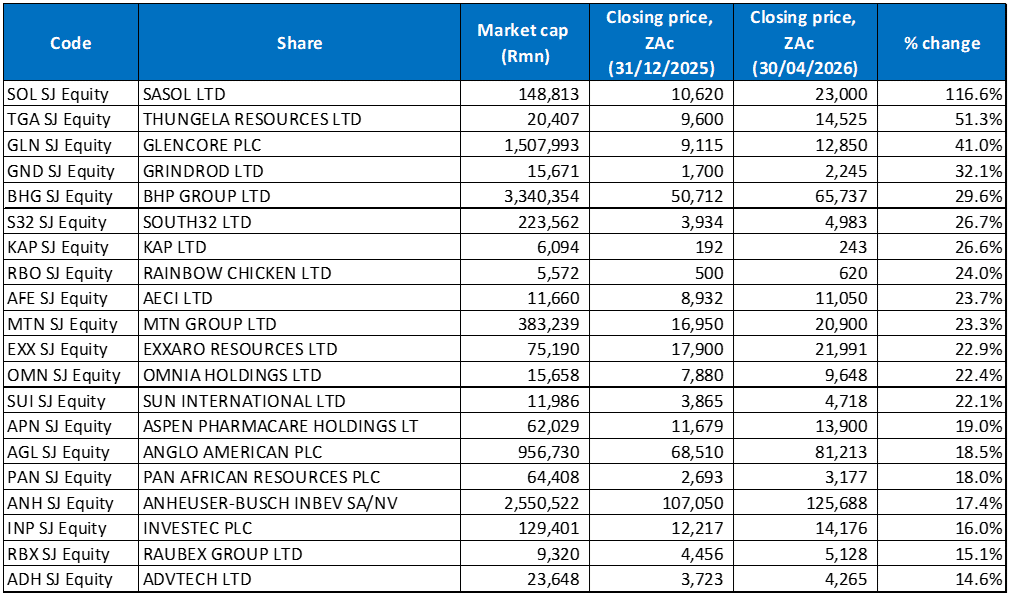
Figure 3: The 20 best-performing shares YTD, % change
Source: Bloomberg, Anchor Capital
April’s YTD JSE-listed equities’ performances were very similar to those for the year to end March, as gold and PGM shares were pushed out again following another turbulent month for these commodities. Fifteen of the 20 best-performing shares YTD were unchanged from last month, with a significant overlap with March’s best-performing shares. The common thread across the top performers: direct or indirect leverage to the energy shock that has defined global markets in 2026 and companies that sell things people cannot stop buying, regardless of geopolitics.
Leading the charge again was Sasol, which has long been an unloved laggard on the JSE, with a 116.6% rise YTD. The share has been a standout performer following the geopolitical shock of the Iran conflict and soaring oil prices. It is one of the few domestic counters that structurally benefits from the very shock pressuring the broader economy, as higher oil prices flow almost directly into Sasol’s synthetic fuels margins, making it the purest JSE-listed energy play. In addition, as part of its integrated chemicals and energy business, Sasol sells a variety of chemical and petrochemical feedstocks (coal-based and domestically sourced – protecting it from the supply shocks that are impacting pure-play importers). For most JSE-listed companies, oil prices pushing higher is unambiguously bad news, but for Sasol, it is a direct tailwind.
Sasol was again followed by Thungela Resources (discussed earlier; +51.3% YTD) in second place, despite the coal miner also being April’s worst performer (-13.4% MoM), with Glencore (+41.0% YTD) staying in third place. These counters, together with BHP (+29.6%) and South32 (+26.7%), reflect the broader energy and materials re-rating driven by the same conflict. The disruption to Strait of Hormuz shipping has prompted Asian nations to substitute coal for oil and LNG, sending thermal coal prices to 17-month highs in March. Glencore, BHP, and South32 benefit from their diversified commodity exposure across coal, copper, and energy transition metals, all of which have seen demand and pricing support in the current environment.
Grindrod (discussed earlier; +32.1%) reflects SA’s improving logistics infrastructure story, with record port volumes at Maputo underpinning a structural earnings recovery. KAP (discussed earlier; +26.6%) and Rainbow Chicken (+24.0%) represent domestic value re-ratings as SA Inc. sentiment stabilised. In comparison, AECI (+23.7%) has benefitted from rising mining sector activity that drives demand for its speciality chemicals and explosives, while MTN (+23.3%) reflects improving African telecommunications fundamentals and rand hedge appeal.
Taken together, the list of best performers YTD is a portrait of an oil-shocked world: energy producers, commodity diversifieds, and domestic recovery plays — all beneficiaries of a macro environment that few anticipated when 2026 began.
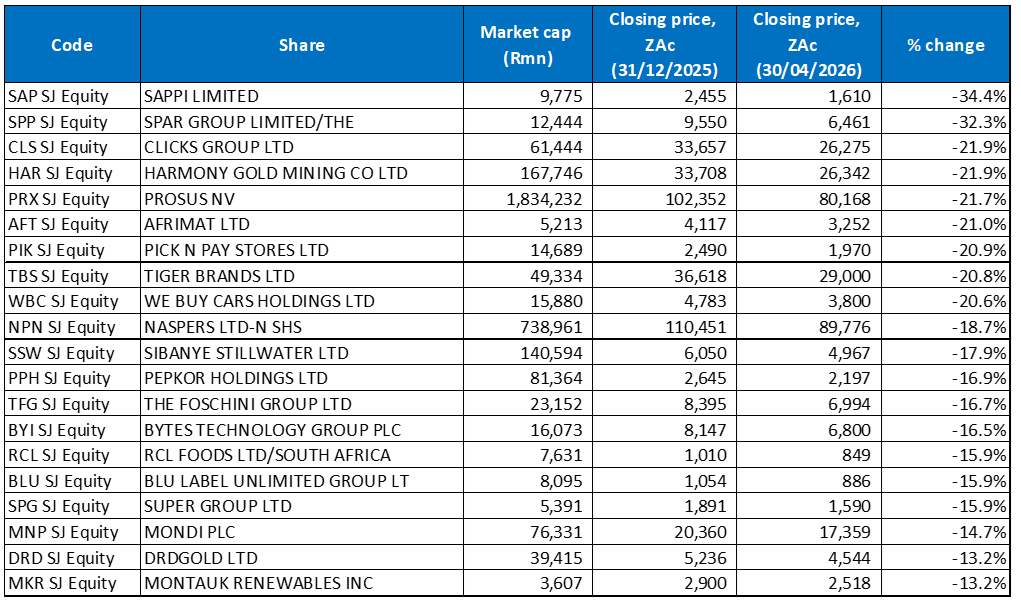
Figure 4: The 20 worst-performing shares YTD, % change
Source: Bloomberg, Anchor Capital
While energy stocks continued to celebrate, other cohorts of JSE-listed shares were down significantly, with most of the YTD worst performers sharing a common vulnerability – exposure to the SA consumer at a time of acute and sustained cost pressures. In addition, gold miners and industrials were weighed down by their own sector-specific headwinds.
Sappi led the losers, down 34.4% YTD. Its losses reflect a business under severe structural pressure. The Group’s 1Q26 adjusted EBITDA dropped 56% YoY to US$90mn, driven by falling dissolving wood pulp prices, a strong rand reducing its US dollar-denominated revenue, and operational disruptions at its North American facilities. Weak demand across graphic paper and packaging markets, combined with global overcapacity, has left it with limited near-term earnings recovery visibility.
Sappi was followed by SPAR (-32.3% YTD), which continues to be weighed down by operational challenges following its troubled SAP system implementation and continued weakness in its European business. Consumer pressure across multiple geographies has compounded an already difficult turnaround story.
Spar, Clicks (-21.9%), and Pick n Pay’s (-20.9%) share price declines YTD reflect the tough operating environment facing SA retailers. Rising oil prices are feeding directly into higher logistics and fuel costs, squeezing margins already under pressure from aggressive competitor pricing and a SA consumer whose disposable income has been eroded by elevated inflation. Pick n Pay remains in the midst of a painful multi-year turnaround, with its balance sheet restructuring still incomplete.
Like other pure-play gold miners, Harmony (-21.9% YTD) has fallen victim to the dramatic reversal in the gold price, which peaked at US$5,595/oz in January and closed April at US$4617.85 – down 17%.
Investment conglomerates Prosus (-21.7%) and Naspers (-18.7%) share prices have been soft YTD as their largest investment, Chinese tech giant Tencent (-22% YTD), has come under pressure in 2026, with investors concerned that it is lagging in China’s competitive AI race.
Afrimat (-21.0%) has been hurt by iron ore price volatility and risk-off sentiment towards smaller mining names, while Tiger Brands (-20.8%) faces the same inflationary headwinds as the retailers with higher input costs from oil-linked petrochemicals and food commodities that cannot be fully passed on to price-sensitive consumers. Finally, WeBuyCars (-20.6% YTD) is seeing the impact of a weakening appetite for used vehicles as local consumers prioritise essential spending.