

August was a strong month for global equity markets, with the MSCI World gaining 2.6%, bringing its YTD return to 13.4%. However, this positive performance masked a sharp increase in volatility towards month-end as renewed geopolitical tensions, higher oil prices and a more hawkish tone from the US Federal Reserve (Fed) weighed on investor sentiment. Bond markets also came under pressure during the month. On 19 August, concerns over rising US government debt (surpassing the US$40trn milestone), heavy international selling by countries like Japan, and persistent inflationary pressures linked to the conflict in the Middle East triggered a major bond market sell-off. This rout was temporarily halted and reversed after a direct US Treasury intervention, which eased selling pressure, stabilising the market and causing an immediate drop in yields. However, by 20 August, underlying fiscal deficit worries and inflation anxieties resurfaced, causing bond yields to surge back up and entirely wipe out the intervention’s gains. Towards month-end, renewed Middle East tensions, following US strikes on Iranian rocket launchers, pushed crude oil higher, adding to market concerns. At the same time, newly appointed Fed Chair Kevin Warsh delivered a notably hawkish speech at the 2026 Jackson Hole Economic Policy Symposium, raising concerns that further rate hikes may be necessary before the end of this year. Market-implied expectations for a late-2026 rate hike increased sharply, pushing bond yields higher and creating additional headwinds for equities. Technology stocks experienced greater volatility and rotation as investors scrutinised returns on artificial intelligence (AI) infrastructure spending.
In the US, the strong 2Q26 earnings season helped drive equity markets higher. The three major US averages experienced a two-phase performance: strong gains and record highs through the middle of the month were followed by a sharp pullback as geopolitical and inflation concerns intensified towards month-end. Still, all three indices ended August higher. The tech-heavy Nasdaq rose 3.6% MoM (+13.1% YTD), the Dow gained 1.4% MoM (+10.7% YTD), and the S&P 500 advanced by 2.5% MoM (+12.1% YTD).
US economic data proved a mixed bag. July headline inflation moderated slightly to 3.4% YoY from 3.5% in June, while core inflation, which excludes food and energy, slowed to 2.5% vs June’s 2.9%. However, the Fed’s preferred inflation measure remained less encouraging. July core personal consumption expenditure (PCE), excluding food and energy, rose 3.3% YoY, unchanged from June, suggesting that underlying price pressures remain above the Fed’s target and limiting the scope for an aggressive easing cycle.
European equity markets were volatile and highly fragmented entering August near all-time highs on the back of strong corporate earnings but buckling under month-end macro shocks (Euro Stoxx 50 +1.0% MoM/+13.5% YTD). Brent crude moving above US$90/bbl raised concerns about a renewed energy shock and its implications for inflation. Hawkish commentary from the Fed reinforced these worries. Among the major country benchmarks, Germany’s DAX (+2.5% MoM/+7.2% YTD) outperformed the rest of the continent, reaching a fresh all-time high. However, France’s CAC declined (-2.1% MoM/+2.3% YTD), weighed down by weakness in luxury stocks following softer international demand data. July eurozone inflation advanced to 2.9% vs June’s 2.8%, continuing to be primarily driven by higher energy prices. Despite inflationary pressures, the eurozone economy performed better than expected, expanding by 0.4% in 2Q26, twice as fast as expected.
UK equities lagged, recording a slightly negative performance, with the flagship FTSE 100 Index ticking down 0.4% MoM (+9.0% YTD). The index had briefly approached record levels earlier in the month, supported by global investors rotating capital away from high-flying, volatile US tech stocks into traditional, defensive “old economy” UK value assets. However, late-month gains were pared by macroeconomic pressures. July inflation rose to 2.9% YoY from 2.6% in June, largely driven by a 13% rise in the cap on energy bills that took effect on 1 July.
China’s equity markets diverged in August, with mainland equities recording solid gains while Hong Kong-listed stocks declined. The Shanghai Composite Index rose 4.0% MoM (+0.4% YTD), while the Hang Seng Index shed 1.2% (-0.2% YTD). Hong Kong equities remained under pressure from continued weakness in the property sector and uncertainty surrounding an impending policy overhaul, which triggered a sharp pullback in real estate stocks. August’s official manufacturing Purchasing Managers’ Index (PMI) improved to 49.8 from 49.2 in July but remained below the 50-point mark separating expansion from contraction. The non-manufacturing PMI, including services and construction, was unchanged at 49.0.
Japanese equities experienced strong gains, although volatility increased sharply on the final trading day of the month. The Nikkei rose 3.0% MoM (+31.7% YTD). July headline inflation hit 1.9% from 1.7% in June, the highest level this year, and primarily reflected an increase in energy costs amid the Iran war.
Among commodities, Brent crude rose 0.4% MoM (+48.7% YTD), driven by geopolitical supply risks, primarily from the ongoing Iran war and severe maritime disruptions in the Strait of Hormuz. Rapid inventory drawdowns further tightened supply, with Brent crude prices moving above US$90/bbl towards the end of the month. Gold gained 9.7% in August (+2.8% YTD), benefitting from safe-haven demand amid geopolitical uncertainty and expectations that softer US economic data could support a more accommodative Fed policy. The yellow metal reached an intra-month high of US$4,690/oz on 21 August, before retreating in the final sessions of the month following the Fed’s more hawkish tone at Jackson Hole, which reinforced expectations that rates could remain restrictive for longer. Platinum group metals (PGMs) recorded strong gains, supported by tightening supply-demand fundamentals. Platinum spiked 9% MoM (-12.8% YTD), while palladium advanced c. 6.3% (-15.8% YTD), and rhodium rose 9.7% MoM (-1.4% YTD).
In South Africa (SA), the JSE delivered a strong performance in August, with the FTSE JSE All Share Index climbing 4.3% (+0.4% YTD). The rally was driven primarily by strong commodity prices, particularly across gold and PGMs, alongside improving sentiment towards selected areas of the local market. Resources were the clear outperformers, with the Resi-10 soaring 25.4% MoM (+8.2% YTD). Corporate activity also supported the mining sector, most notably Northam Platinum’s (Northam) multi-billion-rand takeover offer. By contrast, financials, industrials, and the SA Listed Property Index (SAPY) underperformed. The Fini-15 declined 1.7% (+4.7% YTD), the Indi-25 fell 5.8% (-11.2% YTD), and the SAPY lost 3.9% MoM (+0.1% YTD). As with global markets, the JSE faced strong headwinds during the final trading stretch of August as a more hawkish Fed outlook and fresh Middle East tensions spiked oil prices while weighing on commodity prices. The rand strengthened 2.6% against the US dollar in August (+2.7% YTD), supported by a weaker greenback and continued strength in SA’s key commodity exports.
SA economic data remained mixed. Headline inflation slowed to 4.3% YoY in July from 5.0% in June, although core inflation, which excludes the volatile food and energy components, remained sticky at 4.2% YoY from 4.1% previously. The latest Quarterly Labour Force Survey (QLFS) highlighted continued weakness in the domestic labour market. SA’s official unemployment rate rose to 33.6% in 2Q26 from 32.7% in the previous quarter.
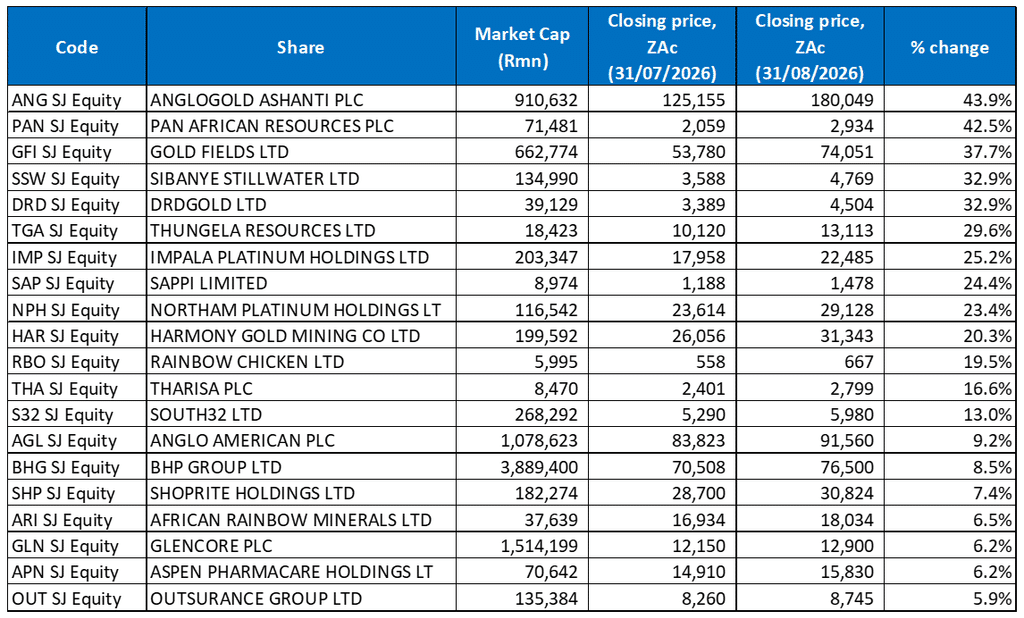
Figure 1: The 20 best-performing shares in August 2026, MoM % change
Source: Bloomberg, Anchor Capital
The strong performance of gold and PGMs, despite a sharp correction towards month-end, translated into substantial gains across the precious metals mining sector, solidifying their position as a preferred hedge against macroeconomic uncertainty and ongoing inflation worries. Unsurprisingly, precious metals miners dominated the 20 best-performing shares on the JSE in August.
AngloGold Ashanti (+43.9% MoM) was the strongest-performing share. Its rally was driven by a combination of strong results, aggressive shareholder return strategies, and a higher gold price, which at one stage exceeded the US$4,600/oz mark during the month. In its 2Q26 results, released on 31 July, the gold miner said that revenue from product sales climbed to US$3.10bn from US$2.45bn, while diluted EPS jumped 48.5% YoY to USc196. AngloGold also announced a major US$2bn share buyback programme and increased its interim dividend to US$0.72/share.
Pan African Resources (+42.5% MoM), a mid-tier gold mining company that extracts gold from both underground mines and surface tailings retreatment plants, ranked second, followed by Gold Fields (+37.7%). Pan African benefitted from a combination of the stronger gold price and positive production projections ahead of its September results. Second-half production output rose sharply to 147,000 oz from 128,296 oz in 1H26, supported by the successful ramp-up of the Mogale Tailings Retreatment plant. Gold Fields’ share price surge was driven by record half-year profits, a massive dividend boost (interim dividend +132% YoY), and an exceptional operational performance from its key global mining assets. The Group’s attributable profit rose 81% YoY to US$1.85bn, or US$2.07/share as the gold price soared and production increased.
Sibanye Stillwater and DRDGold both gained 32.9% MoM. Sibanye’s share price was supported by a strong trading statement indicating that it expects headline earnings per share (HEPS) to increase by over 200% YoY to between R5.71 and R6.51 for the six months ended 30 June. The increase in HEPS was on the back of a record financial performance from its SA gold operations, including those operated by DRDGold, in which it holds a 50.1% stake. Sibanye’s SA gold operations benefitted from a c. 35% increase in the average rand gold price received and a 5% increase in gold sold, which more than offset lower production and higher costs. Its PGM operations also saw a substantial profitability increase on the back of a 67% YoY rise in the average rand platinum, palladium, rhodium and gold basket price received and a 12% increase in PGM sales.
Thungela Resources, Impala Platinum (Implats), and Sappi Ltd gained 29.6%, 25.2%, and 24.4% MoM, respectively. Thungela’s 1H earnings more than doubled after coal production rose (heightened global energy volatility drove benchmark thermal coal prices up 15% to 25%), and it recorded an increase in exports on the back of improved local rail conditions. 1H26 HEPS rose 150% YoY to R4.80, while revenue advanced 2% YoY to R15.2bn. Backed by a powerful net cash position of R6.1bn, the miner declared a R5.50/share dividend vs R2.00 paid in 1H25. Implats benefitted from a combination of impressive full-year profit projections and powerful tailwinds across the commodities sector. Implats indicated that HEPS for the year ended 30 June 2026 was expected to increase to between ZAc2,429 and ZAc2,652, a multi-fold jump from ZAc82/share in the prior year. Sappi’s share price gains were driven by exceptionally bullish forward-looking guidance that overshadowed challenging 3Q26 earnings, which saw adjusted EBITDA decline 34% YoY to US$53mn. However, Sappi explicitly guided that 4Q26 earnings would be “materially above” 3Q levels.
Northam (+23.4% MoM) and Harmony Gold (+20.3% MoM) rounded out August’s strongest performers. Northam had a particularly eventful month, with an unsolicited multi-billion-rand takeover approach from a major local producer prompting the company to launch a formal competitive process. Northam also reported record FY26 results, with operating profit increasing by 293% YoY to R16.7bn, supported by higher PGM basket prices and record sales volumes of more than 1.1mn ounces. Northam ended the period with a net cash position of R2.7bn and declared a record final dividend of ZAc1,000/share. Harmony also benefitted from a strong operational performance, releasing an exceptional FY26 operational update announcing that total gold production surged past the upper limit of its guidance, hitting 1.56mn ounces.
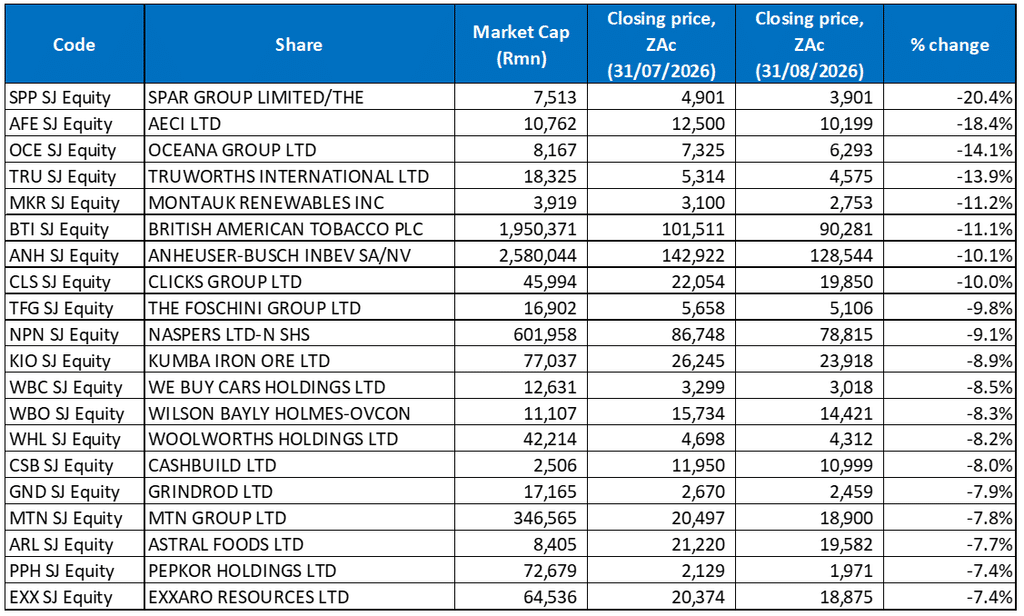
Figure 2: The 20 worst-performing shares in August 2026, MoM % change
Source: Bloomberg, Anchor Capital
The month’s weakest performers were concentrated among domestic-facing consumer services, retail, and industrial stocks. Banks and other financial counters also underperformed the wider market on a relative basis. Acute and persistent cost-of-living pressures and intensifying market competition continued to weigh on consumer-facing businesses. The strong commodity-led rotation further widened the performance gap between resources and other parts of the local market.
SPAR Group Ltd (-20.4%) was the weakest-performing share in August, as governance concerns weighed heavily on investor confidence. On 17 August, the company announced the immediate, concurrent resignations of the non-executive chairman and deputy chair, following the abrupt departure of its former CEO earlier in the year. The latest boardroom changes raised concerns about governance and the execution of SPAR’s operational turnaround under newly appointed CEO Reeza Isaacs. The company continues to address several legacy operational challenges, including the troubled multi-billion-rand SAP software rollout.
AECI and Oceana Group followed, declining by 18.4% and 14.1%, respectively. AECI saw a sharp sell-off on 11 August following the release of its 1H26 results. Although the results showed a 20% YoY rise in operating profit, investors aggressively penalised it due to severe underlying structural issues. The primary drag came from its international chemicals segment, AECI Schirm Germany, which recorded an R330mn asset impairment charge, wiping out its remaining goodwill and intellectual property. Due to the German unit’s operational issues, revenue for the wider AECI Chemicals division slumped 18%, while overall EBITDA fell 11%. This structural deterioration forced the Group’s total revenue down 4% to R15.1bn, highlighting vulnerability outside its core mining unit, while HEPS rose 8% YoY to ZAc653. Oceana continued to face pressure from weaker global fish oil and fishmeal prices, compounded by the impact of a stronger rand on the translation of its US dollar-denominated offshore revenue.
Truworths’ (-13.9% MoM) declined sharply following the release of lacklustre FY26 results that sparked concern regarding stalled momentum. Revenue declined to R23.03bn from R23.07bn posted in the previous year, while HEPS fell 2.7% YoY to ZAc732.2. Concerningly, its UK footwear division, Office, which had previously helped offset weaker domestic trading, recorded a 10% decline in rand-denominated sales.
Renewable energy company Montauk Renewables, British American Tobacco (BAT), and Anheuser-Busch InBev (AB InBev) declined by 11.2%, 11.1%, and 10.1%, respectively. Montauk’s 2Q26 results released on 6 August showed some improvement, including a return to profitability with a modest net income of US$0.2mn and 19.7% YoY revenue growth to US$54.0mn, but its final EPS missed consensus expectations. BAT and AB InBev were also among the weaker performers as large investment funds favoured commodity-linked stocks during the month’s sharp rotation towards resources.
Clicks Group (-10.0% MoM), The Foschini Group (TFG; -9.8% MoM), and Naspers (-9.1% MoM) rounded out August’s worst-performing shares. Clicks’ decline was driven by persistent execution concerns following its earlier IT and warehouse system challenges, pressure on middle-income consumers, and August’s massive JSE sector rotation. TFG’s decline reflected restructuring announcements, concerns around its corporate debt disclosure, and, as with Clicks, broader weakness across domestic-facing equities. Naspers’ double-digit decline was primarily triggered by a concurrent drop in its core tech investment, Tencent, which was down 9.8% in August after its 2Q26 earnings fell short of profit expectations. Although Tencent reported 11% YoY revenue growth, higher AI capital expenditure, which surged by 65%, placed pressure on operating margins.
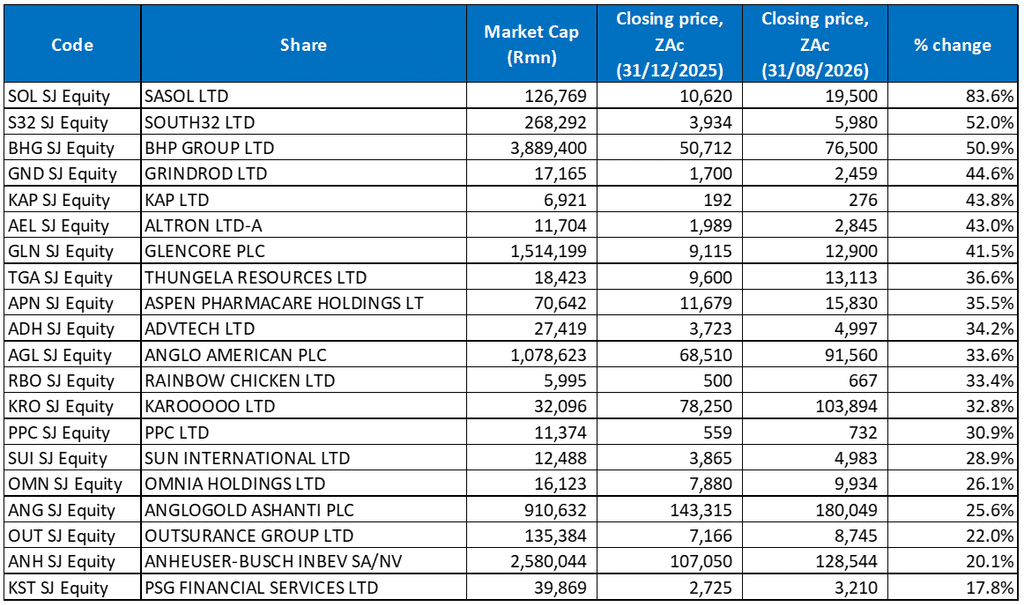
Figure 3: The 20 best-performing shares YTD, % change
Source: Bloomberg, Anchor Capital
Sixteen of the 20 best-performing shares YTD were unchanged from the end-July rankings, highlighting the persistence of several of the market’s strongest themes. Energy counters and diversified miners, including Sasol, BHP Group, and South32, continued to deliver exceptional performances YTD, reflecting a highly favourable environment for cyclical commodity players, logistics turnarounds, and selected mid-cap corporate restructurings.
Sasol (+83.6% YTD) retained the top position for a second consecutive month, capitalising on a powerful convergence of cyclical and company-specific tailwinds. Elevated global crude oil and chemical prices have supported refining and chemical margins, while the company has simultaneously successfully minimised historical operational bottlenecks at its Secunda operations and reduced its legacy debt burden, sparking a valuation re-rating.
Sasol was followed by diversified miners, South32 (+52.0% YTD), and BHP Group (+50.9% YTD). South32 gained a further 13.0% in August, supported by a strong performance from its base metals operation and favourable commodity price tailwinds. Last week it released robust FY26 results, which showed a doubling of its HEPS from ZAc12.4 to ZAc24, a boosted final dividend (full-year dividend up c. 55% YoY), and a major copper reserve upgrade at the Sierra Gorda mine. Investor optimism has also been supported by South32’s ongoing transition toward high-margin base metals, including an agreement to divest its broader aluminium value chain to Alcoa for US$4.1bn. BHP, meanwhile, has benefitted from record copper prices (+44.4% YoY) and a stellar FY26 earnings report, supported by solid cash generation and a higher-than-expected dividend payout.
Logistics and port terminals operator Grindrod (+44.6% YTD) continues to benefit from improving operating momentum. Its share price has been supported by strong 1H26 results, with record port volumes driving a significant increase in core earnings. Revenue climbed 19% YoY to R2.84bn, while the company has also increased its dividend. Notably, heightened global volatility has failed to disrupt record volumes at the Port of Maputo.
KAP Ltd, Altron Ltd and Glencore Plc followed with YTD gains of 43.8%, 43.0% and 41.5%, respectively. Diversified industrial group KAP experienced strong cyclical demand across its chemical and logistics divisions. In addition, turnaround strategies focused on core margin expansion, portfolio pruning, and optimised asset utilisation have successfully restored investor confidence in the company’s underlying earnings potential. Altron’s strategic overhaul and shift towards higher-margin digital transformation, cloud computing, and managed IT infrastructure solutions have paid off, while disposing of non-core assets has streamlined its portfolio and strengthened its balance sheet. The result has been a marked improvement in profitability, margins and cash generation. Glencore’s unique business blueprint, which combines physical production with a large global commodity trading arm, has thrived amid global market volatility. Higher prices for transitional commodities such as copper and cobalt have supplemented structural profits from its energy operations, supporting the Group’s overall performance.
Thungela Resources (+36.6%; discussed earlier), Aspen Pharmacare (+35.5%), and ADvTECH (+34.2%) completed the ten best-performing shares YTD. Aspen’s strong performance has been supported by a rebound in 2H EBITDA of more than 45%, robust commercial pharmaceutical sales and around R3.7bn in cash flow. Additionally, strategic expansion into the GLP-1 weight-loss drugs and debt reduction from divestments have strengthened its balance sheet. In SA, the private education sector has seen robust consumer demand as households prioritise reliable schooling structures. ADvTECH has delivered steady enrollment growth across both its premium school brands and tertiary institutions, supporting highly resilient, defensive cash flows.
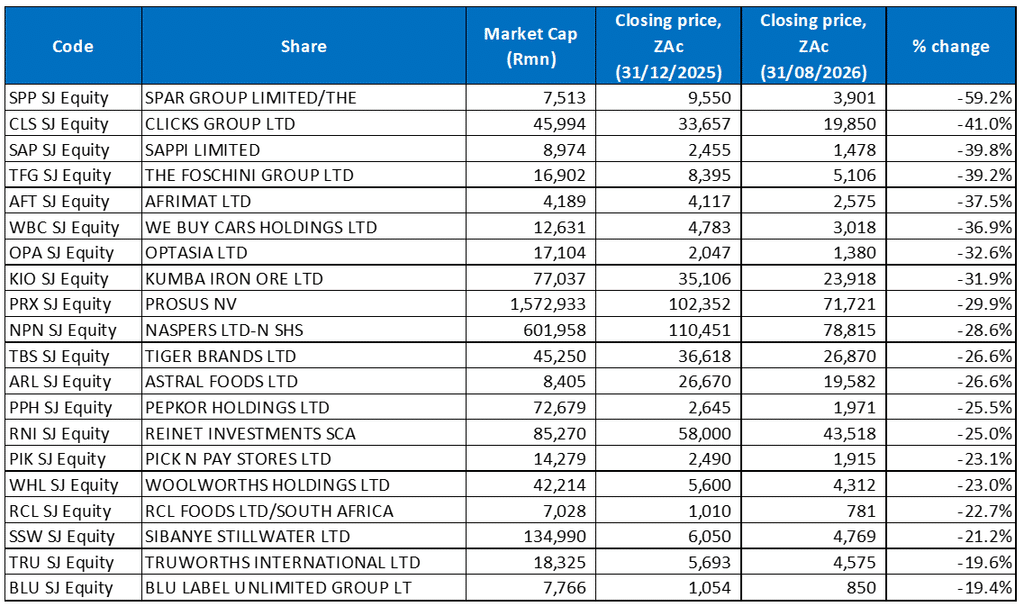
Figure 4: The 20 worst-performing shares YTD, % change
Source: Bloomberg, Anchor Capital
The weakest performers YTD share two common vulnerabilities: significant exposure to a highly challenging SA macroeconomic climate marked by restrictive interest rates and weak demand, and company-specific operational or structural pressures (such as SPAR and Sappi) entirely independent of global headwinds like the Middle East conflict and elevated oil prices. The notable presence of Naspers (-28.6% YTD) and Prosus (-29.9%) on the losers’ list represents a highly unified “tech cluster” drawdown. Because Naspers owns a significant stake in Prosus, which in turn holds a substantial interest in Tencent, their share prices move almost in lockstep with the fortunes of that company. Throughout 2026, Tencent’s share price has faced persistent pressure.
SPAR Group (-59.2% YTD, discussed earlier) overtook Sappi as the worst-performing share YTD, followed by Clicks Group (-41.0%). Sappi (-39.8% YTD), which has been a notable underperformer this year, staged a meaningful recovery in August, with its share price rising 24.4% MoM (discussed earlier). Nevertheless, the paper and packaging Group remains among the weakest performers YTD, although its improved August performance has lifted it to third place.
TFG, Afrimat Ltd, We Buy Cars, and the FinTech and mobile credit platform Optasia followed Sappi, with YTD declines of 39.2%, 37.5%, 36.9%, and 32.6%, respectively. TFG has been impacted by high interest rates and flat real wage growth, which has severely curbed middle-income discretionary spending on fashion, tech, and homeware, driving down clothing retail profit margins. Mid-tier miner and construction materials supplier, Afrimat, has faced cyclical volume slowdowns within its bulk commodities division, tied to slow localised infrastructure rollouts. The Group has also been affected by weakness in industrial metals demand, iron ore price volatility and more cautious investor sentiment towards smaller mining counters. We Buy Cars has faced a more challenging operating environment following its highly publicised listing. The second-hand vehicle market has cooled down significantly, while high interest rates have made vehicle financing far more expensive for consumers, weighing on demand and slowing inventory turnover.
Kumba Iron Ore (-31.9% YTD), Prosus and Naspers (discussed earlier) completed the ten worst-performing shares YTD. Kumba has been particularly affected by a combination of external and domestic constraints. A slowdown in China’s property sector has weighed on global iron ore benchmark prices, while persistent domestic rail constraints have prevented physical product from reaching export ports efficiently, placing additional pressure on realised volumes and earnings.