
For a prolonged period following the global financial crisis (GFC), portfolios were built in a very different environment than today. Interest rates were low, liquidity was abundant, and asset prices benefitted from a long period of monetary support. The traditional 60% (equities)/40% (bonds) portfolio framework remained the foundation of portfolio construction for most investors, but its underlying components did not always behave as expected.
Today, that foundation looks stronger. Interest rates are higher, bond yields are more attractive, and the starting point for the traditional 60/40 framework arguably has a better chance of delivering long‑term outcomes than it has had in some time. Yet, investing has become more challenging. Markets are more volatile, increasingly influenced by shifting inflation dynamics, changing monetary policy, geopolitical uncertainty and rapid changes in investor sentiment. As Howard Marks, co-founder and co-chairman of Oaktree Capital Management, puts it, “You can’t predict, but you can prepare.”
The implication is not that traditional 60/40 portfolios no longer work. Rather, it is that investment outcomes have become less predictable and, at times, more difficult for investors to navigate.
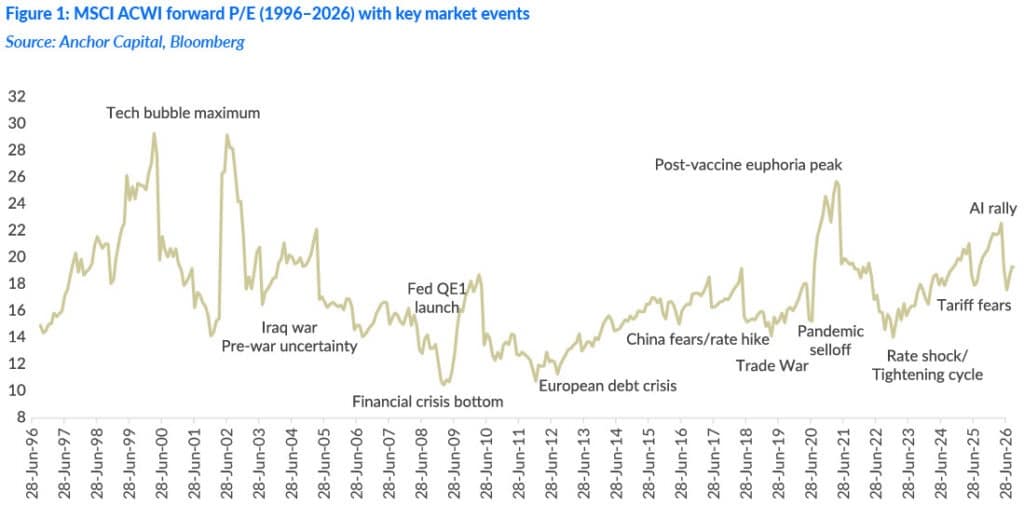
That shift in mindset is important. The objective is not to move away from equities and bonds, but to better understand how they behave in a changing environment and why investors may consider additional return drivers, such as alternative investments (hedge funds, protected equity structured products, physical property, etc.), to help smooth portfolio outcomes over time. As the chart below shows, equity valuations have never followed a straight line. They move through cycles, often shaped by volatile events that only become clear with hindsight.
Public markets: Concentration beneath the surface
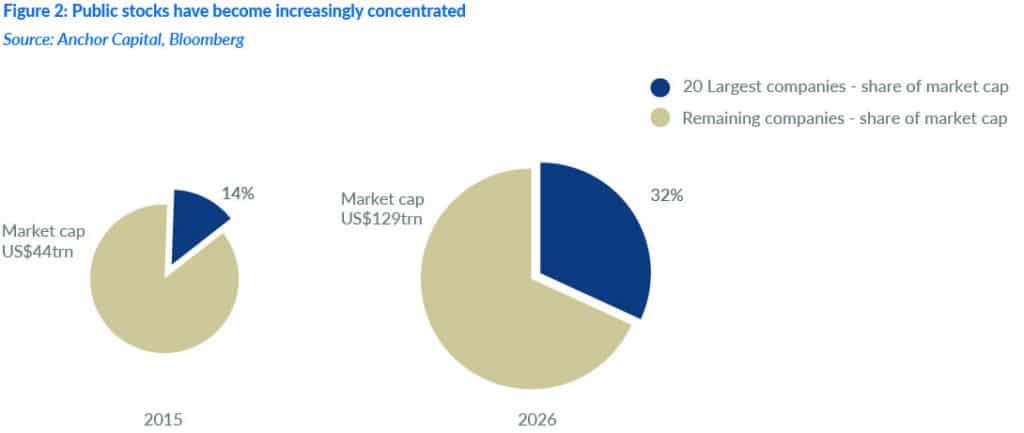
Equity markets remain one of the most powerful long-term wealth creation tools, but a meaningful shift has taken place, with a significant increase in outsized single counters.
While broad global indices still appear diversified at first glance, an increasing proportion of market returns is now being driven by a relatively small number of companies. Within the MSCI All Country World Index ([ACWI], which captures large and mid-cap representation across DMs and EMs, covering c. 85% of the global investable equity opportunity set), the largest 20 companies now represent more than 30% of the total global market capitalisation, compared to less than 15% a decade ago.
This is not necessarily a flaw, but it does change how diversification behaves. Portfolios become more sensitive to a handful of dominant businesses, meaning diversification can appear broad at a headline level while being far more concentrated in practice.
At the same time, private capital markets are evolving and creating more value. Companies are remaining private for longer, creating a broader opportunity set beyond traditional listed markets.
When 60/40 behaves differently
The shift in public markets is now evident in portfolios.
The traditional 60/40 framework still captures the core drivers of long-term wealth creation and, with higher yields now on offer, arguably has a firmer foundation than it did in the years of near-zero interest rates. But more recently, equities and bonds have shown bouts of higher correlation, removing some of the diversification benefits inherent in traditional multi-asset class portfolios.
That does not necessarily mean traditional portfolios no longer work. It does highlight that outcomes are more sensitive to inflation, interest rates, market concentration and shifts in sentiment. In practice, this increases the likelihood of more uneven outcomes, particularly when both equities and bonds come under pressure at the same time.
Rethinking portfolio construction
If traditional drivers are less reliable in practice, portfolio construction needs to evolve with them.
Traditional portfolio frameworks are built on directional exposure, capturing returns from broad market movements. When those drivers become more concentrated and more sensitive to sentiment, outcomes can become less consistent.
A more effective starting point is to look beyond directionality and focus on dispersion, i.e. the widening gap between winners and losers within markets. Periods of higher uncertainty tend to create more of these opportunities.
Alternatives are designed to capture these differences. Rather than relying on markets simply rising, they aim to generate returns from a broader set of opportunities by identifying where value exists within and across markets. This introduces a return stream that is less dependent on market direction and more driven by underlying opportunities and execution.
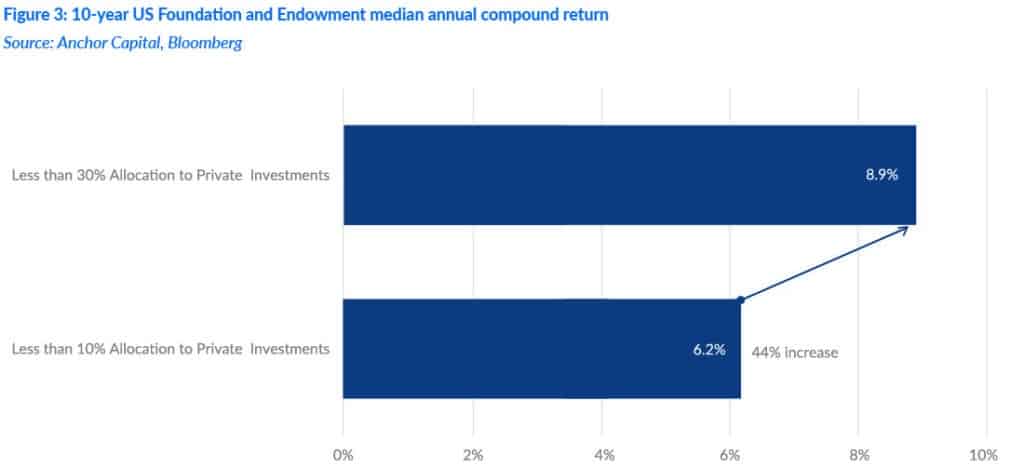
This approach has long been used by institutional investors and in portfolios, particularly pension funds, endowments and foundations, which have consistently incorporated alternatives as a core allocation, benefitting from the broader and more diversified return base.
Improving portfolio outcomes
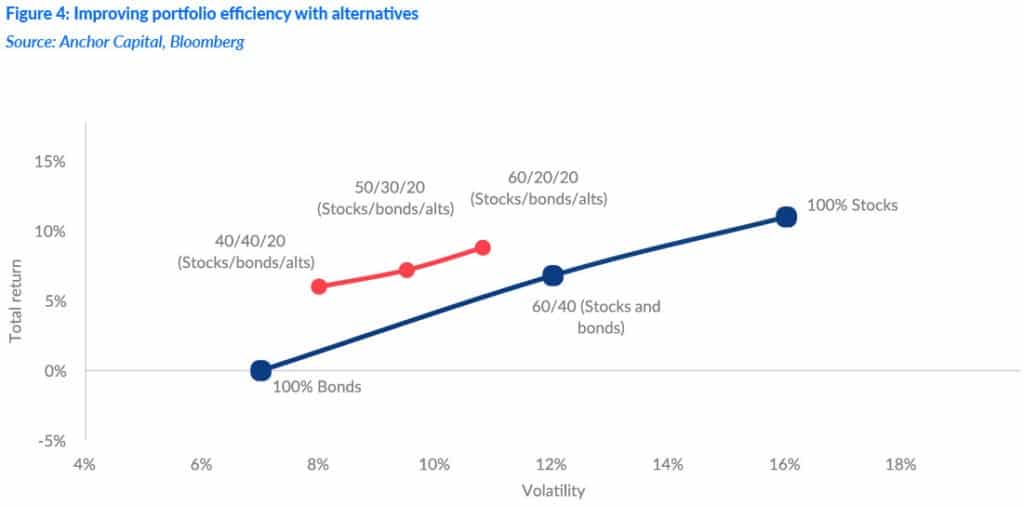
The objective of incorporating alternatives is not complexity for its own sake. It is about improving how portfolios behave across different market conditions. Traditional stock‑bond portfolios sit along a single trade-off between risk and return.
As shown below, even modest allocations to alternatives can enhance portfolio efficiency and resilience by introducing return drivers that are less dependent on equity market direction. A 60/20/20 portfolio, for example, can deliver higher returns than a traditional 60/40 portfolio at a similar level of risk, while more conservative allocations can achieve comparable returns with lower volatility.
Building more resilient portfolios — the Anchor‑Credo approach
At Anchor‑Credo, we believe that the future of investing is not about moving away from traditional equities and bonds, but building on them, augmenting portfolio construction to include a broader set of return drivers through a dedicated alternatives offering. Our objective is not complexity for its own sake, but to improve how portfolios behave across different environments.
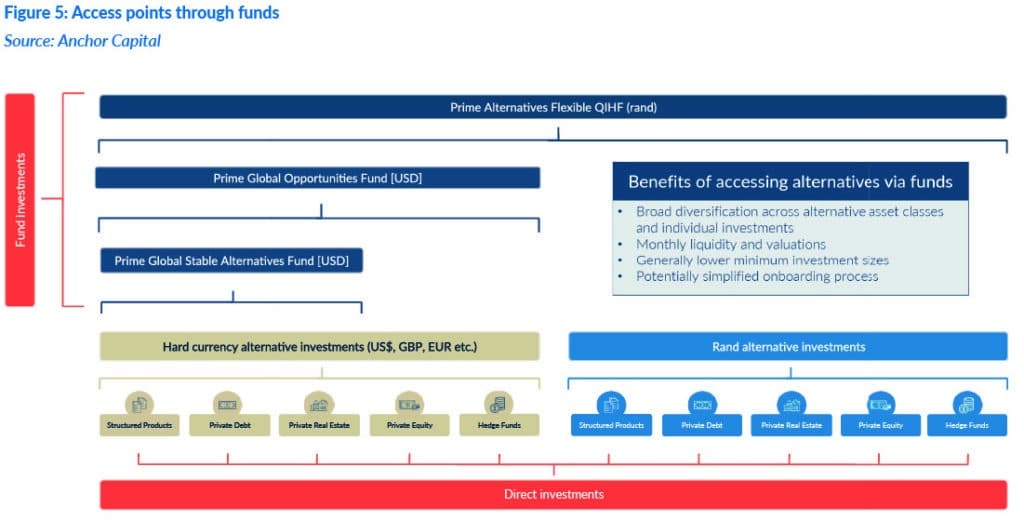
Clients can access this opportunity set through a range of clearly defined strategies, each designed to fulfil a specific role within a broader portfolio:
- The Prime Alternatives Flexible QIHF, our local offering, serves as a core allocation, providing diversified exposure across private debt, hedge funds, structured products, private equity and real estate. With a balanced mix of liquid and less liquid assets, it targets double‑digit rand returns of 10%–14%, whilst maintaining a relatively smooth and stable return profile.
- The Prime Global Opportunities Fund provides offshore exposure to a broader opportunity set across private equity, private debt, private real estate and liquid alternatives, targeting approximately 8%–10% US dollar returns with a focus on risk‑adjusted growth.
- The Prime Global Stable Alternatives Fund, for investors seeking a more conservative allocation, focuses on income generation and capital preservation, targeting 6%–8% US dollar returns through a diversified portfolio of private debt, structured products and private real estate assets.
Together, these strategies aim to broaden the sources of return available to investors, reduce reliance on increasingly concentrated public markets and build more resilient portfolios over time. In our view, this is not a purely tactical decision, but an increasingly important part of modern portfolio construction. The question facing investors, therefore, is no longer whether alternatives have a role to play but rather how they can be incorporated thoughtfully to help navigate a more complex investment environment.