

September was a month when the supposedly safest corner of global markets (MSCI World -1.2% MoM/+12.7% YTD/+1.4% 3Q26) became a source of some of the biggest concerns. Investors faced a challenging backdrop of rising borrowing costs, currency interventions, geopolitical tensions, oil prices moving back above US$100/bbl and renewed debate about the risks associated with AI. Yet it was US government bonds, traditionally the ballast in diversified portfolios, that delivered the biggest shock. The US 10-year Treasury yield peaked above 5.0% late in the month, reaching its highest level since before the 2007–2008 global financial crisis (GFC), while yields in Japan, Germany, France, and the UK also reached multi-year highs. Equity markets proved more resilient, supported by robust corporate earnings and continued enthusiasm for AI, although rising yields and oil prices triggered late-month volatility and renewed inflation concerns. Overall, September once again lived up to its reputation as a difficult month for equities (the so-called September Effect), but the more significant development was arguably unfolding in the bond market.
US equities were broadly weaker last month, with the key backdrop being a shift in expectations around US Federal Reserve (Fed) policy and renewed focus on the impact of higher rates on equity valuations. The three major US indices delivered a mixed month. The tech-heavy Nasdaq (+1.6% MoM/+15.6% YTD/+2.5% 3Q26) ended higher, while the S&P 500 (-0.5% MoM/+11.8% YTD/+2.0% in 3Q26) and the Dow (-4.3% MoM/+5.9% YTD/-2.7% in 3Q26) lost ground.
In US economic data, August headline inflation was unchanged vs July at 3.4% YoY, while core inflation, excluding food and energy, eased to 2.4% from July’s 2.5%. The Fed’s preferred inflation gauge also showed some moderation, with August core personal consumption expenditure (PCE), excluding food and energy, rising 3.0% YoY vs 3.3% in July. The University of Michigan’s monthly consumer sentiment survey fell to 48.1, close to the lowest level in its 74-year history as concerns about higher prices weighed on consumers. However, the US economy continued to show resilience, with 2Q26 GDP revised higher to 2.2% YoY from an earlier estimate of 1.5%, supported by increases in consumer and government spending and investment. The Fed delivered a 25-bpt rate hike mid-month, with hawkish commentary and mixed economic data raising expectations for an additional hike this month.
European equity markets (Euro Stoxx 50 -2.2% MoM/+11.0% YTD/-1.0% 3Q26) experienced a volatile and weaker September, recording their first monthly decline in six months as higher borrowing costs and renewed inflation concerns weighed on sentiment. Among the major country benchmarks, Germany’s DAX fell 4.0% MoM (+2.9% YTD/+0.8% 3Q26) while France’s CAC declined 4.4% MoM (-2.3% YTD/-5.2% 3Q26). The European Central Bank raised rates early in the month and warned that inflation could remain elevated, contributing to higher eurozone sovereign yields and putting pressure on equity valuations. August eurozone inflation accelerated to 3.2% YoY from July’s 2.9%, driven primarily by higher energy costs.
UK equities lost ground in September, with the benchmark FTSE 100 Index down 2.0% MoM (+6.8% YTD/+1.0% 3Q26), as higher oil prices and rising bond yields weighed on sentiment. The Bank of England held rates steady at 3.75% mid-month. August inflation rose to 3.1% YoY, a five-month high, driven by transport costs, with motor fuel inflation rising to 23.0% YoY from 15.5% in July.
China’s equity markets faced renewed pressure in September, with a sharp late-month sell-off pushing indices to multi-month, and in some cases, one-year lows. Weak macroeconomic indicators and geopolitical concerns weighed on sentiment, despite further domestic policy support from Beijing. In the final week of September, ahead of China’s Golden Week national holiday, selling intensified. The Shanghai Composite Index fell 3.6% MoM (-3.2% YTD/-6.2% 3Q26), while the Hang Seng shed 3.7% (-3.2% YTD/-6.2% 3Q26). There were, however, some signs of improvement in China’s economic data. September’s official manufacturing Purchasing Managers’ Index (PMI) snapped two months of contractions, rising to 50.1 from 49.8 in August. The 50-point mark separates expansion from contraction. Non-manufacturing PMI, including services and construction, also returned to expansionary territory, rising to 50.2 from 49.0 in August.
Japanese equities traded sideways to lower for most of September, as global macroeconomic pressures overshadowed strong domestic corporate earnings. The Nikkei nevertheless ended the month 0.7% higher (+32.6% YTD/-4.7% 3Q26). August headline inflation was unchanged at 1.9% YoY, matching July’s print.
A sharp divergence between energy and precious metals characterised commodity markets. Brent crude rose 14.4% MoM (+70.1% YTD/+14.9% 3Q26), supported by the protracted US-Iran military impasse and temporary damage to Saudi Arabia’s East-West pipeline, which raised concerns about global energy supply. Precious metals came under pressure as the US 10-year Treasury yield climbed to multi-year highs, increasing the opportunity cost of holding non-yielding assets. Gold declined 6.3% MoM (-3.7% YTD/+2.6% 3Q26), while platinum group metals (PGMs) also experienced a volatile month. Platinum fell 4.5% MoM (-16.7% YTD/+3.7% 3Q26), palladium declined 11.5% (-25.4% YTD/-5.9% 3Q26), while rhodium rose 0.6% (-0.8% YTD).
The JSE came under significant downward pressure in September, reflecting global macroeconomic headwinds and weakness across several commodities. The FTSE JSE All Share Index dropped 6.7% (-6.3% YTD/-1.6% 3Q26). A major contributor to the decline was the sharp correction in gold and PGM prices, amid concerns about the outlook for global commodity demand. The broader risk-off environment, geopolitical tensions and higher oil prices added to the pressure, while subdued consumer spending remained a challenge for SA-focused businesses. Resources were the weakest major sector, with the Resi-10 down 10.9% MoM (-3.6% YTD/+11.7% 3Q26). Financials and industrials also declined, with the Fini-15 falling 4.4% (+0.1% YTD/-6.0% 3Q26) and the Indi-25 closing 5.9% lower (-16.4% YTD/-11.3% 3Q26). The SA Listed Property Index (SAPY) edged 0.3% higher (+0.4% YTD/-3.6% 3Q26). The rand weakened by 1.9% against the US dollar (+0.8% YTD/+0.5% 3Q26).
South Africa’s (SA) August inflation printed softer than expected, with headline inflation at 4.4% vs 4.3% in July, while core inflation eased to 4.1% from 4.2%. However, the inflation outlook has become more challenging, particularly given higher oil prices and emerging risks to food inflation. Against this backdrop, the South African Reserve Bank (SARB) raised the repo rate by 25 bpts to 7.25% at its meeting on 23 September, in line with market expectations. The decision was unanimous and follows the MPC’s decision to leave rates unchanged in July.
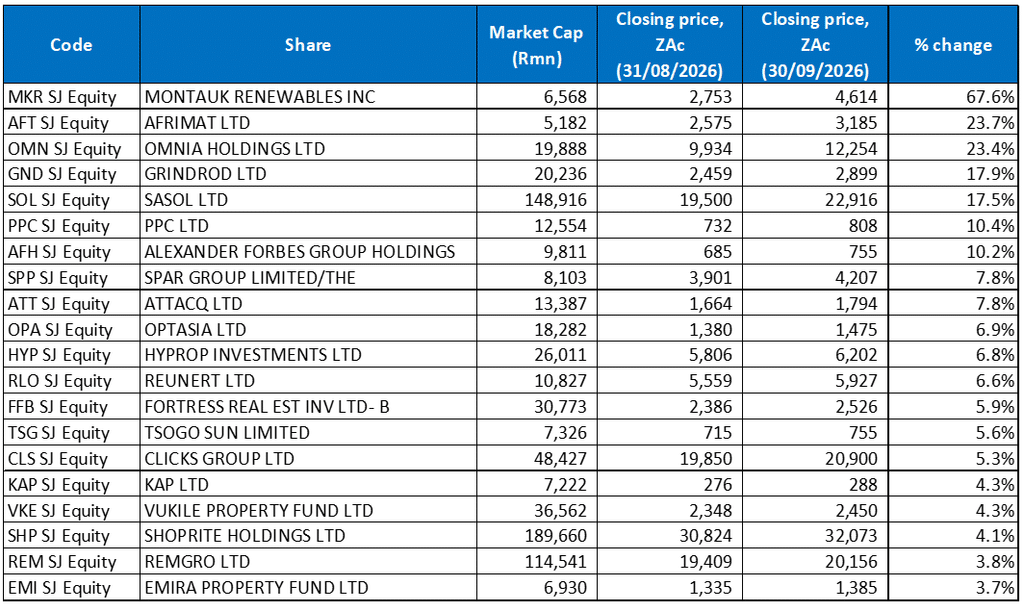
Figure 1: The 20 best-performing shares in September 2026, MoM % change
Source: Bloomberg, Anchor Capital
September was a challenging month for the JSE, but the weakness was far from uniform. As heavyweight resources and precious-metals shares came under pressure, several companies demonstrated resilience, supported by more defensive earnings and company-specific fundamentals. Financials and selected consumer and industrial businesses also proved more resilient during the broader market sell-off, while several mid-cap turnaround stories attracted investor interest. The result was a market in which the headline decline masked significant differences beneath the surface.
Montauk Renewables’ share price has seen strong upward momentum over the past three months but surged 67.6% in September to become the month’s strongest performer. In mid-September, Montauk officially opened its US$200mn Turkey, North Carolina swine-waste renewable natural gas facility. In August, Montauk released interim results showing an improvement in its financial performance. Total operating revenue for the period increased to US$100.4mn while headline earnings per share (HEPS) increased to USc1 vs a loss of USc3/share previously. Montauk has elected not to declare a dividend, instead retaining financial resources to support the continued development of its operations portfolio.
Montauk was followed by mid-tier miner and construction materials supplier, Afrimat (+23.7% MoM). Despite operational headwinds, including higher international logistics costs, Afrimat’s pre-close briefing sessions in late August seemed to reassure investors. Afrimat described the current period as “one of the most challenging years we have experienced” in the company’s 20-year history, citing a combination of adverse structural and economic pressures. However, management also outlined key operational interventions and a strong expected 2H recovery, highlighting the benefits of its diversified commodity exposure. The company identified aggressive cash generation and rapid debt reduction as key immediate priorities.
In third place, fertiliser and explosives Group, Omnia Holdings Ltd (+23.4% MoM), saw its share price rise following a firm, all-cash takeover offer valued at R21.8bn issued by Solar SA Investments. The R134.50/share offer represented a 30.98% cash premium to the pre-announcement trading price.
Omnia was followed by logistics and port terminals operator Grindrod, Sasol and PPC Ltd with MoM gains of 17.9%, 17.5%, and 10.4%. Grindrod continued to benefit from improving operating momentum. Its share price was supported by strong 1H26 results, with record port volumes driving a significant increase in core earnings. Revenue climbed 19% YoY to R2.84bn, while the company also increased its dividend. Notably, volumes at the Port of Maputo reached 8.4mn tonnes, a 29% YoY increase.
Sasol continued to benefit from elevated oil prices, while broader energy sector positioning and structural rotation also supported the share price. As a major defensive energy asset, Sasol has benefited heavily from strategic institutional rotations out of falling spot-precious metal holdings. Sustained production efficiency inside its core coal-to-liquids complex has provided a highly resilient cash cushion, driving rapid short-term capital reallocation into its liquid fuel value lines.
Meanwhile, PPC reported in a trading update for the five months to 31 August that it had experienced stable core infrastructure demand across its regional SA jurisdictions. Group earnings before interest, taxes, depreciation and amortisation (EBITDA) increased 40% YoY while revenue rose by 1% YoY. Growth in Zimbabwe of 4% offset a 2% decline in SA and Botswana cement revenue, where lower sales volumes were partly offset by improved price and product mix.
Alexander Forbes Group Holdings (+10.2% MoM) also performed strongly. The company published a formal SENS notification regarding a share price repurchase agreement involving its largest institutional shareholder, New Veld LLC. The transaction reduced the number of shares in issue and was viewed by the market as supportive of the company’s capital structure.
The beleaguered SPAR Group Ltd (+7.8% MoM) also recovered from a low base. Tensions with independent store owners recently resulted in the departures of former board chair Mike Bosman and director Shirley Zinn. In an effort to strengthen governance and restore trust, SPAR appointed an independent search firm to identify a new chair and non-executive directors by early November, with input from shareholders and retailer representatives. On 28 September, the retailer released a voluntary update in which it stated that ongoing operational turnaround measures have not yet generated sufficient earnings or cash benefits to offset regional pressures. As a result, its FY26 performance is expected to lag 2025 levels, mainly due to weak trading in its Southern African Groceries and Liquor business, subdued wholesale volumes, and elevated retailer credit losses. Management said it remains focused on cash generation, profitability, debt reduction, and retailer support.
Rounding out the month’s 10 best-performing shares were Attacq Ltd and Optasia with MoM share price increases of 7.8% and 6.9%, respectively. Attacq reported robust FY26 results, highlighting the resilience of its property portfolio. Normalised distributable income per share (DIPS) rose 15.5% YoY to ZAc125.1, while the portfolio performance remained strong throughout the year as occupancy reached 94.9% and collections remained high at 99.8%. Revenue increased 9.3% YoY and net operating income rose 7%, supported by improved letting, contractual rental escalations, income from newly completed buildings and lower funding costs. Fintech Group Optasia also delivered strong 1H results in September, with HEPS increasing 50% YoY to USc2.79, while revenue rising 58% YoY to US$185.3mn
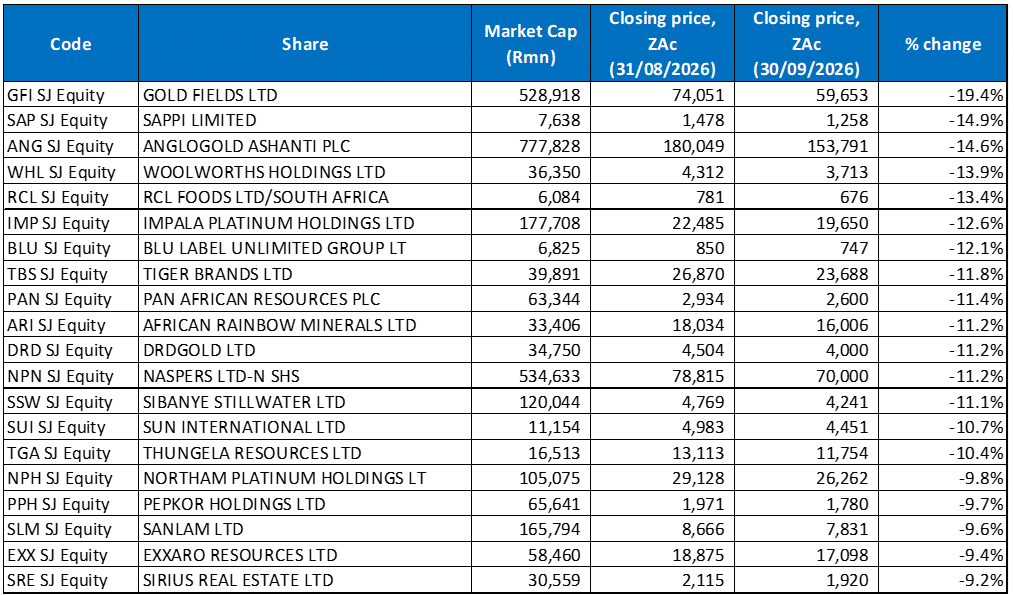
Figure 2: The 20 worst-performing shares in September 2026, MoM % change
Source: Bloomberg, Anchor Capital
In contrast to August, several of the JSE’s big-name mining companies came under pressure as global commodity prices corrected. PGM and gold shares recorded strong pullbacks while the broader sell-off was concentrated in cyclical mining and basic-materials counters, alongside selected domestic food and retail companies facing difficult consumer conditions.
After rising c. 40% in August, Gold Fields was September’s worst-performing share, declining 19.4% MoM. After reaching historic highs earlier in the year, global gold prices pulled back sharply during September, weighing on gold mining shares. For Gold Fields, the decline was further exacerbated by its announcement of a massive, non-binding AUD38.7bn (R455bn) cash-and-share takeover proposal for Australian miner Northern Star Resources. The proposal raised concerns about capital requirements and potential equity dilution. At the same time, the share price fell c. 15% in intraday trading on 28 September after Gold Fields confirmed that its offer for Northern Star had been rejected.
Following a brief respite in August, Sappi’s share price decline resumed in September (-14.9% MoM). Higher debt obligations, elevated logistics and chemical costs stemming from the ongoing Middle East conflict, and structural pressure across parts of its core paper business continued to weigh on margins.
AngloGold Ashanti (-14.6% MoM), like its peers, was impacted by the broad gold price decline in September. It was followed by Woolworths, RCL Foods Ltd SA, and Impala Platinum (Implats) with MoM losses of 13.9%, 13.4%, and 12.6%, respectively.
Last month, Woolworths suffered another setback after it was removed from the FTSE JSE Top 40 Index and replaced by Aspen Pharmacare. Leadership transition anxieties, slowing top-line growth, and margin pressure in its fashion business have also weighed on the counter.
RCL Foods continued to face pressure from higher operating costs and constrained domestic consumer spending. Higher fuel and logistics costs, together with elevated agricultural input prices, have placed pressure on margins, while weaker consumer purchasing power has encouraged consumers to trade down to lower-priced alternatives.
Implats came under pressure as investors reassessed the outlook for PGMs following a sharp correction in PGM prices during 1H26. While Implats’ FY26 results showed a significant improvement in earnings and cash generation, supported by stronger PGM prices, the longer-term outlook remains influenced by changing automotive demand, the transition towards electric vehicles (EVs) and uncertainty around global industrial activity. At the same time, the Group faces structural challenges across parts of its local mining portfolio as legacy shafts approach the end of their productive lives. The combination of commodity-price volatility and uncertainty around future PGM demand continues to make the sector highly sensitive to changes in the global economic and automotive environment.
Implats was followed by Blu Label Unlimited (-12.1% MoM), Tiger Brands (-11.8% MoM), Pan African Resources (-11.4% MoM) and African Rainbow Minerals (-11.2% MoM).
JSE-listed food producers, including Tiger Brands, have faced significant pressure this year as concerns over soaring fuel and food prices and tough trading conditions fuel a risk-off attitude towards the sector. Tiger Brands has also been unable to pass the full brunt of raw material inflation onto struggling local households, resulting in lower volume output and localised margin compressions across its core fast-moving consumer goods (FMCG) portfolio.
Pan African Resources, which gained 42.5% in August, is a mid-tier gold producer with exposure to both underground mining and surface tailings retreatment plants. As a specialised mid-cap producer, Pan African has high leverage to the gold price. When global gold prices fall, its forward-looking earnings projections can contract sharply, prompting capital flight into larger, defensive safe havens.
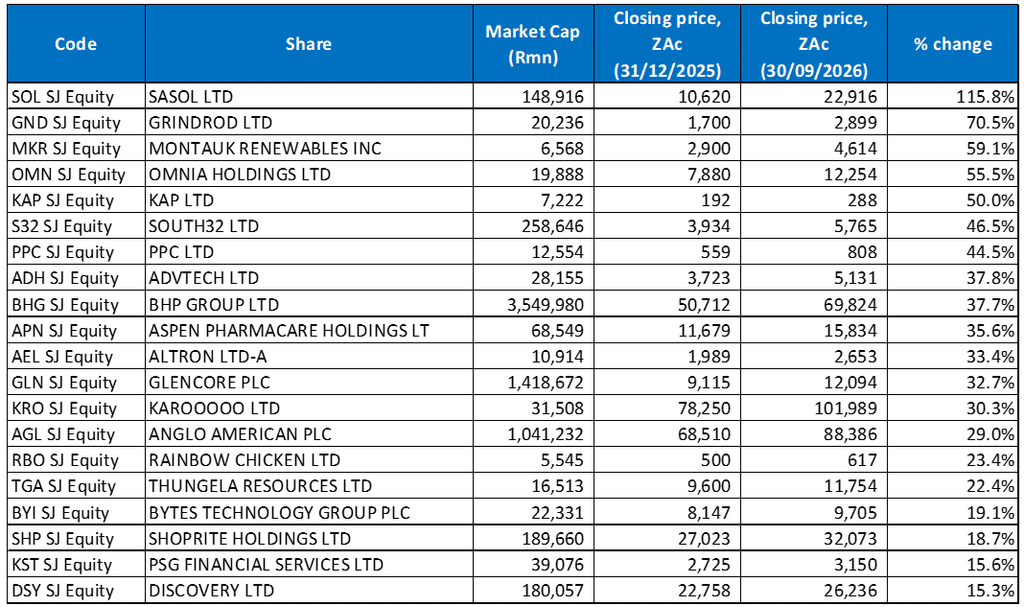
Figure 3: The 20 best-performing shares YTD, % change
Source: Bloomberg, Anchor Capital
The YTD leaders represent a broad mix of structural operational turnarounds, resilient defensive businesses, and global resource companies that have capitalised on 2026’s volatile macroeconomic conditions. Sixteen of the 20 best-performing shares YTD were unchanged from the end-August rankings, highlighting the persistence of several of the market’s strongest themes. Energy counters and diversified miners, including Sasol, Omnia, BHP Group, and South32, continued to deliver exceptional YTD performances, despite the sharp September sell-off in precious metals shares.
Sasol (+115.8% YTD) retained the top position for a third consecutive month, capitalising on a convergence of cyclical and company-specific tailwinds. Elevated crude-oil and chemical prices have supported refining and chemical margins, while Sasol has simultaneously successfully minimised historical operational bottlenecks at its Secunda operations and reduced its legacy debt burden, sparking a valuation re-rating.
Sasol was followed by Grindrod and Montauk Renewables (both discussed earlier), in second and third place with YTD gains of 70.5% and 59.1% respectively.
Omnia (+55.5% YTD) was supported by its strong September performance (discussed earlier), while diversified industrial Group KAP Ltd (+50.0% YTD) continued its dramatic recovery following a challenging FY25. The company’s FY26 results, released in September, revealed a significant operational turnaround despite flat revenue. Operating profit increased 28% YoY and net debt declined by R1.1bn, substantially exceeding its R500mn deleveraging target. Revenue remained stable at R29.6bn, but KAP’s focus on operational efficiency and capital discipline drove meaningful margin expansion. HEPS increased 88% YoY to ZAc45.2.
South32 (+46.5% YTD), PPC Ltd (+44.5% YTD), and ADvTECH (+37.8% YTD) continued their strong performances YTD. South32 reported robust FY26 results in August, which showed a doubling of its HEPS from ZAc12.4 to ZAc24, a boosted final dividend (full-year dividend up c. 55% YoY), and a major copper reserve upgrade at the Sierra Gorda mine. Investor optimism has also been supported by South32’s ongoing transition toward high-margin base metals, including an agreement to divest its broader aluminium value chain to Alcoa for US$4.1bn.
PPC has sustained a massive upward re-rating as its multi-year operational turnaround plan bears fruit. Despite overall sluggish domestic growth, the company has protected its profit margins through strict commercial discipline, refusing to match value-destructive price discounting from rivals.
In SA, private education has benefitted from relatively resilient demand as households continue to prioritise education expenditure. Education and resourcing group ADvTECH has delivered steady enrollment growth across its premium school brands and tertiary institutions, supporting resilient, defensive cash flows. In August, ADvTECH reported a 16% YoY increase in HEPS for the six months to June 2026, while revenue rose 8% YoY to R5.06bn, and operating profit increased 14% YoY to R1.12bn as the Group benefited from enrolment growth and improved cost efficiency.
BHP (+37.7% YTD), the heavyweight among the YTD leaders by market cap, has benefitted from record copper prices (+40.3% YoY) and a stellar FY26 earnings report, supported by solid cash generation and a higher-than-expected dividend payout. While gold and platinum counters experienced steep pullbacks toward the end of 3Q26, capital rotated heavily into global industrial resource titans anchored by stable global copper demand and long-life base metal portfolios.
Rounding out the strongest performers YTD was Aspen Pharmacare Holdings Ltd (+35.6%). Aspen management marked 2026 as a major financial inflection point for the Group. It completed the multi-billion-rand divestment of its Asia-Pacific (APAC) business assets for R28bn in gross proceeds, providing additional balance-sheet flexibility, and also expanded its presence in GLP-1 weight-loss treatments.
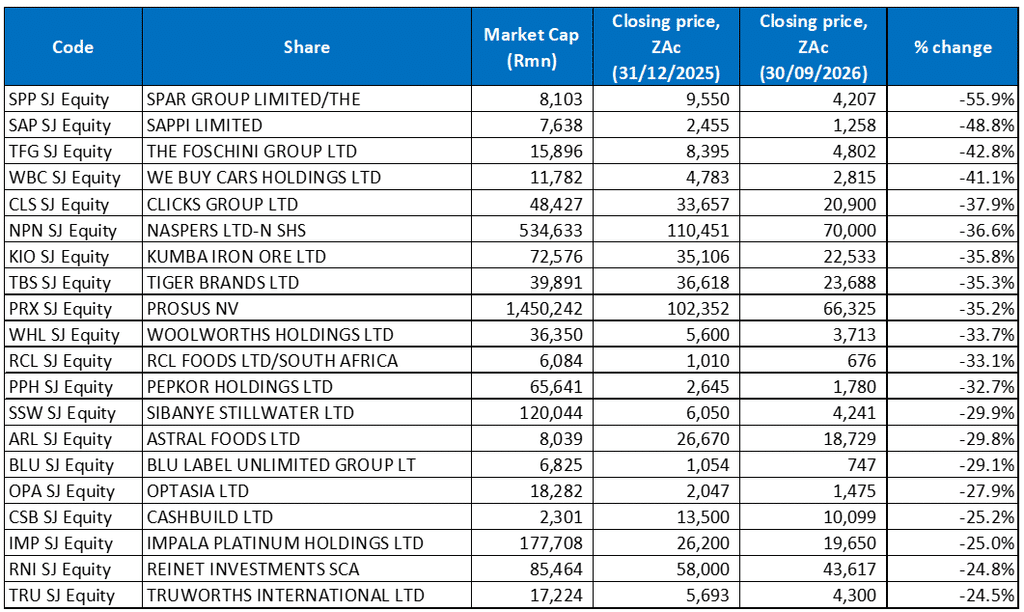
Figure 4: The 20 worst-performing shares YTD, % change
Source: Bloomberg, Anchor Capital
The weakest performers YTD broadly reflect two themes: pressure on consumer-facing businesses from a challenging SA macroeconomic environment (marked by restrictive interest rates and weak demand) and the impact of broader geopolitical and commodity market developments on companies exposed to international technology and resources cycles.
Despite its September recovery, SPAR Group (-55.9% YTD, discussed earlier) led the laggards YTD for a second consecutive month. It was followed by Sappi (-48.8% YTD; discussed earlier) and The Foschini Group (TFG; -42.8% YTD).
TFG has been negatively impacted by high rates and flat real wage growth, which has severely curbed middle-income discretionary spending on fashion and homeware, driving down clothing retail profit margins. Last month, TFG released a trading update confirming plans to close 280 SA stores over the next few years and reversing its previous strategy of rapid expansion. The company said its Australian business was facing its “toughest trading environment” with sales declining by 4.7% over the 21 weeks to 22 August, while its London operations performed somewhat better, recording sales growth of over 2%.
We Buy Cars and Clicks Group fell by 41.1% and 37.9% YTD. We Buy Cars has faced a more challenging operating environment following its highly publicised listing. The SA second-hand vehicle market has cooled down significantly, while high rates have made vehicle financing far more expensive for consumers, weighing on demand and slowing inventory turnover.
Naspers and Prosus declined 36.6% and 35.2% YTD, respectively, reflecting weakness in their core technology investment, Chinese tech giant Tencent, which was down c. 31% YTD.
Kumba Iron Ore, Tiger Brands, and Woolworths (discussed earlier) accounted for the remainder of the ten weakest performers YTD, declining by 35.8%, 35.3% and 33.7%, respectively. Kumba has been impacted by a weakening iron ore premium globally due to a slowdown in China’s property sector, which has weighed on global iron ore benchmark prices (-13.8% YTD), lower realised prices per metric tonne, and localised Transnet rail line maintenance outages that limited export volumes.