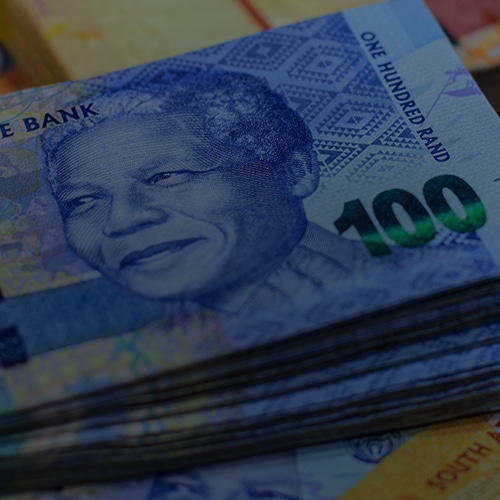

Figure 1: Rand vs the US dollar
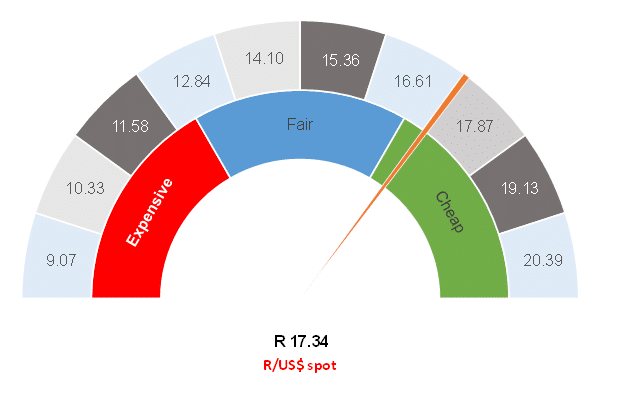
Source: Anchor Capital
Our previous rand view was published back in July 2026. Since then, the rand has performed relatively well, largely trading within a range of R16.00 to R16.50/US$1. However, a combination of global policy developments and growing domestic political uncertainty has recently unsettled the currency. As I write this, on the morning ahead of the South African Reserve Bank’s (SARB) Monetary Policy Committee (MPC) meeting on 19 November, the rand has weakened to around R17.34/US$1.
To understand the recent rand depreciation, we need to look first at developments in the US, which have been a significant driver of rand movements. For South African (SA) investors, US dollar strength is often reflected in rand weakness, making developments in the world’s largest economy particularly relevant to our currency.
It is fair to say that the second term of US President Donald Trump has been characterised by numerous shocks to the US economy. All of these are inflationary in nature, and with enough shocks, the inflation rate can become problematic.
The Trump administration’s overzealous enforcement of immigration policy spilt over with headlines of immigration officials killing US citizens. From an economic perspective, the outcome of all of this was a reduced labour supply, particularly for lower-paying jobs. This can force businesses to offer higher wages to attract and retain employees, while encouraging greater investment in automation and other alternatives to human labour. Both developments have an inflationary impact.
Trade policy has also contributed to inflation concerns. Trump spent the first months of his second term fixated on tariffs and engaging in disputes with the US’ trading partners. Tariffs have the effect of increasing the cost of imported goods on the shelf and creating uncertainty around global supply chains (goods being less freely available). This is, again, clearly inflationary. Engaging in trade wars means that your trading partners will often divert their goods toward other buyers, leading to the US either doing without or needing to source items from more expensive suppliers, again an inflationary impact.
Geopolitical developments have added another layer of uncertainty. The US decision (in conjunction with Israel) to engage in a war on Iran with no clear justification and no plan for success has seen the oil price spike upward by about 49% YTD. Higher energy costs have inflationary implications well beyond the fuel price, feeding into transportation, production and distribution costs across the economy.
Meanwhile, the refusal to regulate the development of the artificial intelligence (AI) industry has exacerbated the AI gold rush; consequently, prices of technology, electronic chips and other supplies continue to move higher, with the additional burden of supplies being limited. Demand pressures, alongside supply constraints, result in rising costs in parts of the technology supply chain. Yet again, inflationary.
US fiscal policy presents a further concern. The One Big Beautiful Bill Act (OBBBA), which aims to reduce taxes and increase disposable income, is expected to add to the US government’s borrowing requirements. While additional disposable income can support consumer spending and economic activity, it also risks adding to inflationary pressures, particularly if demand outpaces the economy’s productive capacity. The associated increase in government debt raises questions about the sustainability of the US fiscal position.
Taken together, all these inflationary shocks have made the inflation outlook considerably more challenging.
After two years of excuses and viewing inflationary pressures as temporary shocks, the US Federal Reserve’s (Fed) Federal Open Market Committee (FOMC) appears increasingly fatigued with the persistence of inflation well above its target. The prospect of further monetary tightening has therefore moved back into focus.
The Fed delivered its first rate hike on 16 September, while financial markets have increasingly priced in the possibility of one or two further hikes. More recently, FOMC member Christopher J. Waller advocated a 0.50% rate hike in December. Minutes from the US Fed’s October meeting, released on 18 November, also surprised markets by revealing that a 0.50% rate hike had been discussed at that meeting. This represents a significant shift in expectations. At the beginning of 2026, we were anticipating interest rate cuts. The conversation has since shifted to the possibility of a further 1.25% to 1.50% in US interest rate hikes.
Expectations that the Fed will increase rates have supported the US dollar, which has strengthened by c. 7% against the euro YTD. The rand, which started 2026 at R16.54/US$1, has weakened by around 5% against the greenback over the same period.
The prospect of further US monetary tightening is therefore an important consideration when assessing the rand’s recent performance.
For much of 2026, the rand benefitted from favourable domestic market sentiment and strong commodity export prices. Higher gold and platinum prices boosted export proceeds, improved mining profitability and led to a meaningful jump in tax revenue for the National Treasury. With a healthy tax take, there was enough money to go around within government; debt levels began to subside, key projects were easy to fund, and investments in infrastructure made sense.
The gold price has now declined by 14% since the beginning of the year, and the equation for National Treasury currently looks slightly more precarious for the next year.
We remain hopeful of a positive rating development from Standard & Poor’s on 27 November, although we regard the outcome as finely balanced, with roughly even odds of an upgrade. Beyond this potential catalyst, however, SA faces a more demanding economic and fiscal environment.
An experienced captain and strong leadership can help a country navigate rough seas. However, the outcome of the 2026 Local Government Elections (LGE) has introduced further uncertainty around the direction of SA’s political landscape. The very real possibility of Action SA President and Founder Herman Mashaba entering political arrangements with populist parties raises questions about the composition and stability of future municipal administrations. We may see the ANC at the helm, sailing through these turbulent economic times aided by Jacob Zuma’s uMkhonto weSizwe (MK) Party on the one hand and Julius Malema’s Economic Freedom Fighters (EFF) on the other. Action SA appears to favour the continuity of the ANC and the support of populism to address the structural decay in our metros, roads and water infrastructure.
Some analysts have warned that such political developments could place further pressure on living standards and municipal service delivery. There is also a real risk that this lurch toward populism could influence the broader Government of National Unity (GNU), potentially undermining some of the progress made over the past two years. This is a low road scenario that seems to be gaining traction. Only time will tell.
In summary, SA is facing a less favourable global environment, a less positive domestic economic environment and growing local political uncertainty. Against this backdrop, the rand’s recent depreciation is perhaps even more so, not surprising.
Figure 2: Actual rand/US$ vs rand PPP model
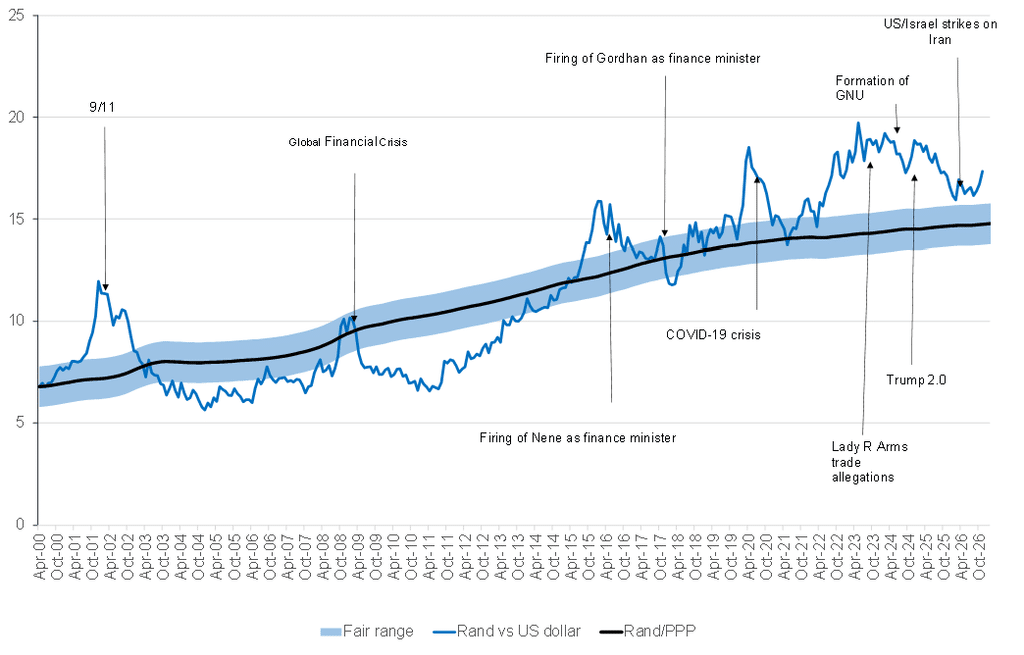
Source: Thomson Reuters, Anchor Capital
Looking ahead, forming a firm view on the rand is particularly difficult at this juncture. While near-term risks remain elevated, we believe some of the current pressures could moderate during 2027.
In our view, market expectations of further US interest rate increases are overstated. We also think that gold and platinum prices should stabilise and perhaps rise again if the US stops hiking rates. Trump’s ability to shock markets should also be curtailed as the Democrats assume a more powerful position in Washington.
For the rand, however, the key risk is political; we saw the rand depreciate by 61% over the period from 2009 to 2017 (the Zuma State Capture years). Although this depreciation occurred gradually, the cumulative impact was significant.
For now, we are adopting a cautious wait-and-see approach. Given the speed and extent of the rand’s recent movements, we do not believe that reacting hastily is necessarily the appropriate response. Should the domestic political outlook deteriorate materially, we expect to have opportunities to reassess and adjust our portfolio positioning.
Our portfolios remain diversified to help navigate periods of heightened uncertainty. We are allowing that diversification to perform its intended role while closely monitoring our exposure to SA risks and retaining the flexibility to respond as the economic and political landscape evolves.