

South Africa’s (SA) labour market has taken a further knock this year, as an increasingly challenging global environment has compounded weak domestic economic growth and longstanding structural constraints. In particular, the global oil shock has exacerbated existing pressures on businesses and households, adding to operating costs and weighing on an already strained domestic economy. Employment fell sharply by 345,000 QoQ in 1Q26, followed by a further decline of 16,000 in 2Q26, bringing total employment to 16.7mn.
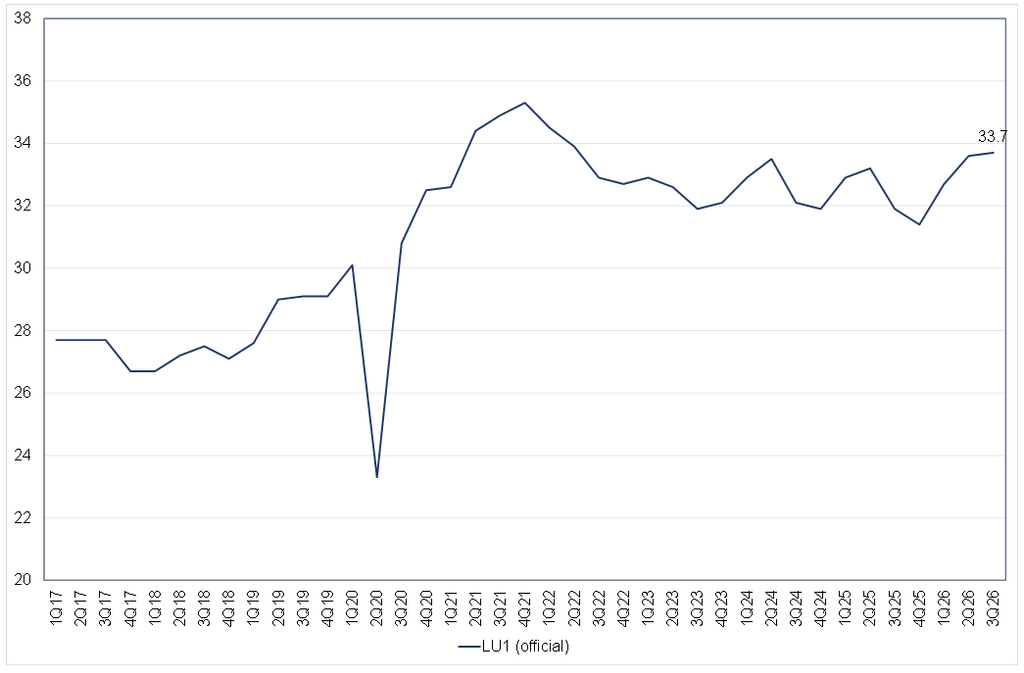
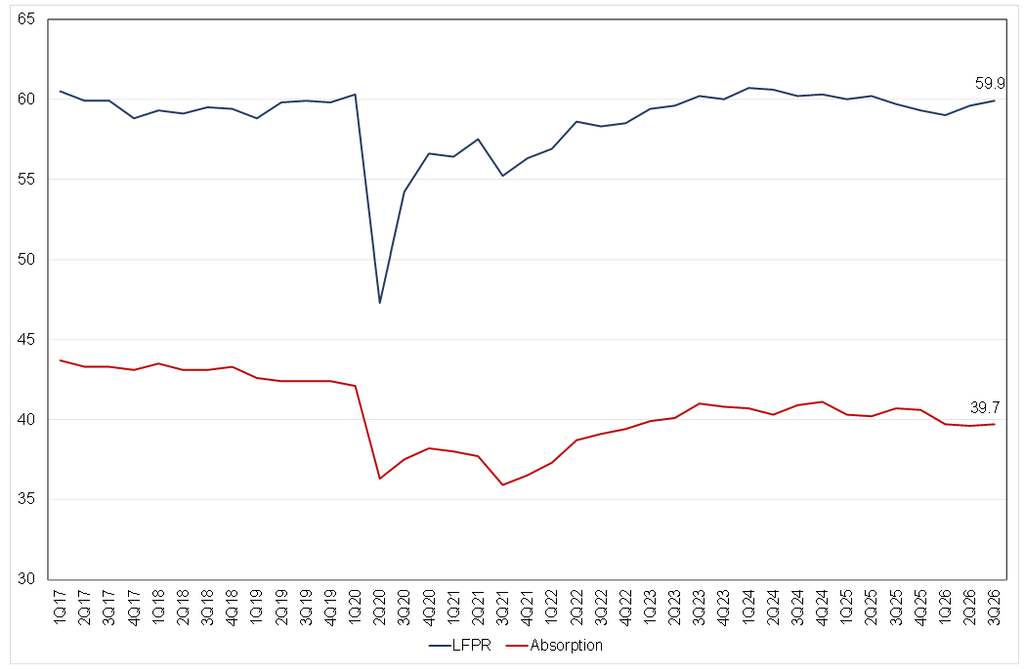
According to the latest quarterly labour force survey (QLFS), released on 10 November, SA’s official unemployment rate edged up by 0.1 ppts to 33.7% in 3Q26. Although employment increased by 101,000 QoQ to 16.8mn, the labour force expanded by a larger 198,000. Consequently, the number of unemployed people rose by a further 97,000, highlighting the economy’s continued inability to generate jobs at a sufficient pace. The labour force participation and absorption rates rose slightly to 59.9% and 39.7%, respectively, indicating a modest improvement in labour market participation, but not enough to prevent a further increase in unemployment.
Figure 1: Unemployment rate trend, YoY % change
Source: Anchor Capital, Stats SA
Figure 2: Labour force participation and absorption rates, % change
Source: Anchor Capital, Stats SA
The sectoral employment picture was mixed. Formal-sector employment increased by 2.2% QoQ, adding 268,000 jobs (+3%/357,000 YoY), while the informal and household sectors shed 98,000 (-27%) and 68,000(-6.2%) jobs, respectively, on a quarterly basis.
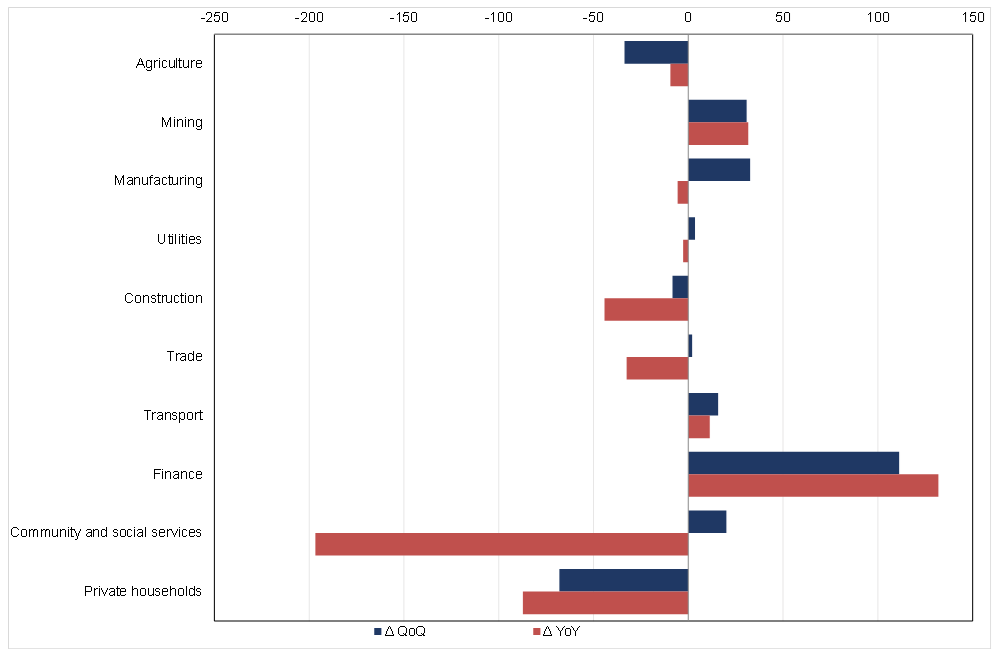
At an industry level, the finance sector recorded the largest increase, with employment rising by 3.8% or 111,000 jobs QoQ. It was followed by mining, where employment increased by 6.8% or 31,000 jobs QoQ.
By contrast, private households remained a significant drag on overall employment, with jobs declining by 7.9% (-87,000 YoY). Community and social services employment increased modestly by 0.5% (+20,000 QoQ), although the sector continued to reflect weakness relative to a year earlier (-4.9%/-197,000).
The agricultural sector, in particular, lost momentum in 3Q26 following robust employment growth of 4.3% in 2Q26. Employment in the sector declined by 9,000 jobs (-1.0%) YoY and by 34,000 jobs (-3.6%) QoQ, indicating a reversal in labour market gains recorded earlier in the year. The manufacturing sector showed signs of improvement, with the addition of 33,000 jobs during the quarter.
Figure 3: Employment by industry, ’000 change QoQ and YoY
Source: Anchor Capital, Stats SA
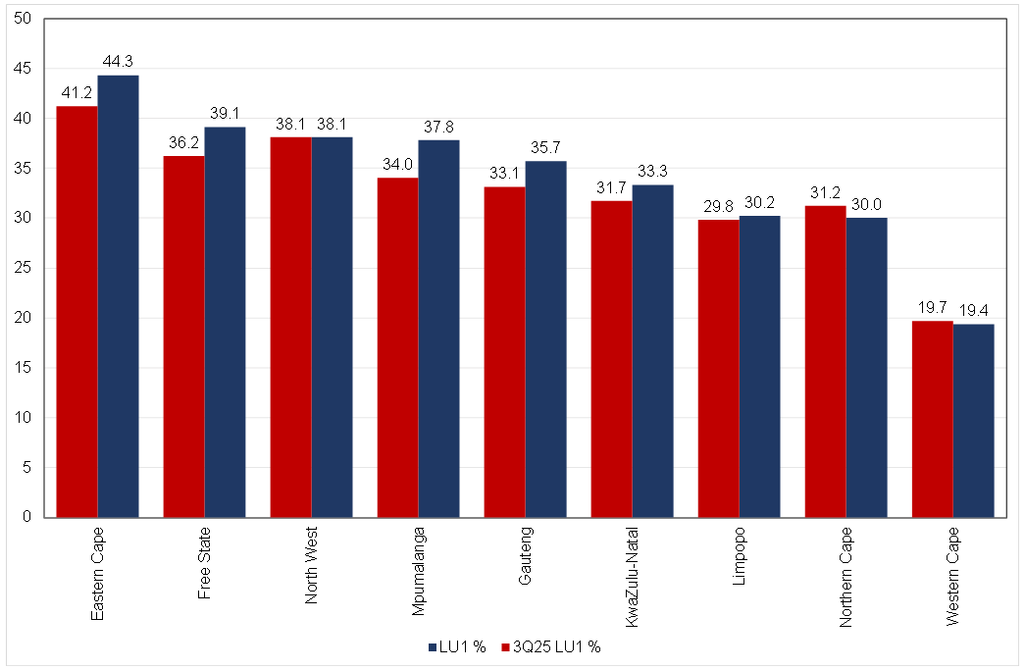
Figure 4: Unemployment rate by province, %
Source: Anchor Capital, Stats SA
Provincial labour market outcomes remained highly uneven. The Eastern Cape continued to record the country’s highest unemployment rate, rising to 44.3% in 3Q26. The Free State’s unemployment rate also increased from 36.2% to 39.1%, while the North West recorded an unemployment rate of 38.1%. By contrast, the Western Cape remained the best-performing province, with unemployment edging down to 19.4% from 19.7%, well below the national average.
Outlook
While the 0.6% quarterly increase in employment is encouraging, the broader trend remains concerning. Compared with a year earlier, total employment fell by 215,000 jobs (-1.3%), while the number of unemployed people rose by 571,000 (+7.1%). The divergence between declining employment and unemployment growth highlights the extent to which job creation remains insufficient to keep pace with labour force growth. It also reflects the persistent structural challenges facing SA’s labour market.
The external (global) environment has added to these pressures and remains an important downside risk. Escalating tensions involving Iran and disruption to shipping through the Strait of Hormuz pushed oil prices sharply higher earlier this year, with Brent crude approaching US$118/bbl in late October. Higher fuel, transport and production costs added additional pressure on local businesses and households already facing subdued domestic demand. Manufacturing production fell by 4.3% YoY in August, with petroleum and chemical products the largest drag, while mining output declined by 12.7% YoY.
Domestic conditions have amplified these external headwinds. GDP contracted by 0.2% QoQ in 2Q26, ending six consecutive quarters of growth, while the RMB/BER Business Confidence Index declined to 38 in 3Q26, its weakest reading since 3Q24. The South African Reserve Bank (SARB) also raised the repo rate twice, taking it to 7.25% in September and tightening financial conditions as growth softened. Against a backdrop of elevated uncertainty, businesses have had little incentive to expand aggressively or increase hiring.
There are, however, some early signs of relief heading into year-end. Brent crude has retreated from its late October highs, falling by roughly 20% (to 10 November) as concerns about further escalation in the Middle East eased. The temporary reduction in the general fuel levy, implemented on 4 November, should also provide near-term support to business costs. In addition, seasonal demand associated with the festive period may support temporary hiring in retail, tourism and logistics, although this is unlikely to alter underlying labour market trends materially.
Nevertheless, employment remains below year-earlier levels, business confidence is subdued, and investment activity remains constrained. Until confidence and fixed investment recover more meaningfully, job creation is likely to remain modest.