

Artificial intelligence (AI) has rapidly become a core driver of business competitiveness. For investors, the question is no longer whether AI will matter, but how quickly it can translate into operating leverage, earnings power and sustained client value.
Our stance is deliberately balanced: optimistic about the opportunity yet disciplined in execution. We view AI as a once‑in‑a‑generation enabler of productivity and client service, while recognising the practical challenges of embedding it safely, consistently, and at scale.
The observations below draw on our direct experience of hands‑on AI adoption within our organisation. While framed for an investment audience, they have been generalised to protect proprietary insights. We have also used AI to assist in drafting this article, with human review throughout.
AI is out there, but the investment question is how to capture the productivity dividend safely and repeatably.
1) Why AI matters for investors
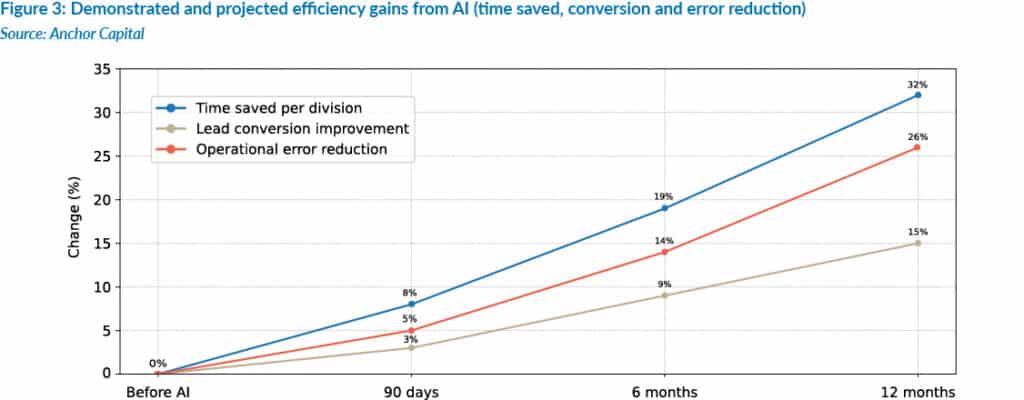
Across industries, early AI adoption is appearing most visible through time saved, cycle‑time compression and quality consistency. These are the building blocks to operating leverage: fewer hours per unit of output, faster conversion of activities into revenue, and limiting rework loops. As adoption matures, these efficiencies compound into margin resilience, improved client retention and broader capacity without proportional headcount growth.
- Operating efficiency: automation of low‑value repetitive tasks frees skilled professionals to focus on higher-value work activities.
- Revenue enablement: improved responsiveness, quicker proposals, tailored communications, and better lead qualification improve conversion.
- Risk management: standardised outputs and human‑in‑the‑loop review processes reduce variability and error rates.
2) Adoption realities: The work behind the gains
While the benefits are compelling, real-world implementation introduces two consistent challenges: structural and behavioural. These are normal — and solvable — but they require sequencing and patience.
a. Structural challenges (systems, data, workflow)
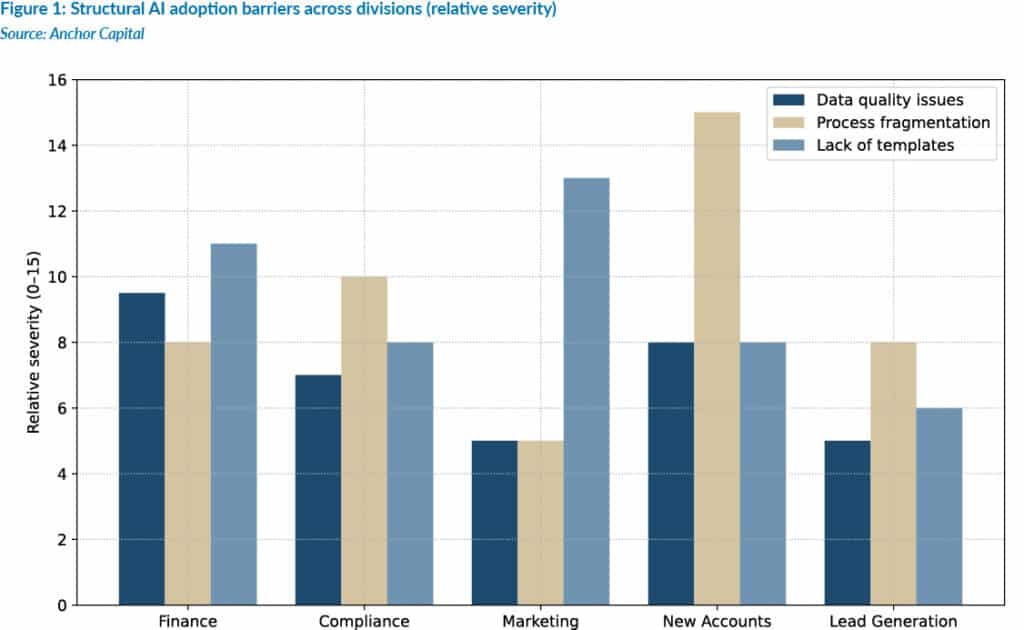
AI is most effective when supported by accessible data and clearly defined processes. In practice, most organisations start with fragmented data and non‑standard templates. AI quickly exposes these gaps early, acting as both an invaluable diagnostic and an initial constraint on value realisation.
b. Behavioural challenges (skills, trust, change management)
AI adoption is a human transition as much as a technological one. Typical reactions range from curiosity to hesitation, often driven by a fear of mistakes, unfamiliar tools (preferences outside approved stacks), and a natural reluctance to learn new workflows. The antidote is practical training, visible leadership support, and space for experimentation.
It is difficult to change a leopard’s spots — unless you show it why the new pattern is better.
Our internal workshops indicate a cautiously positive sentiment overall, with understandable anxiety in pockets of the business (Figure 2).
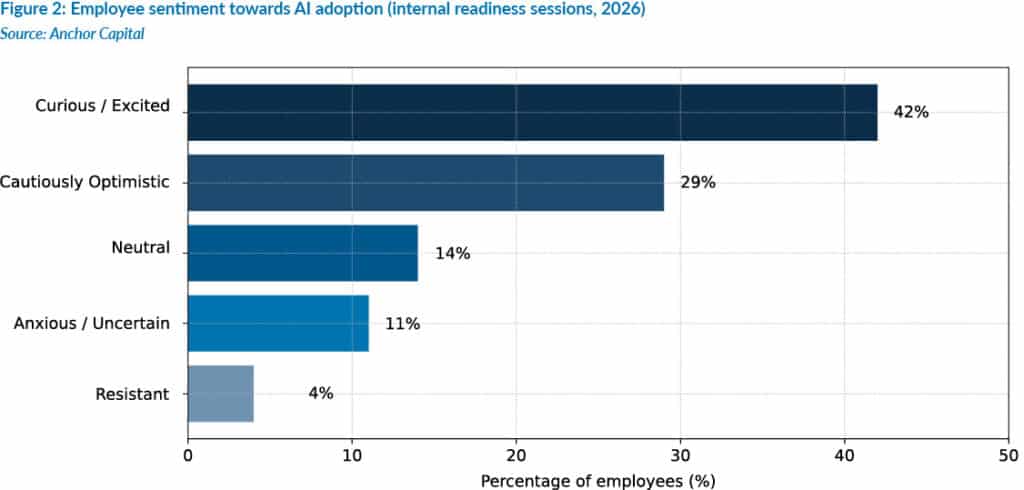
The solution here is cultural engagement, not coercion — training, reassurance, visible sponsorship and space to experiment safely.
1) Where value emerges first (leading indicators)
The initial, most durable returns tend to be concentrated in a handful of repeatable themes:
- Productivity accelerators: meeting and document summarisation, first‑draft generation, structured comparisons and checklists.
- Client experience: faster turnaround times, improved consistency or formatting, and more tailored client communication.
- Decision support: identification of anomalies and patterns that help humans focus on what matters.
AI’s role is not to replace expertise but to remove friction, elevate expertise and amplify the effectiveness of human capital.
1) Responsible implementation and use: safe, considered, human‑led
In regulated environments, governance is a prerequisite for sustainable value creation. Our approach is simple: approved tools, human review, auditability and privacy by design. A structured approach ensures AI augments professional judgement without introducing unnecessary operational or conduct risk.
Key principles include the following:
- Maintaining human oversight for all client‑facing outputs.
- Using approved tooling only with privacy safeguards enabled and logs retained.
- No automated decisions with material client impact without human approval.
2) A sequenced roadmap for investors and operating leaders
A phased approach to AI implementation is suitable for most organisations and allows companies to balance velocity with control:
- Phase 1: Orientation and early wins (0–90 days)
Deploy approved AI tools; run short, practical enablement, target low‑risk use cases (summaries, drafting), measure hours saved and quality improvements, communicate wins.
- Phase 2: Adoption and process alignment (3–6 months)
Embed AI into a few core workflows, standardise templates, establish prompt libraries, nurture internal champions, and track cycle‑time, error rates and user confidence.
- Phase 3: Strategic integration (6–12 months)
Link AI deployment and usage to strategic priorities, integrate structured data, explore agents in sandboxed pilots, strengthen auditability, and define outcome-based key performance indicators ([KPIs] productivity, conversion, retention).
The objective is not full automation, but effective augmentation, thus enhancing human decision-making with measurable business outcomes.
3) Concluding perspective for investors
AI represents a durable shift in how organisations operate and compete, not merely a passing theme. Done well, AI can enhance operating leverage, improve client outcomes, and strengthen resilience without compromising governance.
Our experience to date supports an optimistic but disciplined view: AI is already delivering tangible benefits (we are using AI today, including in creating this article), but scaling its impact requires careful execution, with continued human oversight at the centre.
The opportunity is significant, but realising it consistently will distinguish the leaders from the followers.