
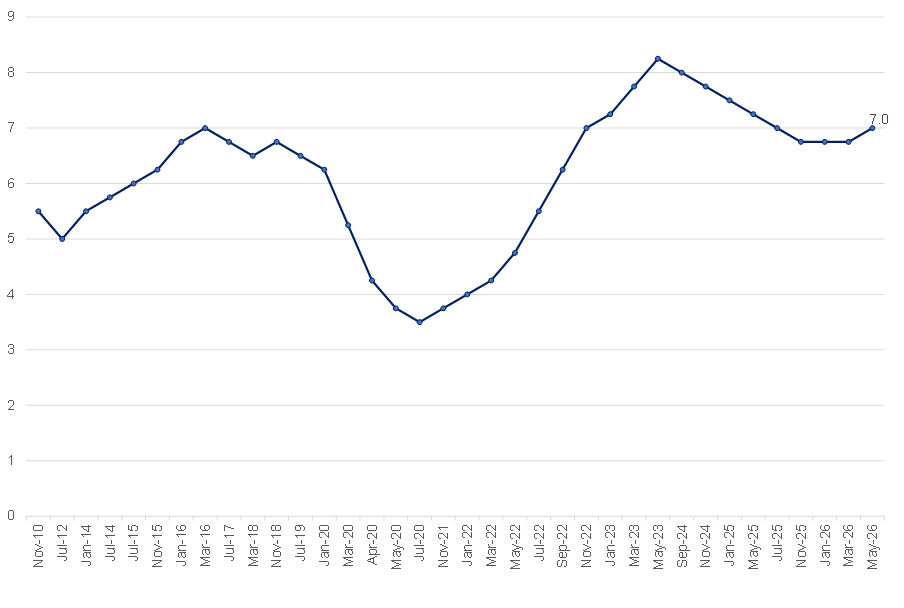
The South African Reserve Bank’s (SARB) Monetary Policy Committee (MPC) raised the repo rate by 25 bpts to 7%, in line with our expectations, citing heightened inflation risks and the increasing likelihood of second-round effects.
The decision comes against a backdrop of persistent geopolitical tensions and ongoing disruptions to oil supply routes, including the Strait of Hormuz, which have kept oil prices volatile at around US$100/bbl. These pressures are now feeding through into the domestic inflation environment. South Africa’s (SA) headline inflation accelerated to 4.0% YoY in April 2026, primarily driven by higher transport and utilities costs, which increased to 5.2% YoY and 4.9% YoY, respectively.
Reflecting the deteriorating global energy backdrop, the SARB revised its average Brent crude oil price assumptions for 2026 higher to US$91/bbl from US$78/bbl in the March forecast round. Quarterly projections were also adjusted materially upward, with Brent expected to average US$103.8/bbl in 2Q26 (vs US$77.8/bbl in 1Q26), before moderating gradually over the remainder of the year to US$94.0/bbl in 3Q26 and US$88.3/bbl in 4Q26. As a result, the SARB now forecasts headline inflation to average 4.4% in 2026, easing to 3.7% in 2027, and returning to the midpoint (3%) of the SARB’s target range only by 2028.
At the same time, the SARB lowered its domestic growth projections by 20 bpts to 1.2% in 2026 and 1.7% in 2027. The downgrade reflects weaker disposable income due to rising inflation and elevated global uncertainty, which are expected to weigh on household consumption and investment.
The MPC reiterated that risks to the inflation outlook remain skewed to the upside. In particular, policymakers highlighted the potential for a prolonged Middle East conflict to sustain pressure on food and fuel prices, weaken the rand and contribute to broader inflationary pressures across the economy. The transition to El Niño conditions is expected to intensify food inflation by amplifying the impact of higher diesel and fertiliser input costs. The SARB also warned of potential non-linear inflation dynamics, where large shocks, such as sharp oil price increases, could have a disproportionately larger impact on consumer prices and inflation expectations.
Figure 1: The history of the SARB MPC’s repo rate changes, %
Source: SARB, Anchor Capital
Fuel prices remain a key upside risk. In May, petrol and diesel prices increased by 14% and 20%, respectively, while the anticipated reinstatement of the fuel levy between June and July 2026 is expected to place further upward pressure on transport costs and, by extension, headline inflation.
Food inflation risks are also building. The Food and Agriculture Organization (FAO) Food Price Index rose by 1.6% to 130.7 points in April 2026, while fertiliser prices, particularly urea, surged by more than 80% between March and April. These pressures could be compounded by the potential emergence of El Niño conditions later in 2026, which may constrain local agricultural output and intensify upward pressures on food prices.
Administrative price increases are likely to add further strain to the inflation outlook. Electricity tariffs for direct customers rose by 8.7% in April 2026, while municipal customers are expected to face a further 9.01% increase from 1 July. These adjustments will add to broader cost pressures for both households and businesses.
Although the rand has remained relatively resilient YTD (+1.4% vs the US dollar), supported by favourable terms of trade driven by strong export prices, continued geopolitical uncertainty and higher oil prices could place renewed pressure on the currency in the coming months, further amplifying imported inflation risks.
Against this backdrop, we expect inflation to average 4.5% in 2026 before moderating to 3.7% in 2027. We believe that the SARB will maintain a cautious and hawkish policy stance. We continue to anticipate at least one additional 25-bpt rate hike in 2H26, potentially as early as July, as the Bank seeks to contain inflation expectations and limit second-round effects.