
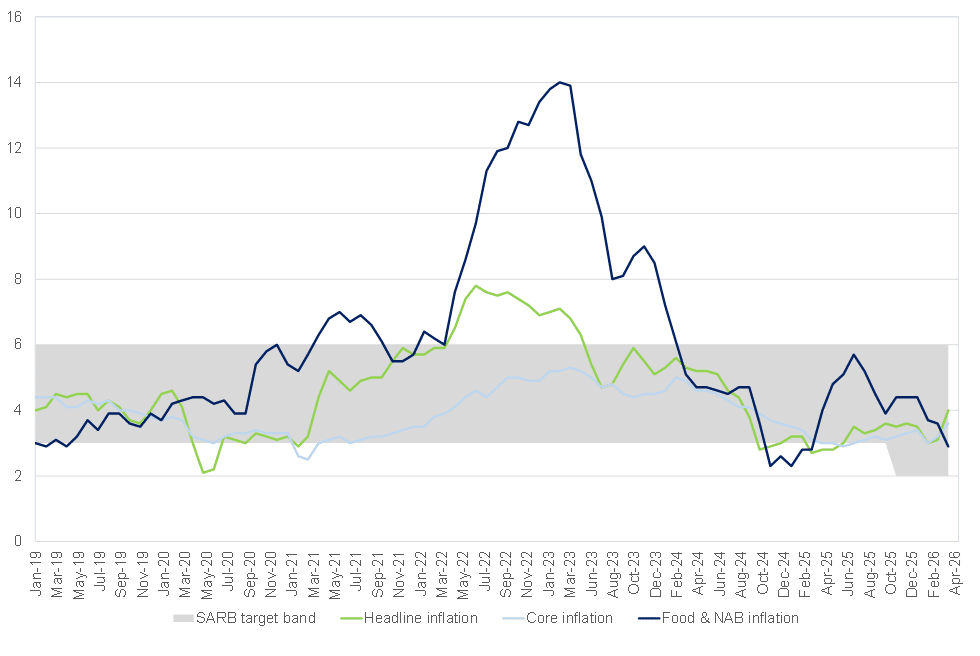
Data released by Statistics South Africa (Stats SA) showed that annual headline inflation, as measured by the Consumer Price Index (CPI), accelerated to 4.0% YoY in April, up from 3.1% in March. Over the same period, core inflation rose to 3.6% YoY from 3.2% previously. This increase reflects the initial pass-through of elevated global oil prices into domestic inflation following disruptions in the Strait of Hormuz linked to the ongoing Middle East conflict.
The higher annual headline inflation was driven primarily by utilities and transport costs, which rose by 5.2% YoY and 4.9% YoY, respectively, contributing approximately 1.2 ppts and 0.7 ppts to the overall inflation print. Higher administered electricity tariffs continued to place upward pressure on utilities inflation, while rising fuel prices translated into higher transport costs, underscoring the continued pass-through of elevated global oil prices into the domestic economy.
Annual insurance and financial services inflation remained elevated, increasing by 5.7% YoY, and contributing 0.6 ppts to headline inflation. Annual service inflation remained elevated, rising to 4.6% (from 4.2%). Goods inflation also accelerated to 3.4% YoY (from 1.8%).
Food and non-alcoholic beverages (NAB) inflation moderated on an annual basis, easing to 2.9% YoY (from 3.6%); however, it increased by 0.8% MoM.
On a MoM basis, headline CPI rose by 1.1%, up from 0.6%. This was largely driven by higher transport costs, which alone contributed approximately 0.7 ppts to the monthly increase. Meanwhile, core inflation, excluding the volatile food and non-alcoholic beverages, fuel and energy categories, moderated slightly to 0.5% MoM (from 0.8%).
Figure 1: SA inflation, YoY % change
Source: Stats SA, Anchor Capital
Fuel price developments remain a key inflation risk. Petrol prices increased by approximately 15% between March and April 2026, while diesel prices rose more sharply by around 35% over the same period. Further increases followed in May, with petrol rising by R3.27/litre and diesel by R6.18/litre, respectively, reflecting a 14% and 20% rise, respectively.
The temporary R3/litre reduction in the general fuel levy in April 2026 helped to cushion the impact of higher global oil prices. The anticipated reinstatement of the levy between June and July 2026 is expected to add further upward pressure on fuel costs and, by extension, headline inflation.
While second-round effects are still emerging, higher fuel costs are increasingly filtering into broader consumer prices, particularly within transport-related services. Increases in e-hailing tariffs, taxi fares, airfares, and bus fares suggest that cost pressures are starting to broaden. Passenger transport costs, for example, have shown consistent increases over recent months, rising by 5% between February and April 2026.
Global food prices also present an emerging risk. The Food and Agriculture Organisation (FAO) Food Price Index (FFPI) has recently begun to trend higher, increasing by 1.6% to 130.7 points in April 2026 amid geopolitical supply disruptions. Although domestic food inflation has moderated, easing from 4.4% YoY in January 2026 to 2.9% YoY in April 2026, the outlook remains vulnerable to weather-related risks. In particular, the potential onset of an El Niño phenomenon, associated with below-average rainfall, in late 2026, could negatively impact agricultural output and place renewed upward pressure on food prices, compounding existing supply-side pressures associated with elevated oil prices.
Overall, inflation risks remain skewed to the upside. Should the Middle East conflict persist, elevated global oil prices are likely to continue placing pressure on domestic fuel and transport costs. Against this backdrop, headline inflation has now moved to the upper end of the South African Reserve Bank’s (SARB) newly adopted 3% target framework, with its narrower 1-ppt tolerance band (2%–4%). This is likely to reinforce the SARB’s cautious policy stance as it seeks to anchor inflation expectations and contain further price pressures. Accordingly, we believe the Monetary Policy Committee (MPC) is likely to increase the repo rate by 25 bpts at its meeting on 28 May.