
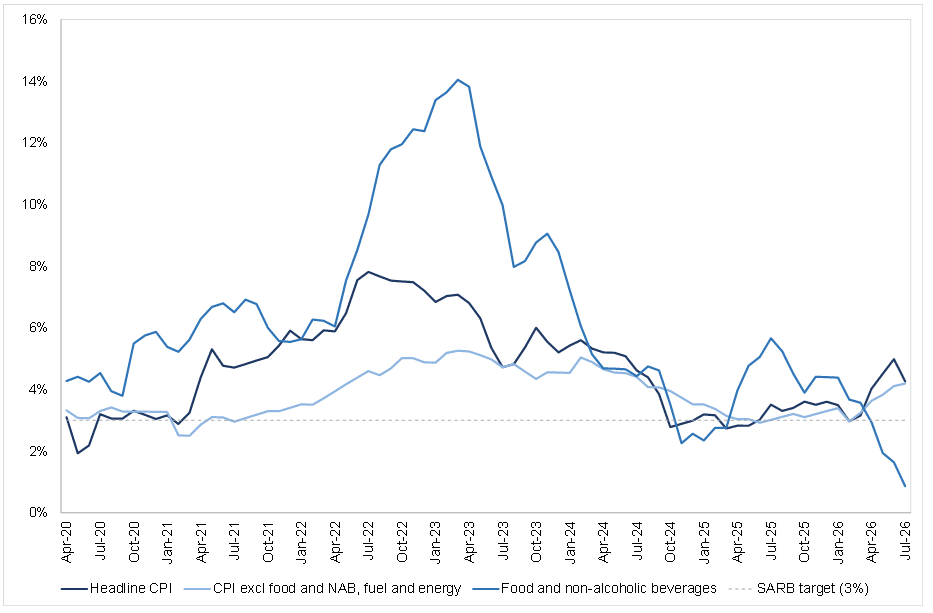
South Africa’s (SA) headline inflation slowed to 4.3% YoY in July 2026 from 5.0% in June, coming in below market expectations of 4.5%. Core inflation, which excludes the more volatile food and energy components, remained relatively sticky, edging up to 4.2% YoY from 4.1% previously. On a monthly basis, headline inflation moderated to 0.2%, slowing from 0.7%, while core inflation slowed to 0.5% from 0.7%.
The moderation in headline inflation was largely driven by base effects following an oil price surge, which led to a slowdown in fuel inflation. Fuel inflation eased 20.0% YoY from 34.0% in June, while fuel prices declined 7.8% MoM. This provided significant relief to transport inflation, which moderated to 8.9% YoY from 12.7% and contracted 2.7% MoM. Passenger transport services remained elevated on an annual basis but moderated from 12.5% to 11.8% YoY. On a monthly basis, passenger transport services prices contracted 0.9%, following an 8% increase in June.
Housing and utilities inflation eased marginally to 5.2% YoY from 5.5%, but remained elevated due to electricity costs, which rose 8.3% YoY and 7.0% MoM following the implementation of higher electricity tariffs in July. Actual rentals and owner equivalent rent remained sticky, increasing 4.1% and 4% YoY, respectively, the same as in June.
Insurance and financial services inflation remained elevated at 5.7% YoY, only marginally lower than June’s 5.9% print. On a monthly basis, insurance and financial services prices increased by 1.0%, reversing the 1.0% decline recorded in the previous month, reflecting higher financial services costs (+0.7%) which more than offset a 0.3% decline in insurance costs.
Figure 1: SA inflation, YoY % change
Source: Stats SA, Anchor Capital
Inflation outlook and policy implications
The moderation in July’s headline inflation print was encouraging, but it is likely to prove temporary as inflation benefitted from lower fuel costs. Petrol 95 and Diesel 0.05% prices declined by approximately 7% and 11%, respectively, in July, providing meaningful relief to transport costs and inflation. However, fuel price dynamics have subsequently turned less favourable, with Diesel 0.05% increasing by a further 6% in August. Looking ahead, the Central Energy Fund’s (CEF) latest projections point to potential fuel price increases of around R2.90/litre for diesel and ZAc88/litre for petrol in September, suggesting that fuel prices could place renewed upward pressure on headline inflation in the coming months.
Domestic food inflation remains subdued, slowing to 0.9% YoY from 1.6% previously and declining 0.2% MoM. This stands in contrast to global trends, with the Food and Agriculture Organization (FAO) Food Price Index (FFPI) rising by 0.6% to 131.1 points in July. SA continues to benefit from favourable base effects, improved agricultural conditions, and adequate food supply, which have helped cushion domestic consumers from the full impact of rising global food prices and ongoing geopolitical disruptions.
The rand has also provided some support, strengthening to around R16.20/US$1 from R16.40/US$1 at the end of July. The currency continues to benefit from elevated gold and platinum prices, which have improved SA’s terms of trade. Nevertheless, the recent recovery in Brent crude oil prices presents a renewed risk to the inflation outlook, particularly given SA’s reliance on imported fuel and the ongoing conflict in the Middle East.
The South African Reserve Bank’s (SARB) Monetary Policy Committee (MPC) elected to leave the repo rate unchanged at 7.00% at its July meeting. While the moderation in headline inflation is encouraging, persistent underlying inflation and renewed pressure from energy prices are likely to keep the SARB cautious. Brent crude has risen above US$90/bbl, compared with around US$70/bbl at the beginning of July, highlighting the sensitivity of the domestic inflation outlook to developments in global energy markets.
While headline inflation has moderated, upside risks from oil prices, fuel costs, and the inflation outlook are likely to keep the SARB cautious. We therefore expect the SARB to maintain a relatively restrictive policy stance, with one additional 25-bpt rate increase likely during 2H26.