

The Medium-Term Budget Policy Statement (MTBPS), tabled in Parliament on Wednesday (21 October), presented a broadly market-friendly fiscal outlook despite a significantly more challenging backdrop than that which informed the February Budget. Since then, the oil shock has intensified inflationary pressures, prompting tighter monetary policy and weakening the growth outlook. Treasury has revised its 2026 GDP growth forecast down to 1.2% from 1.6% in February, with growth expected to remain subdued at 1.6% in 2027. Inflation is now projected to average 4.4% in 2026 before easing to 3.8% in 2027.
Steady fiscal path and softer core inflation offer relief ahead of a tougher 2027
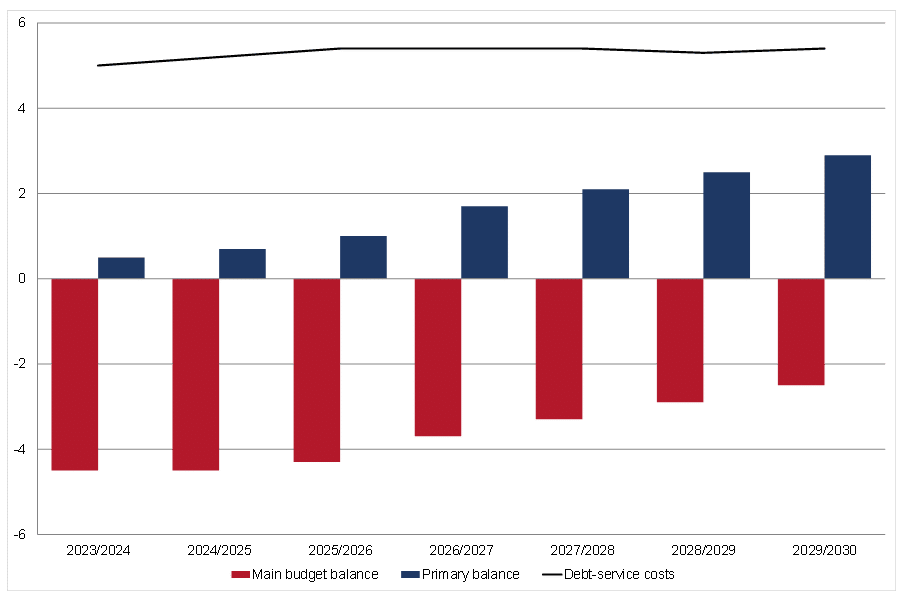
The MTBPS kept fiscal consolidation on track despite the oil shock. Treasury expects a R54.1bn revenue overrun in 2026/2027, although more than half of it is from one-off receipts. Only R17.1bn reflects stronger tax collections, primarily corporate income tax, dividends tax and VAT. A further R6.8bn is attributable to higher mining royalties associated with elevated commodity prices. The biggest contribution, R30.3bn, comes from largely non-recurring receipts, including National Revenue Fund receipts and surpluses surrendered by public entities. Despite these caveats, the main budget deficit is projected to narrow from 4.3% of GDP in 2025/2026 to 3.7% in 2026/2027 and to improve further to 2.5% of GDP by 2029/2030.
Figure 1: The main budget and primary balance as % of GDP
Source: Anchor Capital, Treasury
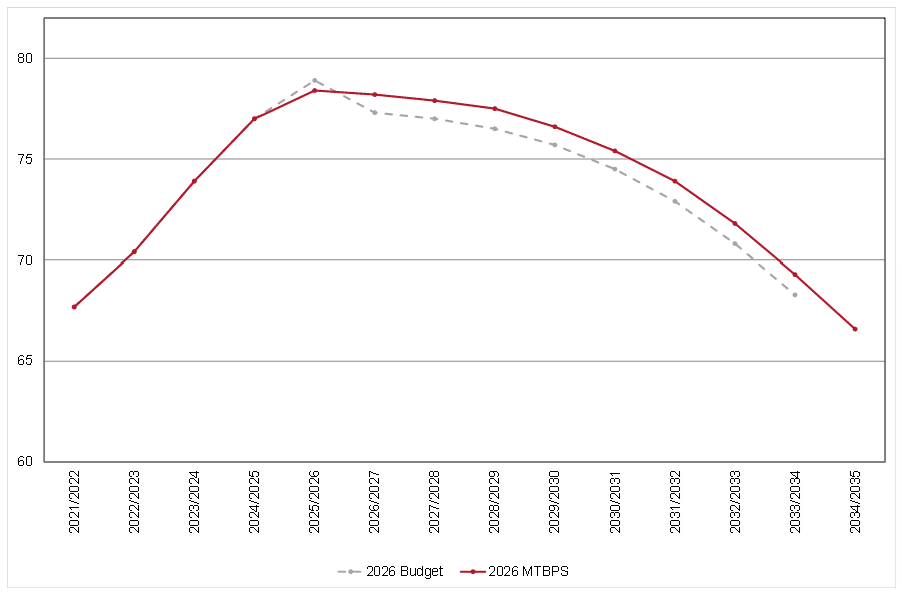
Importantly, fiscal consolidation remains on track despite the external shock. Gross loan debt is estimated to have peaked at 78.4% of GDP in 2025/2026, slightly earlier and below the 78.9% projected in the February Budget. Debt is now expected to decline more gradually, reaching 76.6% of GDP by 2029/2030, compared with the previous projection of 75.7%. Nevertheless, the overall trajectory remains downward, while the primary surplus is forecast to strengthen from 1.7% of GDP this year to 2.9% by 2029/2030. Debt-service costs remain a significant constraint, however, absorbing more than one-fifth of government revenue.
Figure 2: Gross loan debt: 2026 Budget vs 2026 MTBPS, % of GDP
Source: Anchor Capital, Treasury
To cushion households and businesses against higher fuel costs, the government announced temporary fuel levy relief. From 4 November to 1 December 2026, the levy will be reduced by R3.00 per litre for diesel and R1.50 per litre for petrol before being partially unwound through early January. The estimated R10bn cost will be funded through the reversal of an earlier transfer to the Central Energy Fund (CEF). While the measure should moderate the near-term inflation peak, it is unlikely to alter the broader inflation trajectory. As the measures are withdrawn in early 2027, fuel inflation is likely to accelerate again as the effects of higher global oil prices continue to filter through the economy.
The Social Relief of Distress (SRD) grant has once again been extended for another year rather than incorporated into the expenditure baseline, meaning its roughly R35bn annual cost continues to flatter the outer-year fiscal projections. At the same time, Treasury has increased the contingency reserve to R10bn in anticipation of weather-related risks associated with El Niño, which could raise agricultural production costs and weigh on output from late 2026 into 2027.
The MTBPS includes the planned introduction of fiscal anchor legislation in 2027. Rather than imposing a rigid numerical debt ceiling, the proposed framework will require each administration to define its own fiscal objectives, report regularly on progress and explain any material deviations from its targets. Enhanced oversight by the Financial and Fiscal Commission should strengthen transparency and accountability, helping to entrench fiscal discipline and improve the credibility of fiscal policy over time.
CPI: Fuel pushes inflation higher, but core pressures ease
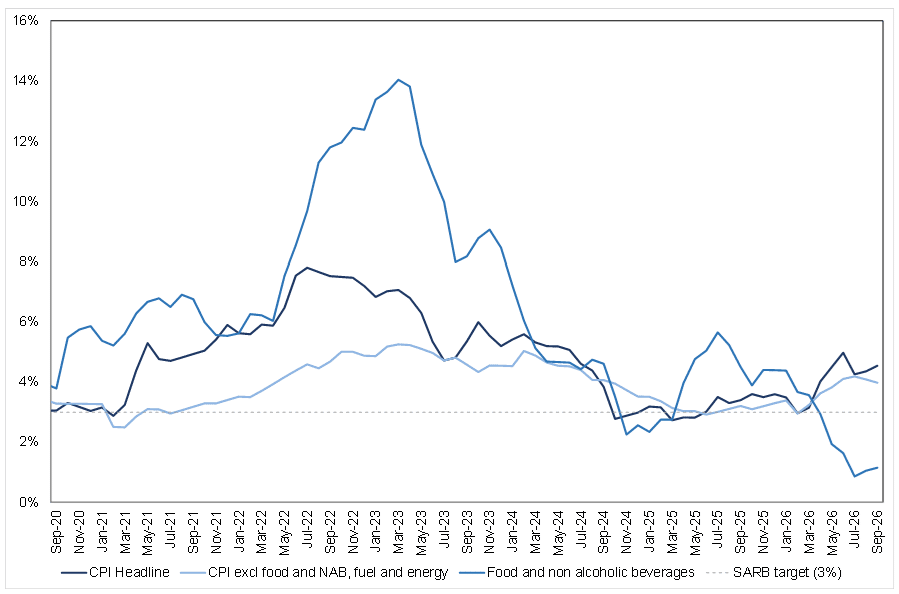
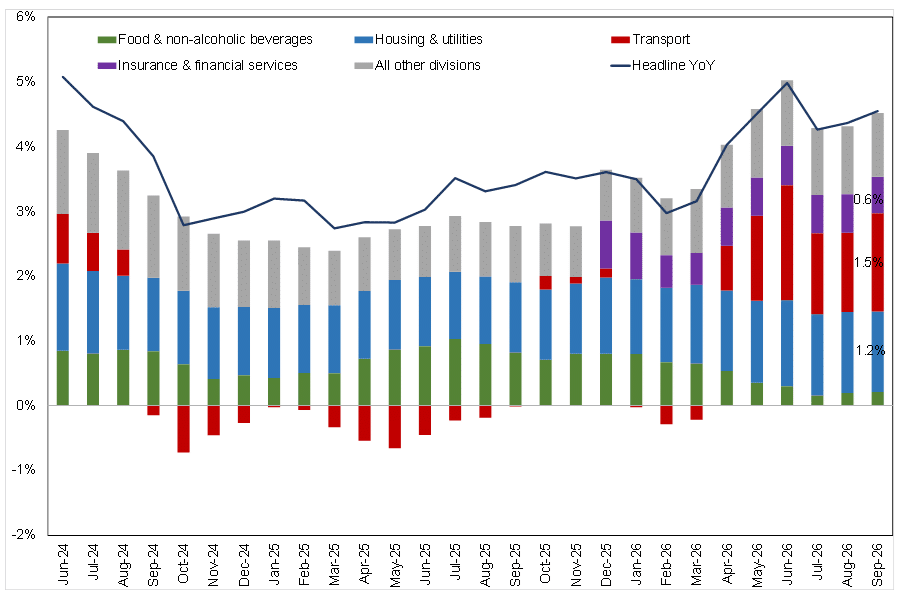
South Africa’s (SA) headline consumer price inflation rose to 4.5% YoY in September from 4.4% in August, undershooting the market consensus forecast of 4.7%. Headline inflation increased by 0.4% MoM.
Figure 3: SA inflation, YoY % change
Source: Anchor Capital, Stats SA
Figure 4: Contributions to headline CPI inflation, ppts/YoY, %
Source: Anchor Capital, Stats SA
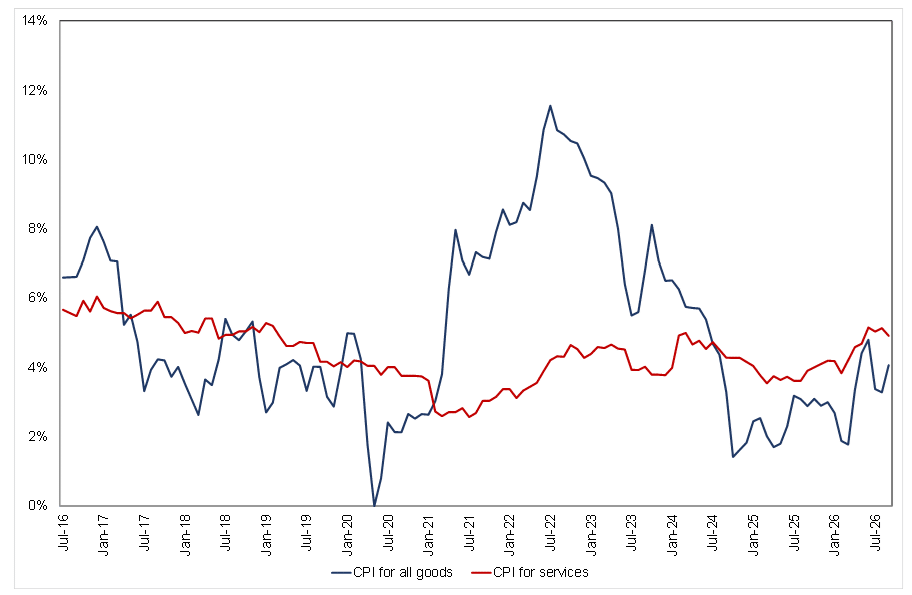
Fuel remained the dominant driver of inflationary pressure. Transport inflation accelerated to 10.8% YoY, contributing 1.5 ppts to the headline rate following September fuel price increases of R1.34/litre for petrol and approximately R3/litre for diesel. As a result, goods inflation accelerated to 4.1% from 3.3%.
Figure 5: Goods vs services inflation, YoY % change
Source: Anchor Capital, Stats SA
By contrast, underlying inflationary pressures continued to moderate. Core inflation eased to 4.0% YoY in September from 4.1%, while services inflation slowed to 4.9% from 5.1%.
Food inflation picked up to 1.0% in September from 0.7% in August but remains subdued. Higher global palm oil prices, caused by dry weather in Southeast Asia, pushed up oils and fats, and a global supply disruption lifted fish and seafood. The rise in vegetables, milk, dairy and eggs largely reflected base effects, as these categories were in deflation a year earlier. The heavily weighted categories continue to contain overall inflation. Cereals and fruit and nuts remain in deflation, while meat inflation is softening amid good domestic supply. Concerns about foot-and-mouth disease have also eased as cattle vaccination gets underway.
Global oil market risks have intensified, with disruptions to shipping routes through the Middle East, ongoing Houthi attacks affecting Red Sea trade, and Ukrainian strikes on Russian energy infrastructure all contributing to higher prices. Brent crude has risen toward US$110/bbl, adding to the risk of further fuel-driven inflation.
September is therefore unlikely to mark the peak in headline inflation. October’s R3.33/litre petrol increase will be reflected in the October inflation print. The fuel levy relief should broadly offset the petrol increase indicated for November and result in a net reduction in fuel prices. It lowers the near-term peak, but it is unlikely to alter the broader inflation trajectory.
For the South African Reserve Bank (SARB), the softer core and services inflation strengthen the case for keeping the repo rate unchanged at 7.25% at its 19 November meeting. However, the Bank is likely to remain cautious about the potential second-round effects from higher fuel costs.
Retail momentum steady as fuel relief cushions the festive season
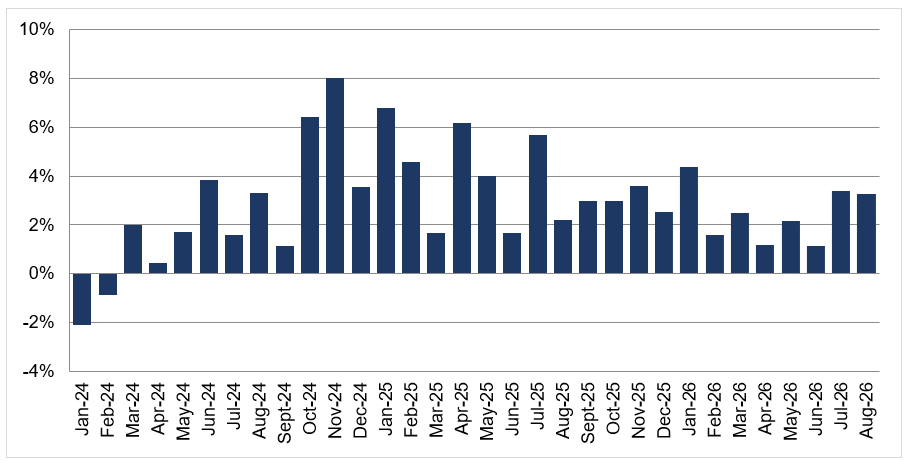
Figure 6: Real retail sales, YoY % change
Source: Anchor Capital, Stats SA
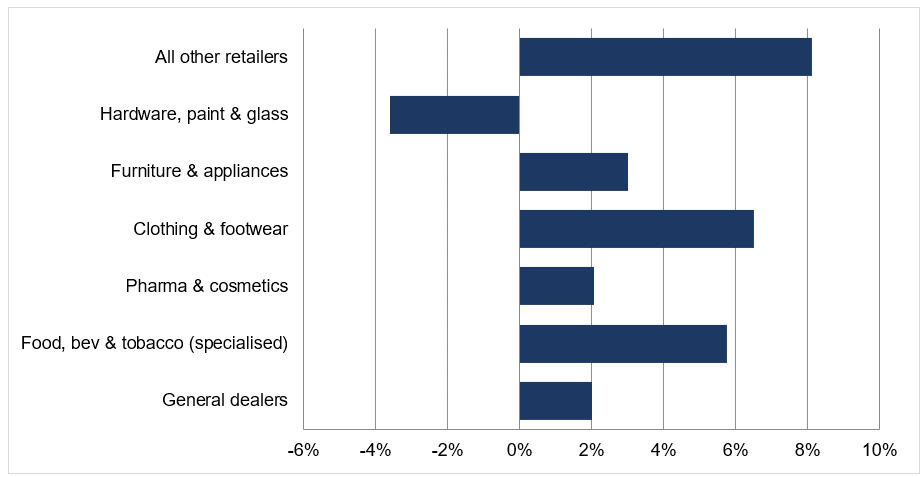
Figure 7: Real retail sales YoY % change by retailer, latest month
Source: Anchor Capital, Stats SA
August retail sales grew 3.3% YoY in real terms, broadly matching July’s 3.4%. On a seasonally adjusted basis, sales slipped 0.3% MoM, a modest pullback after July’s 2.4% jump. The underlying trend remains encouraging: sales rose 1.1% in the three months to August compared with the previous three months, pointing to a positive contribution from household spending to third-quarter GDP.
Growth was broad-based across everyday and discretionary categories. Clothing and footwear rose 6.5% and contributed a full percentage point to overall growth. Other retailers recorded growth of 8.1%, general dealers 2.0% and specialised food stores 5.8%. Low food inflation continues to stretch household budgets further.
The weaker areas are in the more credit-sensitive, big-ticket categories. Hardware sales fell 3.6%, while growth in furniture and appliances slowed to 3.0% from 6.3% in July. This weakness is likely to persist as the SARB’s two rate hikes this year, which have taken prime to 10.75%, feed through to household debt-servicing costs.
The fourth-quarter outlook is mixed. October’s petrol increase and higher borrowing costs will weigh on disposable income. However, the fuel levy relief should contain pump prices and lower transport costs heading into the festive season. The SRD grant extension should also support spending among lower-income households.
The risks become more pronounced in 2027. As fuel levy relief unwinds and El Niño places upward pressure on food production costs, real income growth is likely to come under pressure. This is consistent with Treasury’s forecast that household consumption growth will slow to 1.7% in 2027 from 2.3% this year.
Outlook
The near-term picture is one of resilience, but the risks are building into 2027. Headline inflation is likely to continue to accelerate in October, before fuel levy relief from 4 November helps moderate price pressures over the festive period. As the relief tapers in the new year, however, fuel inflation is likely to re-accelerate, shifting the effective peak into early 2027 rather than eliminating it. Food inflation, although still low at 1.0%, is likely to trend higher over the next 12 to 18 months as El Niño, higher fertiliser and diesel costs, and global edible oil prices feed through to consumers. The combination of higher food price pressures and the withdrawal of fuel levy relief presents an upside risk to Treasury’s 3.8% inflation forecast for 2027. For monetary policy, easing core and services inflation supports the case for the SARB to hold the repo rate at 7.25% on 19 November. We nevertheless expect a hawkish tone, given elevated oil prices and rand vulnerability. Inflation remains above the SARB’s 3% target, leaving little room for complacency.
For bond markets, the MTBPS provides a supportive fiscal backdrop: the deficit is narrowing, debt has peaked, and the primary surplus is strengthening. However, the composition of the revenue overrun, the SRD grant’s exclusion from the expenditure baseline and the rising gross borrowing requirements (that rise to R586.2bn in 2029/2030 on heavy redemptions) remain points to watch. In the near term, global factors are likely to remain the dominant drivers of bond-market performance. These include the US Federal Reserve’s (Fed) 28 October decision, elevated US Treasury yields, US dollar strength and the trajectory of the US–Iran conflict. The US midterm elections on 3 November could also provide a potential window for de-escalation.
On growth, household spending should hold up through the final quarter. Into 2027, slower consumption, the withdrawal of fuel relief and weather-related pressure on agriculture point to downside risks to Treasury’s 1.6% growth forecast.
Overall, the MTBPS reinforces the credibility of SA’s fiscal consolidation path at a time of heightened external uncertainty. The challenge will be to preserve this progress while managing the inflationary and growth consequences of the oil shock. For investors, the improving fiscal trajectory is encouraging, but the sustainability of revenue gains, elevated borrowing requirements and the uncertain global environment remain important considerations.