
May was an exceptional month for global equity markets (MSCI World +4.6% MoM/+10.7% YTD), which extended April’s gains, defying historical seasonal trends (May is a relatively modest month for US markets, hence the adage “sell in May and go away”). Equity markets were driven by three dominant themes: the artificial intelligence (AI) capex supercycle, robust 1Q26 US earnings, and growing optimism around a possible US-Iran deal that will ease the oil price shock.
US macroeconomic data released in May showed that April headline inflation rose 3.8% YoY vs March’s 3.3% print, the highest since May 2023. Core inflation, which strips out food and energy, increased by 2.8% YoY from 2.6% previously, well above the US Federal Reserve’s (Fed) 2% goal. April core personal consumption expenditure (PCE), excluding food and energy, the Fed’s preferred inflation gauge, climbed 3.3% YoY, vs March’s 3.2% – the highest reading since November 2023.
US equities soared to record highs, driven by impressive earnings (c. 83% of S&P 500 companies beat estimates), AI capex spending, and reports on 29 May that the US and Iran had reached a memorandum of understanding to extend the ceasefire. The tech-heavy Nasdaq led the gainers (+8.4% MoM/+16.1% YTD), notching new highs with NVIDIA being the primary catalyst as it posted 1Q27 results which showed hyperscaler capex collectively running at c. US$725bn for 2026 (+77% YoY). The S&P 500 rose 5.1% MoM (+10.7% YTD), while the Dow ended 2.8% higher MoM (+6.2% YTD).
European equity markets advanced but lagged the US and Japan, with the Euro Stoxx 50 up 2.9% MoM (+4.5% YTD), remaining below pre-Iran War levels. With fewer AI and tech-focused companies vs the US and Asia, the region is less able to benefit from the AI rally that helped drive outperformance elsewhere. France’s CAC rose 0.8% MoM (+0.4% YTD), and Germany’s DAX jumped 3.3% MoM (+2.5% YTD). April eurozone inflation rose to 3.0% vs March’s 2.6%, driven largely by higher energy costs. As a major net energy importer, Europe is especially vulnerable to energy shocks.
May was a volatile month for UK equity markets, with the FTSE 100 barely changed vs end-April’s level (+0.3% MoM/+4.8% YTD). April inflation surprised to the downside, printing at 2.8% YoY vs March’s 3.3%. The Office for National Statistics said energy costs had fallen due to a combination of lower wholesale prices and the government’s energy bill support measures introduced before the start of the Iran conflict. Unfortunately, this improvement in inflation is likely to be short-lived.
In China, equity markets, which had a broadly positive May, saw gains fade into the month-end as investors took profit in tech and semiconductor shares. The Shanghai Composite was down 1.1% MoM (+2.5% YTD) and the Hang Seng declined 2.3% MoM (-1.7% YTD). May’s official manufacturing PMI printed at 50 vs April’s 50.3, matching the 50-point mark that separates expansion from contraction. Non-manufacturing PMI, including services and construction, came in at 50.1 vs 49.4 in April.
Japan’s benchmark Nikkei soared 11.9% (+31.8% YTD), the strongest performance among major global equity indices and surpassing the 66,000 level for the first time in its history. The equity market was powered by the AI-investment cycle and an ongoing structural rerating of Japanese equities. Headline inflation printed at 1.4% in April vs March’s 1.5%, remaining below the Bank of Japan’s 2% target for a fourth consecutive month.
Brent crude (-19.3% MoM/+51.3% YTD) had another volatile month, as oil prices swung wildly in May, before ending the month lower at US$92.05/bbl. Outside of oil, commodity performance was mixed. Gold (-1.7% MoM/+5.1% YTD) was notably weak, continuing a correction from all-time highs set earlier this year. Platinum group metals (PGMs) remained under pressure, mirroring the broader precious metals correction. Platinum declined 3.4% MoM (-6.8%YTD), despite tight supply from SA and Russia and strong demand from China, with palladium down 11.2% MoM (-16.0% YTD) and rhodium falling by 12.0% MoM (-4.1% YTD).
The JSE consolidated in May, with the FTSE JSE All Share Index (-0.3% MoM/-1.0% YTD) ending the month basically flat. Mining shares remained under pressure as precious metals prices pulled back, weighing on large index constituents such as Gold Fields (-9.9%), Sibanye Stillwater (-1.8%), Northam (-1.4%), and Impala Platinum (-0.2%), which closed May lower. These losses offset firmer financial and property counters, leaving the market largely rangebound. Unlike many global peers, the South African (SA) equity market lacks significant exposure to large tech companies and thus benefited less from the global AI-driven rally. Resources were again the weakest segment (Resi-10 -1.7% MoM/+1.0% YTD), while the SA Listed Property Index advanced by 0.2% MoM (-1.0% YTD) and financials firmed (Fini-15 +0.8% MoM/+2.6% YTD). Industrials ended May lower (Indi-25 -0.9% MoM/-7.8% YTD). The rand strengthened 2.7% MoM (+2.1% YTD) against the US dollar.
SA headline inflation accelerated to 4.0% YoY in April from 3.1% in March. Over the same period, core inflation rose to 3.6% YoY from 3.2% previously. The higher inflation print reflects the initial pass-through of elevated global oil prices into domestic inflation. At its meeting on 28 May, the South African Reserve Bank (SARB) raised the repo rate by 25 bpts to 7%, citing heightened inflation risks and the increasing likelihood of second-round effects.
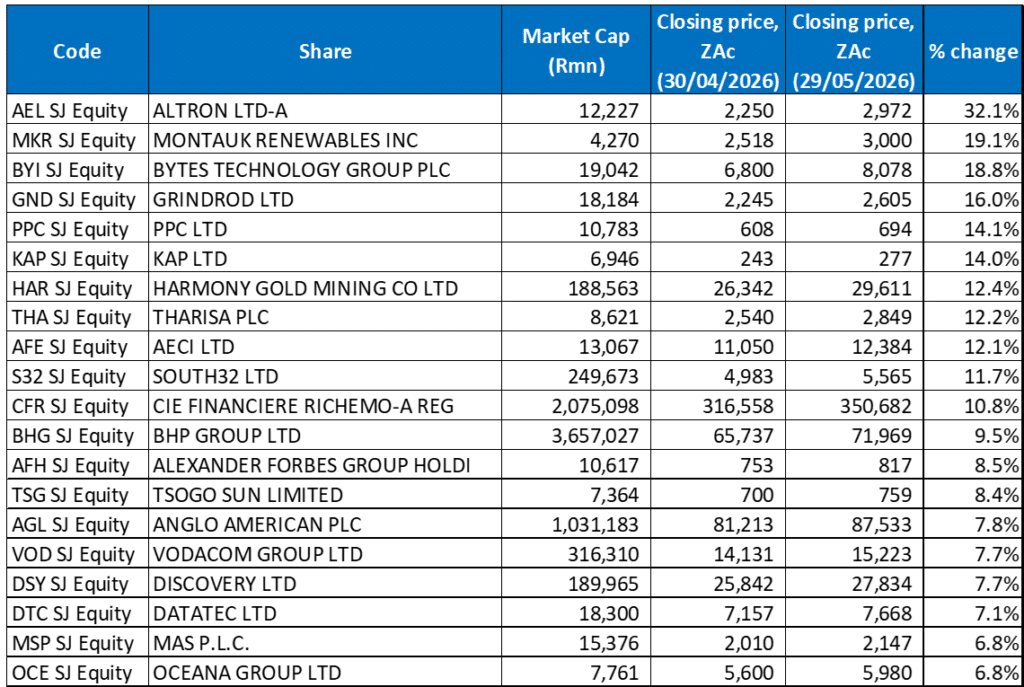
Figure 1: The 20 best-performing shares in May 2026, MoM % change
Source: Bloomberg, Anchor Capital
May’s winning shares included companies from sectors such as technology, industrials and select financials, while hospitality and gaming counters showed some resilience, and Harmony Gold bucked the precious metals sell-off trend.
Altron, one of the JSE’s most credible domestic tech plays, which operates across managed services, digital transformation, its own platforms (including vehicle recovery business Netstar) and its fintech and healthtech businesses, was May’s best performer with a 32.1% gain. The share price leapt more than 15% on 25 May after Altron reported a hike in its FY26 dividend and a special R500mn dividend payout. Group revenue advanced only 1% YoY to R9.6bn, but headline earnings per share (HEPS) jumped 34% YoY, driven by technology services demand. Altron has undergone a three-year strategic overhaul that its CEO set out in 2023, and which has shifted the company decisively towards its platform business.
Montauk Renewables, the US Nasdaq-listed biogas company with a secondary listing on the JSE, had another strong month with its share price up 19.1% in May. Montauk, which had been a JSE laggard for a long time, was the month’s second-best-performing share. Its continued gains were likely driven by a combination of factors, including higher oil prices (which meaningfully improve the economics of renewable natural gas as an alternative fuel source), while the bigger geopolitical backdrop around energy security has led investors to look for clean energy plays on the JSE.
In third place, Bytes Technology, listed locally and on the London Stock Exchange, rose 18.8% MoM. The company’s shares have soared due to its return to strong second-half profitability, continued demand for AI and cloud services, and the launch of a new GBP25mn share buyback programme. In May, Bytes reported FY26 revenue growth of 1.6% YoY to GBP220.5mn, while HEPS declined 6.1% YoY to GBp21.4. However, it recorded strong second-half (2H26) momentum during which it overcame the drag caused by Microsoft’s shift to consumption-based incentives, posting an 11.5% YoY jump in 2H revenue and better-than-expected gross invoiced income.
Logistics and port terminals operator Grindrod’s (+16.0% MoM) share price gains were likely built on the continued positive momentum from its March results, port throughput recovery (despite commodities volumes being under pressure) and rand-hedge earnings from its shipping operation. The company has experienced record throughput at the Port of Maputo, and the ongoing rollout of rail reform in SA, which is opening third-party access to the country’s national rail network and expanding Grindrod’s operational footprint and growth pipeline, is likely also benefitting sentiment.
Grindrod was followed by PPC Ltd, KAP Ltd and Harmony Gold with MoM gains of 14.1%, 14.0%, and 12.4%. PPC shares rose after the Group said in a trading statement that its FY26 HEPS would increase by between 20% and 33% YoY. In addition, media reports in May indicated that German multinational Heidelberg Materials was in talks to appoint financial advisers in preparation for a bid for PPC. Harmony Gold, rather counterintuitively (given the gold price’s decline in May), found itself among the ten best performing shares, after the gold miner said it was on track to meet full-year production, grade and cost guidance following a 5% uptick in its 3Q output. In its operational update, Harmony reported revenue of R68.4mn for 9M26 – up more than one-third from the previous comparable period.
Tharisa plc, an integrated resource Group that mines, processes, and beneficiates PGMs and chrome concentrates, rose by 12.2% MoM. Its share price surged after Tharisa flagged a bumper 1H26 financial report showing a nearly fivefold increase in profit. HEPS for the six months to March 2026 were expected to come in between USc16.1 and USc16.6 (c. R2.65 to R2.74), representing a YoY increase of between 455% and 472%. Revenue was expected to rise by 28% YoY to US$359.4mn.
Rounding out May’s ten best-performing shares were AECI Ltd and South32 with price gains of 12.1% and 11.7%. AECI has benefitted from a combination of its February results and its fundamental business positioning, with rising mining sector activity driving demand for its speciality chemicals and explosives. In addition, fertiliser prices, particularly urea, have surged over 80% between March and April, which is especially beneficial for AECI’s chemicals segment, supplying agricultural products.
Unlike gold and PGM miners, which sold off in May, South32 benefitted from its diversified commodity exposure; its portfolio of aluminium, copper, manganese, zinc and silver held up well. It has also been helped by the successful post-cyclone recovery of its Australian manganese operations and robust recent operational earnings that exceeded analyst expectations.
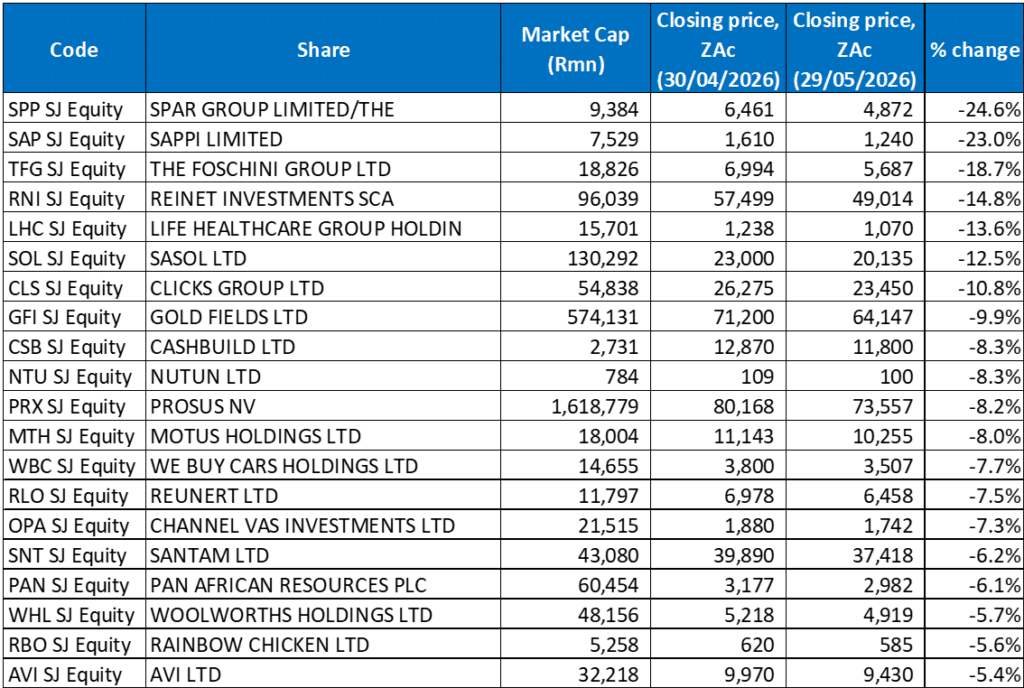
Figure 2: The 20 worst-performing shares in May 2026, MoM % change
Source: Bloomberg, Anchor Capital
Precious metals were the weakest sector by some distance, reflecting a further pullback in gold and PGM prices through May. Beyond precious metals, energy-sensitive businesses, and discretionary consumer names bore the brunt of May’s headwinds (the oil shock, rising inflation, and the SARB rate hike).
The SPAR Group (-24.6% MoM), which has been under pressure due to operational challenges following its troubled SAP system implementation, continued weakness in its European business, and consumer pressure across multiple geographies, which has compounded an already difficult turnaround story, was last month’s worst-performing share. Last week, the share price plunged further after it released a 1H26 profit warning wherein the retailer flagged that HEPS would decline by up to 60% YoY, driven by deep margin compression, rising operational costs, legacy issues, and executive changes.
SPAR was followed by Sappi Ltd with a 23.0% MoM share price decline, reflecting a company under severe structural pressure. The global paper and pulp business’s earnings are highly sensitive to global industrial demand and the rand exchange rate. Weak commodity pricing and margin pressure from elevated energy inputs (directly linked to the oil shock) have also weighed on the price. On 7 May, Sappi’s share price slumped over 11% after it posted a US$413mn (c. R6.7bn) 2Q26 loss compared with a US$20mn profit the year before, with expectations that 3Q26 may be worse.
In third place, clothing retailer The Foschini Group (TFG) was down 18.7% MoM. TFG released a trading statement in May, warning shareholders that it would report a worse-than-expected 30% to 40% YoY drop in HEPS due to weak domestic trading, a R750mn brand values impairment and higher interest. The clothing and accessories retailer, which operates in SA, the UK, and Australia, said it expects FY26 HEPS to be between ZAc609,4 and ZAc710,9, compared with ZAc1,015,6 in FY25.
Reinet Investments, Life Healthcare and Sasol followed TFG with MoM declines of 14.8%, 13.6%, and 12.5%, respectively. Reinet’s share price fell after it reported a 4.5% YoY decline in its FY26 net asset value (NAV) to EUR6.6bn. This decrease in the overall portfolio value was driven primarily by a weakening of the British pound and US dollar against the euro. Life Healthcare initially declined after it released a disappointing trading update in early May. The hospital group then posted its results last week, which showed that revenue grew by a modest 2.4% YoY to R12.4bn, while normalised EPS increased by 8.4% YoY. However, the outlook was disappointing, with the 12 months to September 2026 expected to see growth of only c. 2% YoY, weaker vs its competitors. Sasol’s share price faced downward pressure due to a combination of weaker oil prices, depressed international chemical prices, and a stronger rand.
Clicks Group’s (-10.8% MoM) share price decline has primarily been driven by a disappointing FY26 profit outlook, ongoing supply chain disruptions, and rising market competition. The company said in April that it expected slower FY26 earnings growth of between 4% and 9% YoY, which fell short of market expectations. More fundamentally, a constrained local consumer environment with reduced household spending has led to softer retail sales growth compared to previous years. Higher fuel prices, driven by the oil shock, will translate directly into increased pressure on household budgets (and thus discretionary spending), which eventually flows through to Clicks’ retail pharmacy, health and beauty volumes.
Gold Fields (-9.9% MoM), Cashbuild and Nutun (both down 8.3% MoM) rounded out May’s ten worst-performing shares. Gold Fields’ recent share price struggles stem from a combination of the precious metals selloff (gold price -1.7% MoM), operational challenges, geopolitical pressures, and sector-wide market volatility. Cashbuild’s share price has faced significant turbulence and is down primarily due to the strain on consumer spending from rising food and fuel costs.
Finally, Nutun’s share price fell due to a combination of heavy legacy debt, declining earnings, and challenging market conditions. In May, Nutun released 1H26 results, which showed that sales were R711mn compared to R745mn a year ago, while it recorded a net loss of R63mn compared to the R122mn loss in 1H25. Nutun has suffered a multi-year decline in EPS, driven by restructuring costs, macroeconomic headwinds and the fallout from the SA Taxi business during its time as a subsidiary of Transaction Capital.
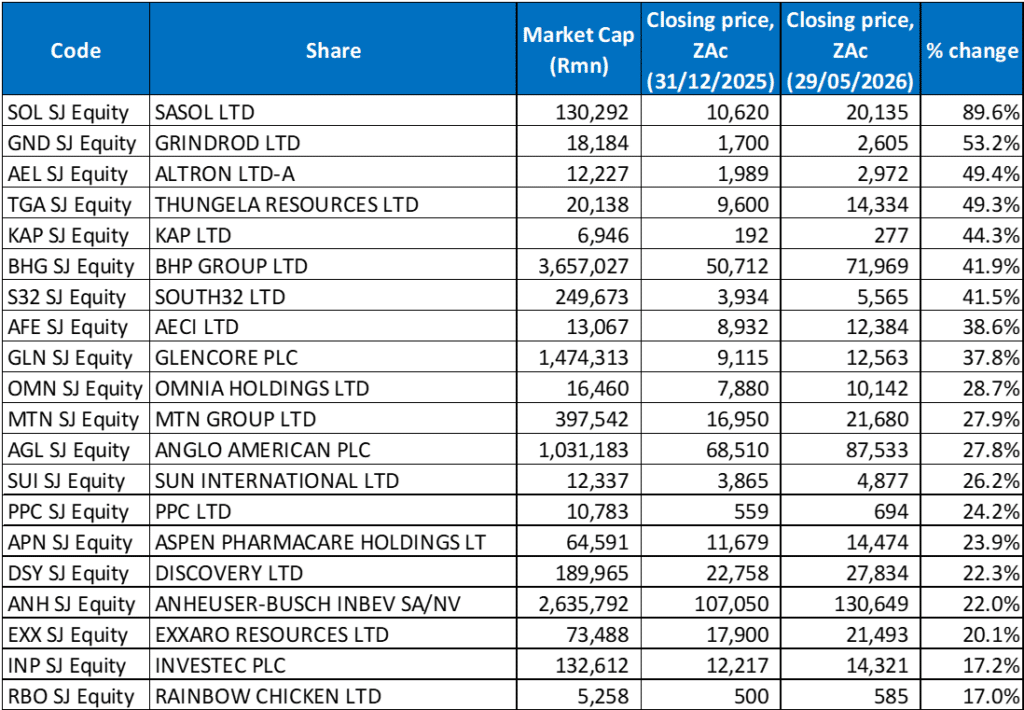
Figure 3: The 20 best-performing shares YTD, % change
Source: Bloomberg, Anchor Capital
Seventeen of the 20 best-performing shares YTD were unchanged from the year to end-April’s best performers, as gold and PGM counters were pushed out again following another turbulent month for precious metals. The common thread across these shares was direct or indirect leverage to the energy shock that has defined global markets this year, and companies that sell what people cannot stop buying, regardless of geopolitics.
Despite a share price decline in May, Sasol (+89.6%) remained the best-performing share YTD. Sasol, leading the YTD table, summarises the oil price trajectory in 2026 as the closure of the State of Hormuz and ensuing oil shock drove Sasol’s earnings expectations sharply higher. It is one of the few SA counters that structurally benefits from the very shock that is pressuring the broader economy – higher oil prices flow almost directly into its synthetic fuels margins, making it the purest JSE-listed energy play. In addition, as part of its integrated chemicals and energy business, Sasol sells various chemical and petrochemical feedstocks (coal-based and domestically sourced – protecting it from supply shocks that are impacting pure-play importers).
Following its impressive monthly gains in May, Grindrod moved up a few notches from April to take second place as its YTD gain jumped to 53.2%, reflecting SA’s improving logistics infrastructure story. Altron, May’s best-performing share, came third among the strongest performers YTD (+49.4%), supported by continued execution of its technology-focused growth strategy.
Altron was followed by Thungela Resources (+49.3% YTD), KAP Ltd (+44.3% YTD), and BHP Group (+41.9% YTD). Thungela’s YTD share price gain is due to a combination of sustained demand for thermal coal in developing Asian markets and broader market shifts toward traditional energy producers during periods of geopolitical uncertainty. The ongoing energy supply disruption environment has prompted Asian nations to substitute coal for oil and LNG, initially sending thermal coal prices to 18-month highs of c. US$146/tonne in March. While prices have since retreated, they seemed to find a floor in May at c. US$130/tonne on Chinese supply concerns. BHP, South32 (+41.5% YTD) and Glencore (+37.8% YTD) are also benefitting from their diversified commodity exposure across coal, copper, and energy transition metals, all of which have seen demand and pricing support since the start of the Iran war.
AECI (discussed earlier) rose 38.6% YTD, while Omnia (+28.7% YTD) rallied to multi-year highs, ending May above the R101/share mark. In its recent FY26 trading update, Omnia projected its full-year HEPS would jump by between 17% and 23% YoY. Omnia is one of SA’s largest producers and suppliers of fertiliser. While it is heavily exposed to sulphur and ammonia prices coming from the Middle East, the surging demand for critical minerals and commodities, coupled with higher global prices for agricultural chemicals, has boosted its outlook.
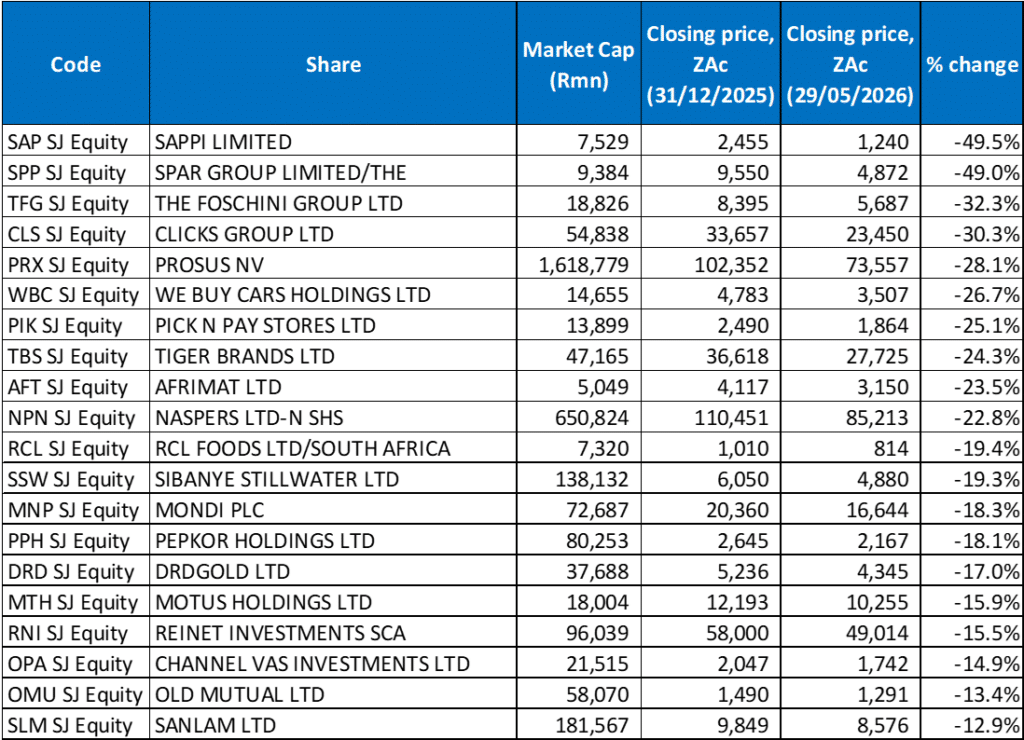
Figure 4: The 20 worst-performing shares YTD, % change
Source: Bloomberg, Anchor Capital
The JSE has been an extremely bifurcated market since the Iran conflict began. While energy stocks and select technology names continue to celebrate, other cohorts of JSE-listed shares are down significantly, with most of the YTD worst performers sharing a common vulnerability – SA consumer-facing businesses at a time of acute and sustained cost pressures (inflation, rate hikes and ensuing higher food and fuel costs). In addition, gold miners and industrials have been negatively impacted by their own sector-specific headwinds.
Sappi (discussed earlier) was again the worst-performing share YTD – down 49.5%. Spar (-49.0%), TFG (-32.3%), Clicks (-30.3%), WeBuyCars (-26.7%), and Pick n Pay’s (-25.1%) YTD share price declines reflect the tough operating environment facing local retailers, including, in the case of WeBuyCars, the impact of a weakening appetite for used vehicles as consumers prioritise essential spending. Higher oil prices feed directly into increased logistics costs, squeezing margins already under pressure from aggressive competitor pricing and a SA consumer whose disposable income has been eroded by the high cost of living.
Tiger Brands (-24.3%) faces the same inflationary headwinds as the retailers with higher input costs from oil-linked petrochemicals and food commodities that cannot be fully passed on to price-sensitive consumers, while Afrimat (-23.5%) has been negatively impacted by iron ore price volatility and risk-off sentiment towards smaller mining names.
Investment conglomerates Prosus (-28.1%) and Naspers’ (-22.8%) share prices have been soft YTD on the back of their largest investment, Chinese tech giant Tencent’s (-9% MoM/-29.0% YTD) uneven trajectory including AI disruption fears (concerns that AI will “cut out the middle man” when it comes to platform businesses like Tencent), the ongoing NAV discount problem and their 2025 share price rallies (both were up over 30% in 2025).