
Figure 1: Rand vs the US dollar
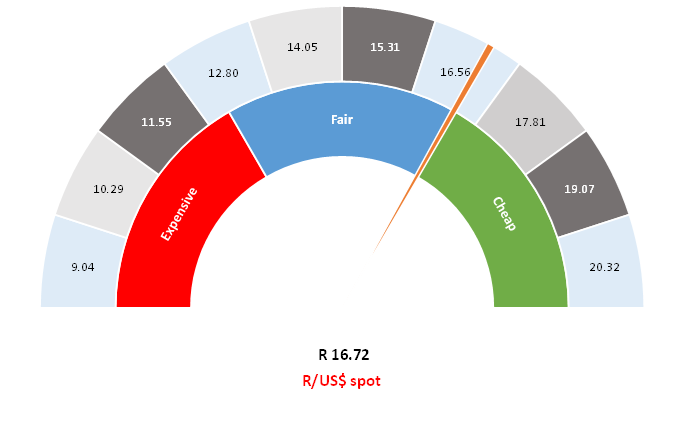
Source: Anchor Capital
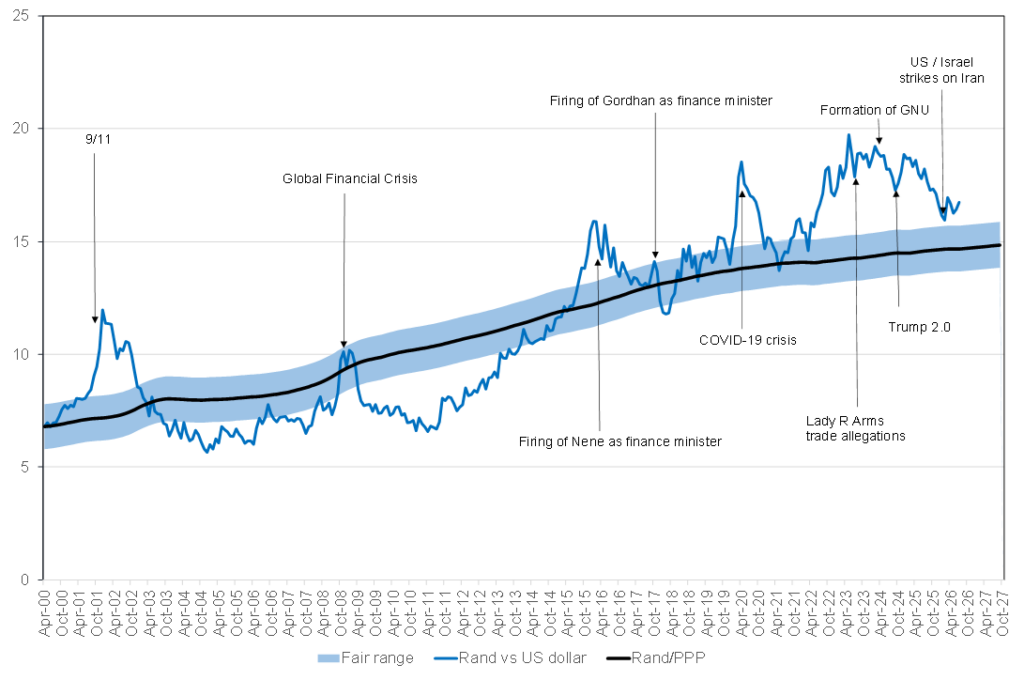
The South African Reserve Bank’s (SARB) Monetary Policy Committee (MPC) surprised both us and the broader market by leaving the repo rate unchanged at 7.00% at its meeting on 23 July. Four MPC members voted to keep rates unchanged, while two members preferred a 25-bpt hike. Importantly, the SARB’s messaging was also more dovish than many had expected.
The SARB’s decision prevented the expected widening of South Africa’s (SA) interest rate differential relative to the rest of the world and prompted an immediate market reaction. The rand weakened by around 3%, from R16.40/US$1 on 22 July to R16.82/US$1 following the announcement, briefly touching a three-month low of R16.98/US$1 before recovering modestly to around R16.76/US$1 by 28 July.
In our view, two factors explain the recent weakness in the currency. First, the SARB’s decision not to raise rates made some depreciation inevitable, although the initial move appears to have overshot slightly, and it has come back a bit since the MPC rate decision. Second, heightened geopolitical tensions in the Middle East pushed oil prices above US$100/bbl at the time of the MPC meeting, weighing on broader risk sentiment and emerging market (EM) currencies. As geopolitical tensions subsequently eased and oil prices retraced to the US$81–US$90/bbl range, sentiment towards risk assets improved, providing support to the rand.
Recent market behaviour highlights the sensitivity of global financial markets to geopolitical developments. Episodes of escalating tensions followed by periods of de-escalation have repeatedly resulted in sharp moves in energy markets, underscoring the importance of oil as a driver of investor sentiment. This pattern has unfolded multiple times during US President Donald Trump’s second term. The July Iran conflict pushed oil prices above US$100/bbl, President Trump paused active military strikes unexpectedly, and the price of oil plunged c. 10%. In March, fears around the closure of the Strait of Hormuz saw crude spike to near US$120/bbl. President Trump then abruptly declared the war “very complete, pretty much”, resulting in energy prices plummeting immediately.
Looking ahead, we expect the rand’s near-term trajectory to remain closely linked to geopolitical developments and the path of global monetary policy. The US Federal Reserve (Fed) concludes its latest policy meeting on 29 July, with market participants assigning a 62% probability to rates remaining unchanged at 3.50%–3.75%. A dovish outcome (rates on hold and the Fed downplaying the need for imminent rate hikes) could support a modest recovery in the rand. A more hawkish stance, or an unexpected rate increase, would likely strengthen the US dollar and place renewed pressure on the local unit.
Over the medium term, SA continues to benefit from supportive commodity prices, particularly gold and platinum, which help offset the impact of higher oil prices. Consequently, we believe the rand retains scope to recover from current levels, provided external conditions become more favourable.
While global developments have dominated market attention in recent months, domestic political risk factors should not be overlooked. Municipal elections scheduled for 4 November and the ANC elective conference in 2027 have the potential to introduce periods of localised volatility. Nevertheless, for now, our base case remains that both events will produce outcomes broadly acceptable to financial markets.
Although near-term volatility is likely to persist, we remain constructive on the rand’s medium-term prospects and believe recent weakness reflects a combination of external shocks and policy surprises rather than a deterioration in SA’s underlying fundamentals.
Figure 2: Actual rand/US$ vs rand PPP model
Source: Thomson Reuters, Anchor Capital