

The rise in US Treasury yields has revived familiar concerns that large budget deficits, growing government debt and bond vigilantes are forcing investors to demand a higher fiscal risk premium. We think that explanation is overstated. The US fiscal position is unquestionably an important long-run constraint. Still, the fiscal position has not deteriorated enough over the past four years to explain either the timing or the scale of the latest move in yields. Treasury yields have instead moved closely with US Federal Reserve (Fed) expectations. At the same time, the selloff has also been broad across G7 (Canada, France, Germany, Italy, Japan, the UK and the US) government bonds and coincided with quantitative tightening (QT).
We see the rise in yields as primarily reflecting a higher market-implied long-run policy rate and a normalising term premium as the post-global financial crisis (GFC) era of quantitative easing (QE) unwinds. For the cyclical direction of yields, investors should focus more on the Fed than the US Treasury. Our view is that the Fed will ultimately not deliver the tightening discounted by markets currently. If that happens, Treasury yields (and the US dollar) should move lower.
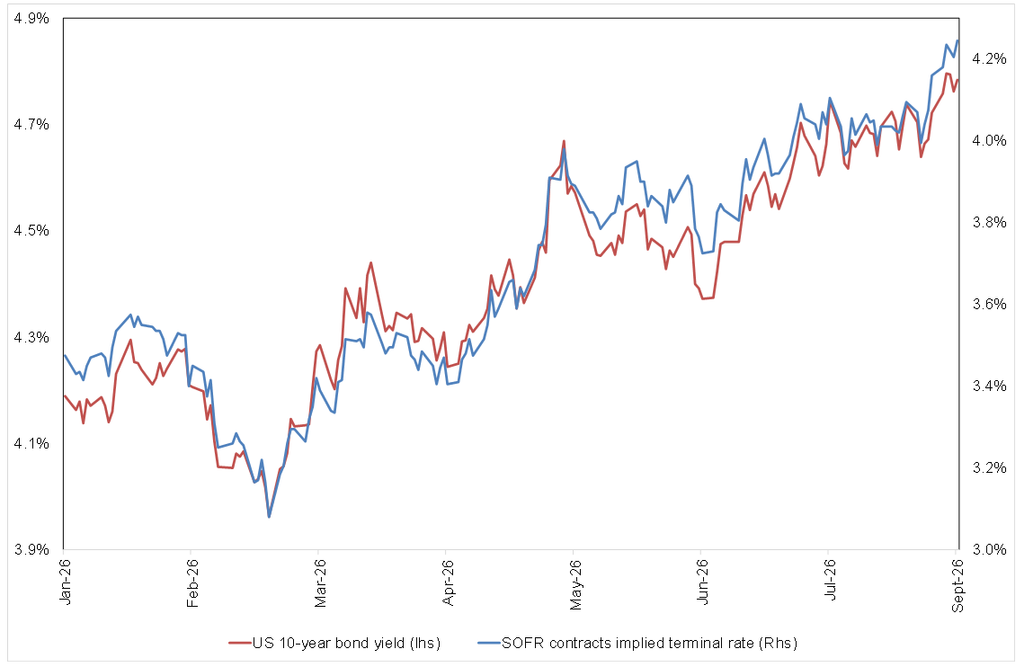
Figure 1: The repricing in US Fed expectations explains the move in bond yields
Source: Thomson Reuters, Anchor Capital
Figure 1 offers the clearest explanation for the move in US Treasury yields. During 2026, the 10-year US Treasury yield has moved closely with the market-implied long-run Secured Overnight Financing Rate (SOFR). Markets entered the year expecting two Fed interest-rate cuts. However, the inflation shock associated with the Middle East conflict prompted a sharp reversal in expectations. By the end of August, markets were pricing in close to two rate hikes. Both US nominal and real Treasury yields rose alongside this repricing. The sequencing matters. The major new development has been a more hawkish monetary-policy outlook rather than a sudden deterioration in the US fiscal position. The distinction matters. If the Fed ultimately fails to deliver the tightening discounted in the overnight index swap (OIS) curve, Treasury yields should fall as investors unwind those expectations, and the US dollar should also weaken.
US fiscal fears look overstated
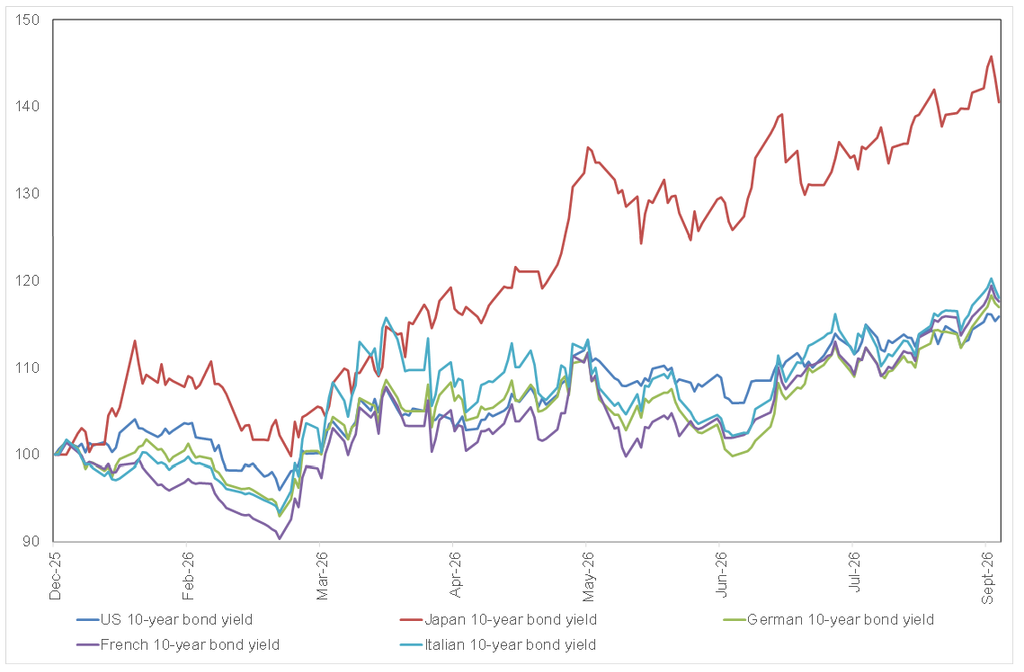
Figure 2: A global bond rout (rebased to 100 as at 31 December 2025)
Source: Thomson Reuters, Anchor Capital
Cross-market evidence also argues against a US fiscal-crisis narrative. Figure 2 shows that the bond selloff has been global. But importantly, it also shows that ten-year US Treasuries have outperformed Japanese government bonds (JGBs), French OATs, Italian BTPs and German bunds this year. If investors were becoming specifically concerned about US fiscal sustainability, we would expect US Treasury bonds to consistently underperform their developed-market (DM) peers and for the US-specific risk premium to rise materially. That is not what we have observed. In fact, US credit default swap (CDS) pricing, for example, has remained largely range-bound for years.
The US fiscal position is undoubtedly less comfortable than before the COVID-19 pandemic, but much of the deterioration is old news. US deficits and its debt burden have remained broadly elevated since 2022 rather than suddenly worsening in 2026. The headline budget deficit is large, but the primary deficit, which excludes interest payments on government debt, is closer to 2.5%-3% of GDP, and the current-account deficit remains around 3% of GDP. Despite running twin deficits, the US is the only economy large enough to absorb the massive savings glut generated by current-account surpluses in Japan, China and the eurozone. These are not signs of an economy facing funding issues from an external-balance perspective. The UK, the second-largest economy running a current-account deficit, is simply too small to absorb the global savings glut. From an internal perspective, the US retains greater fiscal capacity relative to its G7 peers, including a larger nominal growth base to arrest the debt burden and a lower tax burden it can raise to reverse fiscal deficits.
Historical data also cautions against treating the US budget deficit as a simple forecasting tool for bond yields. Since the 1990s, the correlation between the US 10-year bond yield and the fiscal deficit has been strongly positive. The wider the fiscal deficit, the lower the US bond yield. Periods of widening fiscal deficits frequently coincide with recessions, forcing the Fed to lower the policy rate, resulting in lower bond yields. Fiscal sustainability clearly matters for the long-run equilibrium level of yields, but it is a poor explanation of the timing of the current selloff.
A more plausible explanation is that the global bond market is adjusting to the end of an extraordinary period of monetary intervention. For more than a decade after the GFC, QE, under which central banks bought large quantities of government bonds, helped suppress DM bond yields. As G7 central banks moved towards QT from around 2022/2023, that support began to disappear and bond yields started to trend higher.
A higher term premium is normalisation, not evidence of crisis
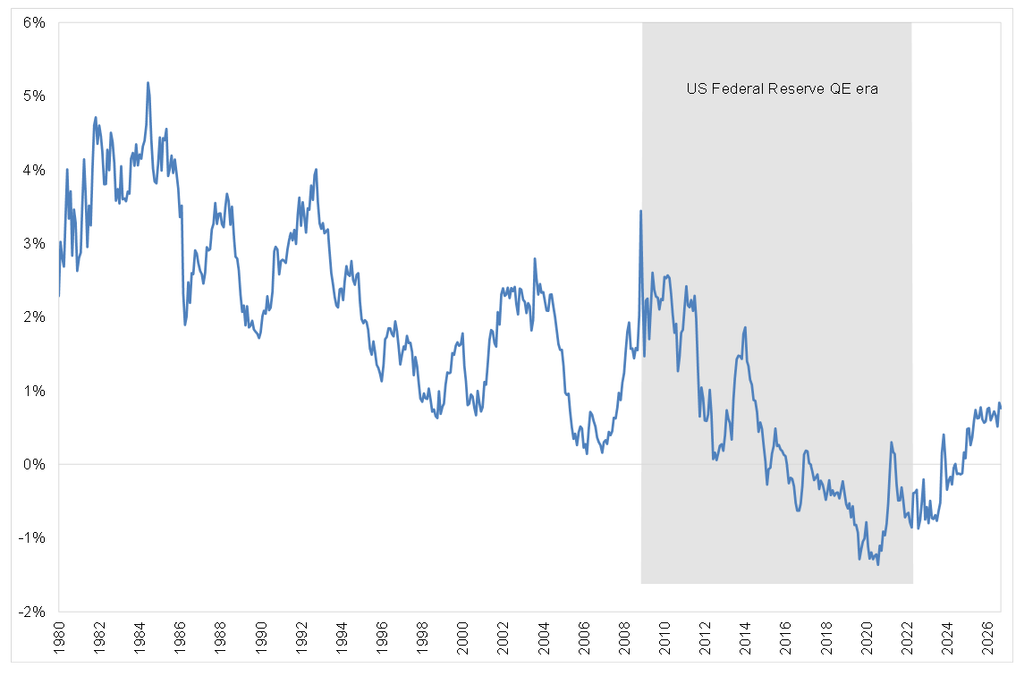
Figure 3: ACM US 10-year term premium
Source: Federal Reserve Bank of New York, Anchor Capital
The second important driver of higher Treasury yields is the term premium. The term premium is the additional return investors demand for lending money to the government for a long period rather than continually rolling over short-term investments. It compensates investors for taking on risks such as future inflation, interest-rate uncertainty and changes in the growth outlook.
Figure 3 shows how the term premium has recently risen as the Fed has conducted QT and inflation has remained elevated. This represents a reversal of QE-era conditions (for most of the 2010s). During that period, aggressive central-bank bond purchases and persistent inflation undershoots pushed term premiums to unusually low, often negative, levels. QT removes a structural buyer and returns duration risk to private sector balance sheets. A positive term premium is therefore not evidence of fiscal stress; it is consistent with a return to a more normal bond-market regime. Japan offers a similar example, where higher inflation, stronger wage growth and the Bank of Japan’s (BoJ) balance-sheet reduction have pushed the term premium higher.
The current US term premium also looks less alarming historically. A term premium of roughly 0.8% is above the level seen in the late 2010s but broadly comparable with the early 2000s and well below the levels seen during the 1980s and 1990s. Importantly, long-run inflation breakevens also remain relatively anchored. If investors were genuinely pricing an uncontrolled fiscal or inflationary tail risk, we would expect a much larger long-term inflation compensation. Instead, the market appears to be demanding a more normal level of compensation for holding duration after years of artificial compression.
The next inflation impulse should be lower
This is where our view differs most from the market.
We think markets are currently too hawkish on the Fed because the underlying inflation impulse is weakening. Shelter, the largest US consumer price index (CPI) component, should decelerate further as high mortgage rates, softer housing activity and a cooler labour market feed through with a lag. Wage growth has also moderated to 3.1% YoY, while stronger productivity has kept unit labour-cost growth relatively subdued at 1.2% YoY, reducing pressure on supercore inflation.
Productivity is also the key medium-term force. The current rapid AI-related investment should allow output to expand with less unit-cost pressure, just like the internet boom in the 1990s. Recent inflation firmness has largely reflected supply pressures rather than excess demand, with little evidence of second-round effects. Unless demand reaccelerates sharply, we believe it will be difficult for the Fed to justify a renewed rate-hiking cycle, and we continue to call for a Fed hold this year.
Conclusion
We are constructive on US Treasuries and interest rate swaps at current yields and would use the selloff as an opportunity to add duration. Fiscal policy remains an important secular risk, but we see little evidence that a fiscal crisis is driving the current move. Instead, the selloff is better explained by two forces: a higher market-implied long-run Fed policy rate and the restoration of a positive term premium after years of extraordinary QE distortion. Both adjustments appear to be well advanced. At the same time, we expect the next inflation impulse to weaken as shelter inflation cools, wage growth moderates, unit labour costs remain contained, and productivity improves. This creates an attractive asymmetry for investors. Current yields offer meaningful income through carry, while a dovish repricing by the Fed would provide scope for capital upside as bond yields fall. For these reasons, we believe the next material move in long-end US Treasury yields is more likely to be lower than higher.