
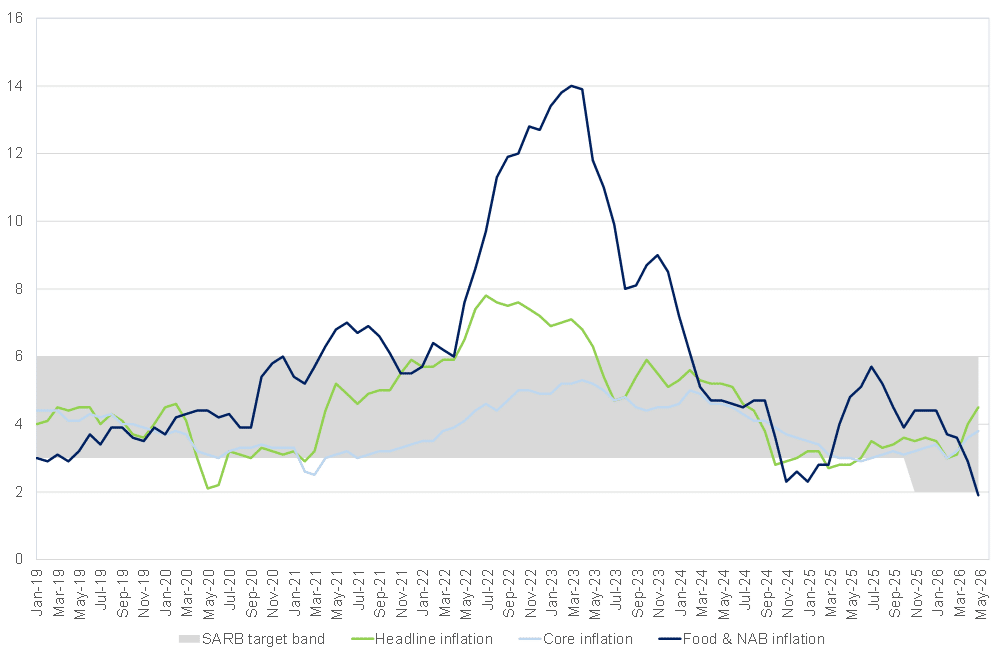
South Africa’s (SA) annual headline inflation rose to 4.5% in May 2026, up from 4.0% in April, but below market expectations of a 4.7% print. The increase reflects the ongoing pass-through of the global oil price shock into domestic prices. Core inflation, which excludes the more volatile food, fuel and energy components, also edged higher to 3.8% YoY from 3.6%.
Transport and housing, and utilities were the largest contributors to the increase, rising by 9.4% and 5.3% YoY, respectively. Transport inflation was driven by higher fuel prices, which surged by 28.7% YoY in May 2026, up from 11.4% previously. Housing and utilities inflation accelerated due to higher electricity and gas costs, with this subcomponent rising to 9.4% YoY from 8.2%, reflecting the recent Eskom tariff hike.
Other categories remained elevated, with insurance and financial services inflation rising by 5.7% YoY, while goods and services inflation increased by 4.4% and 4.7% YoY, respectively.
MoM, inflation showed some moderation, with headline inflation easing to 0.7% from 1.1% in April. Core inflation also slowed to 0.2%, from 0.5% previously.
On a monthly basis, transport costs moderated to 4.1% from 5.5% previously. Fuel prices, while still elevated, saw a slower pace of increase at 14.3%, compared to 18.2% in April. Housing and utilities costs edged up slightly, rising from 0.1% to 0.2% in May 2026. This was primarily driven by higher electricity and gas tariffs, alongside maintenance costs, which increased by 1.2% and 2.4% MoM, respectively.
Figure 1: SA inflation, YoY % change
Source: Stats SA, Anchor Capital
Outlook
Recent progress towards a preliminary US/Iran agreement has reduced some pressure on global oil prices, with Brent crude declining to below US$80/bbl. However, a full recovery to pre-28 February 2026 (when US-Israeli military action against Iran started) oil supply is expected to take time, meaning energy prices are likely to remain elevated compared with pre-conflict levels in the near term.
Domestically, fuel price pressures have been partly cushioned by the government’s extension of the fuel levy relief into May 2026, limiting the increase in pump prices and moderating the inflationary impact during the month. However, petrol prices increased by R1.43/litre in June, which is expected to maintain pressure on transport costs and lift headline inflation in the June print. Some relief is expected from July onwards (as fuel prices moderate), although the reinstatement of the fuel levy will partly offset this.
Food inflation remains contained, easing to 1.9% in May from 3.7% in March and 2.9% in April. However, elevated input costs (fuel, fertiliser and logistics costs) could gradually feed through into food prices in the coming months. In addition, the potential emergence of El Niño conditions later in 2026 remains a key upside risk, as it could disrupt local agricultural production and push food prices higher.
Against this backdrop, the South African Reserve Bank (SARB) is expected to maintain a cautious policy stance, with one further 25-bpt rate hike still anticipated in 2H26. The SARB projects headline inflation to average 4.4% in 2026 and 3.7% in 2027, returning to the Bank’s 3% target only by 2028.
Under a scenario of sustained geopolitical de-escalation, particularly with a durable US/Iran peace agreement, headline inflation is likely to peak around July 2026, reducing the need for further aggressive tightening by the SARB beyond the expected single 25-bpt rate hike. However, risks remain tilted to the upside, particularly from the potential impact of El Niño conditions later in the year. The severity and persistence of El Niño will be key to determining when the interest rate easing cycle can resume.