
The South African Reserve Bank’s (SARB) Monetary Policy Committee (MPC) elected to leave the repo rate unchanged at 7.00%, defying our and market expectations that had largely anticipated a 25-bpt increase. The decision was not unanimous, with four MPC members voting to keep rates unchanged, while two members preferred a 25-bpt hike.
Figure 1: The history of the SARB MPC’s repo rate changes, %
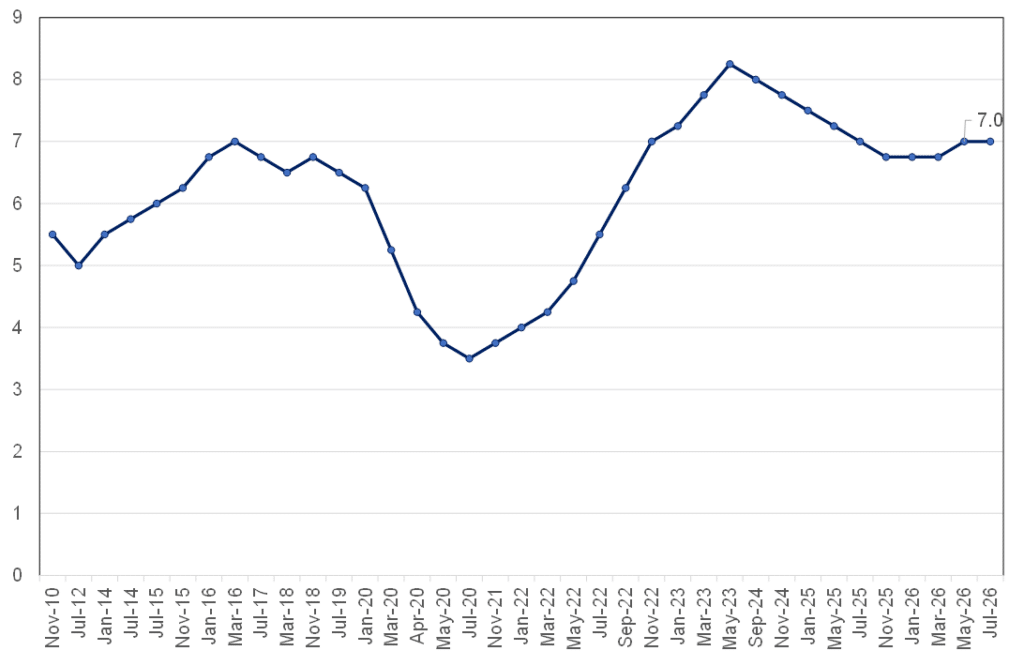
Source: SARB, Anchor Capital
The MPC’s decision comes against a backdrop of persistent geopolitical uncertainty and elevated inflation risks. In particular, the renewed escalation of tensions between the US and Iran during July has amplified concerns around global energy supply disruptions. Heightened risks to shipping routes through the Strait of Hormuz drove Brent crude oil prices above US$90/bbl, increasing the potential for imported inflationary pressures.
While the SARB acknowledged that inflation remains above its preferred 3% objective, it noted that the recent acceleration has been driven primarily by higher fuel costs. Food inflation, by contrast, has eased owing to favourable harvests and the fading effects of foot-and-mouth disease. However, services inflation has become an increasing concern, with categories such as transport and insurance continuing to register inflation rates well above 3%.
Notwithstanding these risks, the SARB has revised its average inflation forecast for 2026 lower, to 4.0% from 4.4% previously, while noting that the anticipated effects of El Niño on agricultural output are more likely to emerge in 2027.
The SARB highlighted oil prices as the key risk to the inflation outlook. Under an adverse scenario, where oil averages US$100/bbl, inflation would likely remain elevated and necessitate further policy tightening. Conversely, should oil prices ease towards the SARB’s baseline forecast of around US$78/bbl, inflationary pressures could ease more rapidly, potentially allowing the interest rate-cutting cycle to begin sooner.
Outlook
While the SARB’s decision to leave the repo rate unchanged at 7.0% was more dovish than our expectations given the prevailing inflation backdrop, it reflects the MPC’s preference to assess whether recent inflationary pressures prove transitory. In our view, however, the balance of risks remains tilted to the upside as the broader macroeconomic environment continues to point to persistent upside risks to inflation.
In data released earlier this week, SA’s headline inflation accelerated to 5.0% YoY in June, up from 4.5% in May, moving further above the SARB’s preferred 3% inflation target. The increase largely reflects the direct impact of the Iran conflict on global energy markets, which has driven higher fuel and public transport costs. June’s core inflation, which excludes food and energy, also accelerated to 4.1% YoY from 3.8% in May, suggesting broader underlying price pressures are beginning to build.
The latest Bureau for Economic Research (BER) survey also shows inflation expectations continue to drift higher, rising to 4.2% for 2027 and 4.1% over the next five years. Prospects for a meaningful improvement in 3Q26 are limited, with expectations likely to deteriorate further should oil prices remain elevated or geopolitical tensions persist.
The rand has remained relatively resilient, and we project it to average c. R16.39/US$1 for 3Q26, supported by SA’s favourable terms of trade, which have helped limit imported inflation. Nevertheless, the rand remains vulnerable to external developments, including sustained oil price increases, a stronger US dollar and higher-for-longer US interest rates, which could trigger capital outflows and place downward pressure on the local unit.
SA food inflation risks also warrant close monitoring. Although favourable summer rainfall, adequate grain supplies and healthy dam levels have helped contain food price pressures to date, the probability of an El Niño-induced drought has increased. Combined with higher fertiliser, transport and other agricultural input costs, this presents a meaningful upside risk to food inflation over the coming quarters.
Against this backdrop, we maintain a 4.8% and 3.7% average inflation forecast in 2026 and 2027, respectively. While the SARB has opted to pause for now, the inflation outlook remains uncertain, and we believe monetary policy is likely to remain restrictive until there is greater confidence that inflation expectations are converging sustainably toward the Bank’s preferred 3% objective.