

Quarterly Employment Statistics (QES) data released by Statistics South Africa (Stats SA) on 30 June highlight a continued deterioration in SA’s labour market, with employment declining on both a quarterly and annual basis. The latest data reinforce the view that the post-COVID-19 pandemic recovery phase has faded, with job creation increasingly constrained by weak domestic demand and persistent structural constraints limiting the economy’s ability to absorb labour. Indeed, the shift from cyclical recovery to structural weakness is increasingly evident, with underlying challenges such as logistical inefficiencies and weak fixed investment continuing to weigh on employment creation. Even during periods of relative improvement, job gains have been insufficient to reduce unemployment, leaving the labour market structurally constrained.
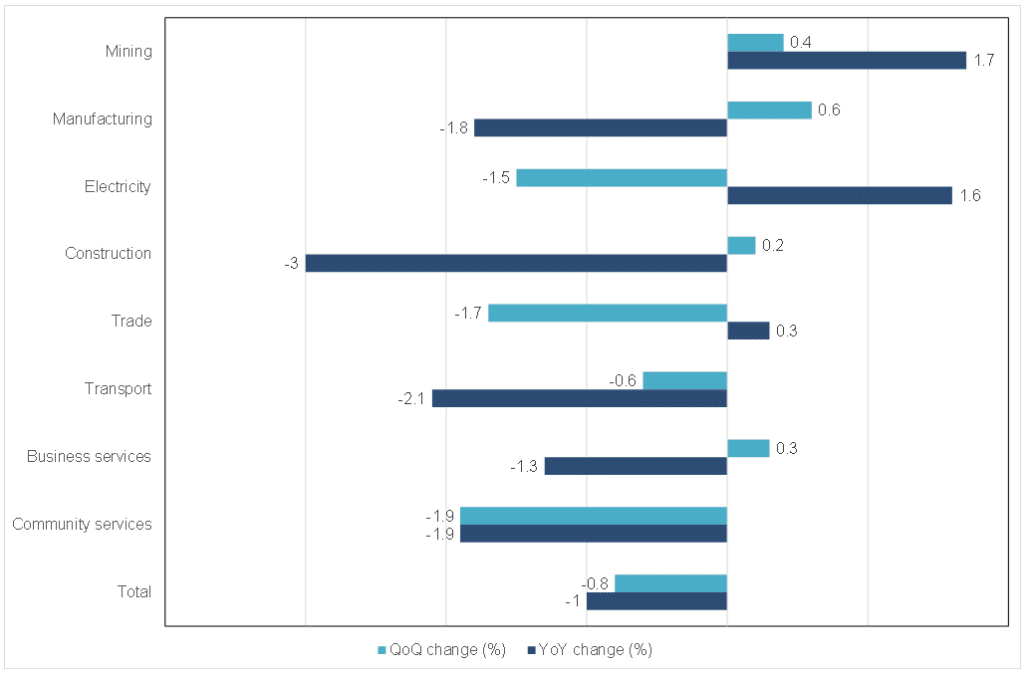
Total employment fell by 121,000 (-1.1%) between March 2025 and March 2026. During 1Q26, employment declined by 80,000 QoQ to 10.468mn, representing a 0.8% quarterly contraction.
The weakness was broad-based across key domestic industries. Significant job losses were recorded in community and social services (-1.9% QoQ) and trade (-1.7% QoQ), reflecting subdued household demand. Employment also declined in electricity (-1.5% QoQ) and transport (-0.6% QoQ), highlighting ongoing cost pressures and structural constraints. These declines were only partially offset by modest employment gains in more cyclical and externally supported sectors, including manufacturing (+0.6% QoQ), business services (+0.3% QoQ), mining (+0.4%) and construction (+0.2% QoQ).
On an annual basis, employment declines were similarly broad-based, with contractions in construction (-3.0%), transport (-2.1%), community and social services (-1.9%), manufacturing (-1.8%), and business services (-1.3%), pointing to sustained weakness across both consumption-linked and production-oriented sectors. While mining (+1.7%), electricity (+1.6%), and trade (+0.3%) recorded gains, these were insufficient to change the broader employment picture materially.
Figure 1: Employment by industry, March 2026
Source: Stats SA, Anchor Capital
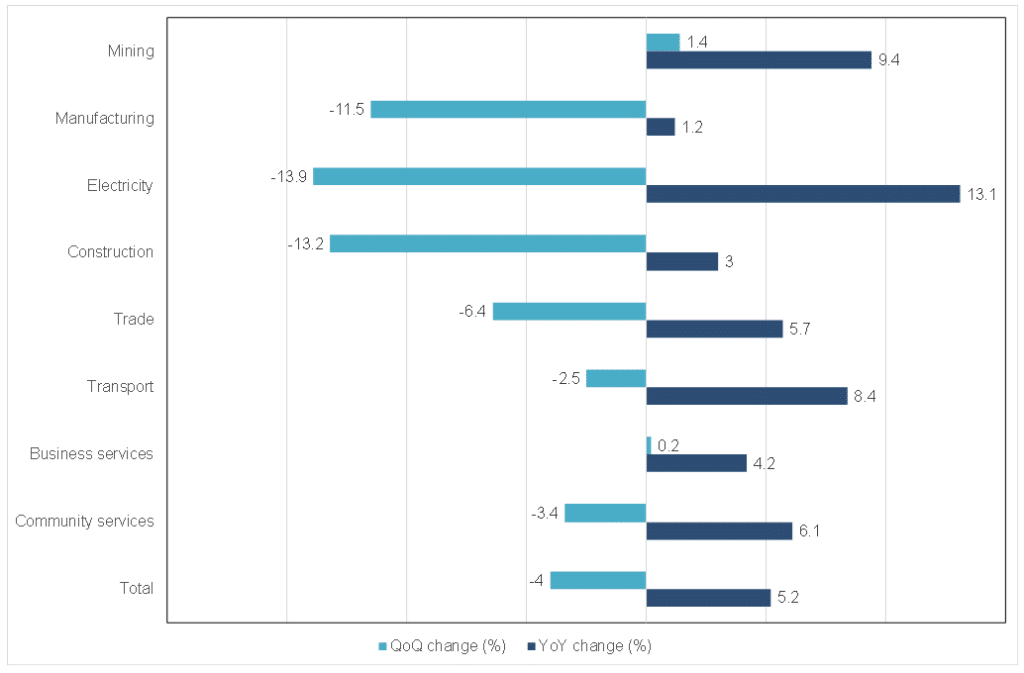
Consistent with the deterioration in employment conditions, gross earnings growth also softened on a quarterly basis. Total gross earnings declined by 4.0% QoQ, falling from R1.08trn in December 2025 to R1.04trn in March 2026.
The largest quarterly declines were recorded in construction (-13.2%), manufacturing (-11.5%), trade (-6.4%), and electricity (-13.9%), alongside more moderate decreases in community services (-3.4%) and transport (-2.5%). These declines highlight both cyclical softness and ongoing cost pressures facing businesses.
While business services (+0.2%) and mining (+1.4%) recorded marginal increases, these were insufficient to offset the broader decline. YoY, however, gross earnings rose by R51.4bn (+5.2%), indicating that income growth remains positive but is losing momentum.
Figure 2: Gross earnings by industry, March 2026
Source: Stats SA, Anchor Capital
Outlook: Recovery gives way to structural constraints
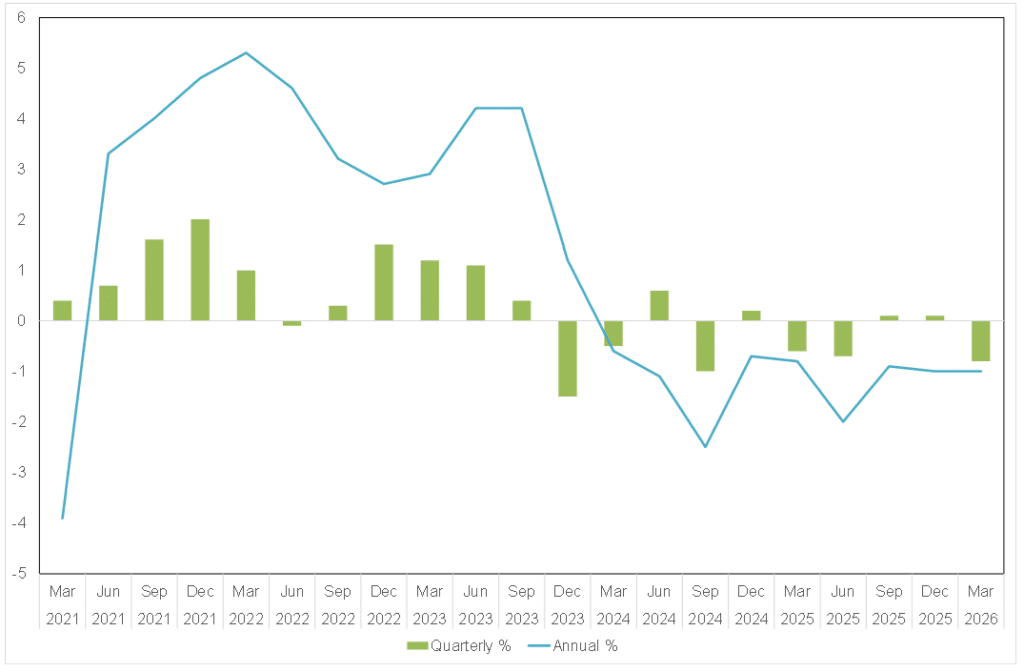
Figure 3: Employment trend by industry, 2021- 2026
Source: Stats SA, Anchor Capital
SA’s labour market has transitioned from a post-pandemic recovery phase into one characterised by stagnation and, more recently, contraction. The initial rebound in 2021 was underpinned by strong and broad-based job gains and lower base effects, with this momentum extending into 2022, albeit at a more moderate pace. However, by 2023, the cycle reached a turning point as employment growth slowed markedly, culminating in a sharp contraction towards year-end amid tightening domestic conditions and a less supportive global environment.
Since 2024, the labour market has remained weak with frequent job losses and negative annual growth, signalling a loss of momentum and a shift towards a low-growth environment with limited capacity to sustain employment gains.
The broader SA economic backdrop remains challenging. Annual headline inflation rose to 4.5% in May 2026, up from 4.0% in April, reflecting the impact of geopolitical uncertainty and elevated oil prices. At the same time, real GDP growth showed only a marginal improvement to 0.5% QoQ in 1Q26 from 0.4% in 4Q25. Although economic activity showed stronger-than-anticipated economic momentum in the early part of the year, it does not reflect the impact of the war in the Middle East on domestic activity. Since then, economic sentiment has deteriorated, with the Business Confidence Index (BCI) declining in 2Q26, pointing to weakening business conditions amid rising uncertainty and cost pressures.
Looking ahead, SA’s labour market will likely remain under pressure, with employment conditions in 2Q26 expected to be further dampened by the spillover effects of the Middle East conflict, which has weighed on global demand and heightened uncertainty. This, combined with already subdued domestic activity, suggests limited scope for meaningful job creation. At the same time, persistent labour market slack suggests limited wage pressures, which should help contain second-round inflation effects.