

South Africa’s (SA) annual headline inflation accelerated to 5.0% YoY in June 2026, up from 4.5% in May, exceeding market expectations of 4.7%. Core inflation, which excludes the more volatile food, fuel, and energy components, also increased to 4.1% YoY, from 3.8% previously. Inflation risks remain skewed to the upside amidst renewed geopolitical tensions in the Middle East.
The main contributors to headline inflation were transport, housing and utilities, and insurance and financial services, which increased by 12.7%, 5.5%, and 5.9% YoY, respectively (compared to 9.4%, 5.3% and 5.7%, respectively, in the previous month). Meanwhile, both goods and services inflation accelerated, rising to 4.8% and 5.2% YoY, respectively, from 4.4% and 4.7% in May. Food inflation remained subdued, easing to 1.6% YoY in June 2026 from 1.9% previously.
On a monthly basis, headline inflation remained steady at 0.7%, unchanged from May’s print. The monthly increase was primarily driven by housing and utilities, which accelerated to 0.8% MoM from 0.2% in the previous month. Food and non-alcoholic beverages prices increased by 0.5% MoM, following a flat reading in May. By contrast, transport inflation moderated monthly, increasing by 2.9% MoM compared with 4.1% MoM in the previous month.
Figure 1: SA inflation, YoY % change
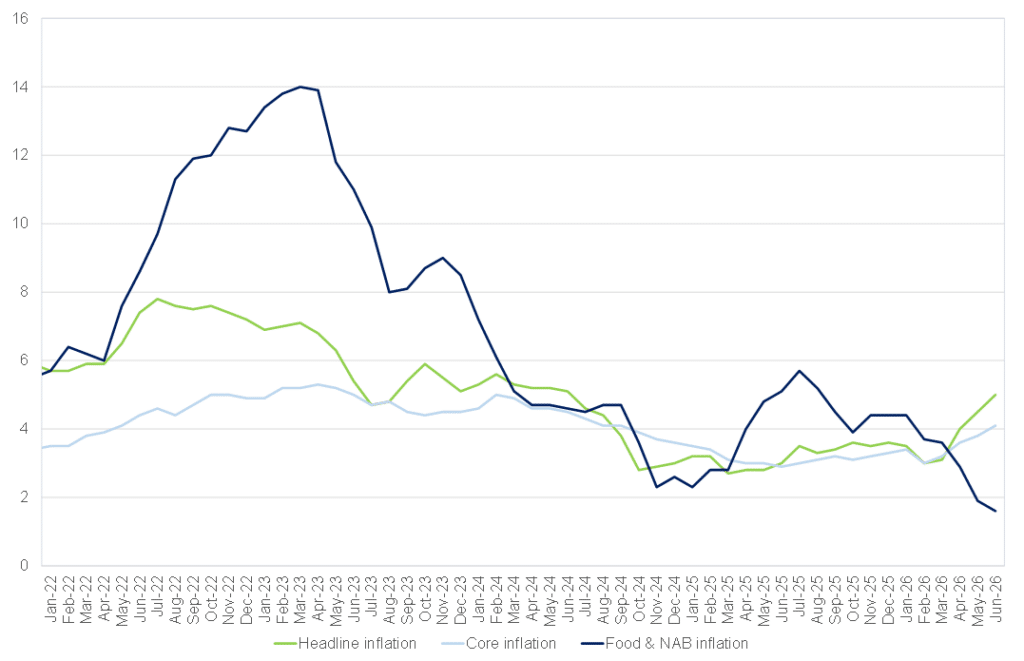
Source: Stats SA, Anchor Capital
Inflation outlook and policy implications
At its May meeting, the South African Reserve Bank (SARB) highlighted the risk that a prolonged Middle East conflict could sustain upward pressure on fuel and food prices. The Bank also cautioned that potential El Niño conditions could exacerbate food inflation by reducing agricultural output and amplifying the impact of higher diesel and fertiliser costs on agricultural production.
The inflation backdrop improved temporarily during June as oil prices retraced to approximately US$72/bbl following the signing of a Memorandum of Understanding (MoU) and a 60-day ceasefire agreement between the US and Iran. The agreement facilitated a faster-than-expected normalisation of shipping flows through the Strait of Hormuz, easing concerns about potential supply disruptions and supporting a more favourable global inflation outlook.
Unfortunately, the inflation outlook has deteriorated materially over recent weeks. The renewed escalation of tensions between the US and Iran in early July reignited inflation concerns, with supply disruptions through the Strait pushing Brent crude oil prices above US$90/bbl, raising the risk of higher fuel costs and a resurgence in energy-driven inflation. Elevated oil prices are also expected to increase fertiliser and transportation costs, placing upward pressure on agricultural input expenses and, ultimately, food prices.
Global food prices had continued to ease in June 2026, largely driven by lower grain, dairy, and sugar prices. Domestically, food inflation has remained subdued throughout 1H26, as higher fertiliser and fuel costs have yet to affect agricultural production or food supply materially. However, these pressures are expected to become more apparent toward the end of 3Q26, coinciding with the period when farmers typically increase purchases of fuel and fertiliser in preparation for the 2026/2027 planting season, which is expected to begin in mid-October. As input costs rise ahead of the planting season, they are likely to weigh on planting decisions, reducing the area under cultivation and potentially constraining crop yields and agricultural output in the subsequent season, adding pressure on food costs.
In addition, the increasing probability of an El Niño-induced drought poses a threat to crop yields and agricultural production. While favourable soil moisture conditions following the prolonged summer rainfall season should provide some near-term support, a sustained period of drier weather could adversely affect agricultural output over the medium term.
Against this backdrop, we revise our average inflation forecast for 2026 upward to 4.8% from 4.5%, reflecting heightened inflationary pressures. Our 2027 inflation forecast is unchanged at 3.7%.
We expect the SARB’s Monetary Policy Committee (MPC) to raise the repo rate by 25 bpts at its 23 July meeting. A combination of higher oil prices, rising inflation expectations, elevated food inflation risks, and concerns around potential second-round inflation effects is likely to reinforce the SARB’s determination to anchor inflation expectations around its 3% target.