

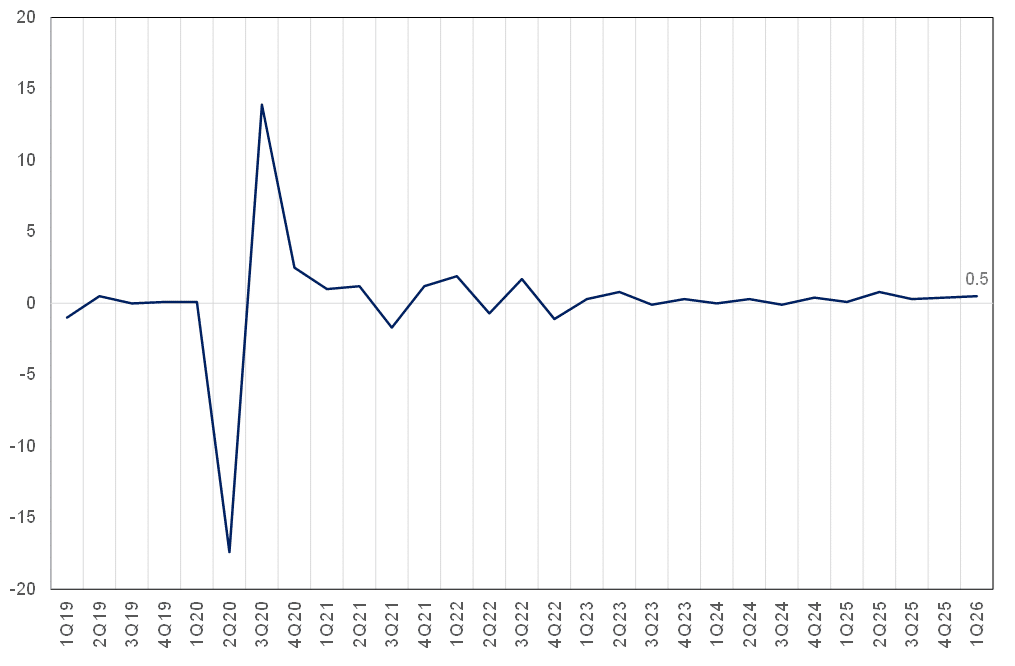
South Africa’s (SA) real GDP growth edged higher to 0.5% QoQ in 1Q26, up from 0.4% in 4Q25, while annual growth accelerated to 1.9% YoY, according to data released by Statistics South Africa (Stats SA). The outcome exceeded market expectations of 0.3% QoQ and 1.8% YoY growth, respectively, indicating slightly stronger-than-anticipated economic momentum in the early part of the year.
The agriculture, forestry and fishing sector was the strongest contributor to growth, expanding by 3.9% QoQ, a marked improvement from 0.4% in the previous quarter. The sector was supported by improved output in field crops and horticultural products. The mining and quarrying sector also contributed positively, growing by 0.7% QoQ, after contracting by 0.6% in 4Q25, driven primarily by increased production of platinum group metals (PGMs) and gold.
Activity across the services sector remained broadly resilient, although momentum showed signs of moderation in some segments. The trade, catering and accommodation sector expanded by 0.7% QoQ, easing slightly from 0.9% in 4Q25, but contributing 0.1 ppts to growth, supported by increased activity in wholesale trade, motor trade, and the food, beverages, and accommodation segments. The finance, real estate and business services sector increased by 0.9% QoQ, contributing 0.2 ppts to overall growth, although it slowed down from 1.4% previously. The transport, storage and communication sector rebounded by 0.7% QoQ, following a 0.3% contraction in 4Q25.
In contrast, the manufacturing sector contracted for a second consecutive quarter, declining by 0.8% QoQ and subtracting a 0.1 ppt from growth. Weakness was broad-based, with the petroleum, chemicals, rubber and chemical products; metals and machinery, and wood, paper, publishing and printing industries recording the largest declines.
The electricity, gas and water sector expanded modestly by 0.4% QoQ, driven by increased electricity consumption, while construction grew by 0.2%, both recovering modestly from contractions (of 2.2% and 1.3%, respectively) recorded in 4Q25.
Figure 1: SA GDP growth QoQ % change
Source: SARB, Anchor Capital
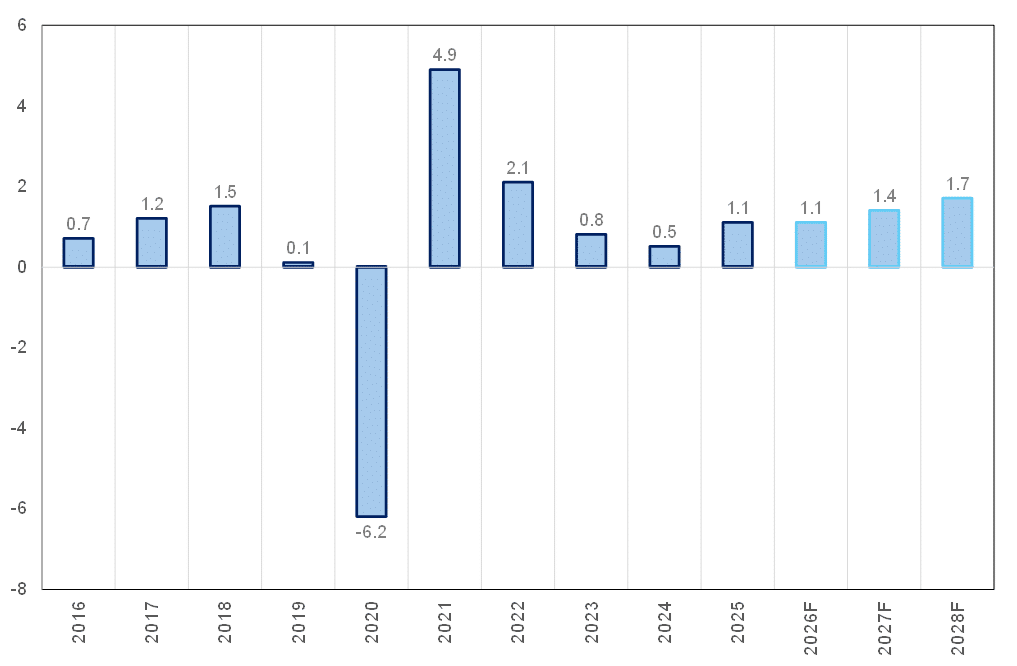
Figure 2: SA GDP annual growth rate, YoY % change
Source: SARB, Anchor Capital
Outlook
While SA’s stronger-than-expected GDP outcome is encouraging, it largely reflects economic conditions before the escalation of the Middle East conflict. It therefore does not yet capture the full impact of subsequent energy market disruptions.
The escalation of the conflict has exerted sustained upward pressure on global oil prices, translating into significantly higher domestic fuel costs in 2Q26 and contributing to a rise in headline inflation to 4.0% YoY in April 2026. Transport and utilities inflation accelerated to 5.2% and 4.9% YoY, respectively, prompting the South African Reserve Bank (SARB) to raise the repo rate by 25 bpts at its May Monetary Policy Committee (MPC) meeting.
Looking ahead, the combination of elevated fuel costs and higher interest rates is likely to weigh on household spending and business activity, placing downward pressure on consumption and, therefore, limiting near-term economic growth.
The manufacturing industry remains particularly vulnerable given its exposure to energy-intensive production processes and imported input costs. Although the recent moderation in diesel prices may offer some near-term relief, this benefit is likely to be partially offset by the reduction in fuel levies, limiting the extent of cost relief for producers. As a result, we expect cost pressures to remain elevated, continuing to weigh on margins, production activity, and the broader recovery in the manufacturing sector.
The outlook is further complicated by the possibility of a prolonged Middle East conflict, which could keep global oil prices elevated and place additional pressure on inflation. At the same time, the potential emergence of El Niño conditions later in 2026 poses a risk to agricultural output and food prices, adding to broader inflationary pressures.
Against this backdrop, we expect the SARB to maintain a cautious policy stance, with a further 25-bpt rate hike likely in July 2026, conditional on inflation dynamics.
External conditions also present challenges. Softer global commodity prices, particularly for SA’s key export commodities, alongside persistently elevated oil prices, could weaken export earnings, deteriorate the terms of trade, and place renewed downward pressure on overall growth and the rand.
SA’s GDP growth is projected to average 1.1% in 2026 and 1.4% in 2027, reflecting a subdued and fragile recovery path. While agriculture and mining provided support in 1Q26, growth is likely to remain constrained by elevated inflation, tighter financial conditions and subdued business confidence.
Indeed, leading indicators already point to softer activity. Both the latest Absa Purchasing Managers Index (PMI) and BER Business Confidence Index deteriorated in May, suggesting that domestic business sentiment and operating conditions have weakened amid rising uncertainty and mounting cost pressures.