
Summary
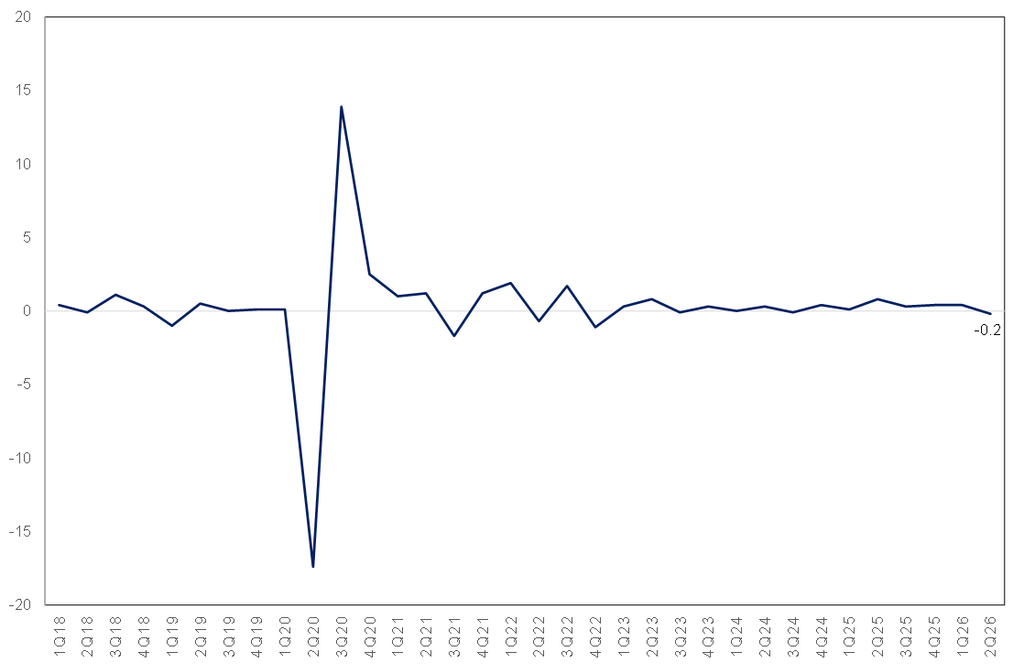
South Africa’s (SA) economy declined by 0.2% QoQ in 2Q26, falling short of the consensus expectation of a 0.1% contraction and marking the first quarterly contraction since 3Q24. Annual growth also slowed, with real GDP increasing by just 0.9% YoY, short of the 1.2% expected.
The weaker GDP outcome largely reflects the fragility of SA’s economic recovery. While several sectors continued to expand, the contraction was driven by weakness in some of the economy’s largest industries, including mining, manufacturing, and trade, catering and accommodation.
The escalation of the Middle East conflict during the quarter added to these pressures. The resulting surge in global oil prices increased input and transportation costs across the economy, weighing on overall economic activity.
Figure1: SA GDP growth QoQ % change
Source: Anchor Capital, Stats SA
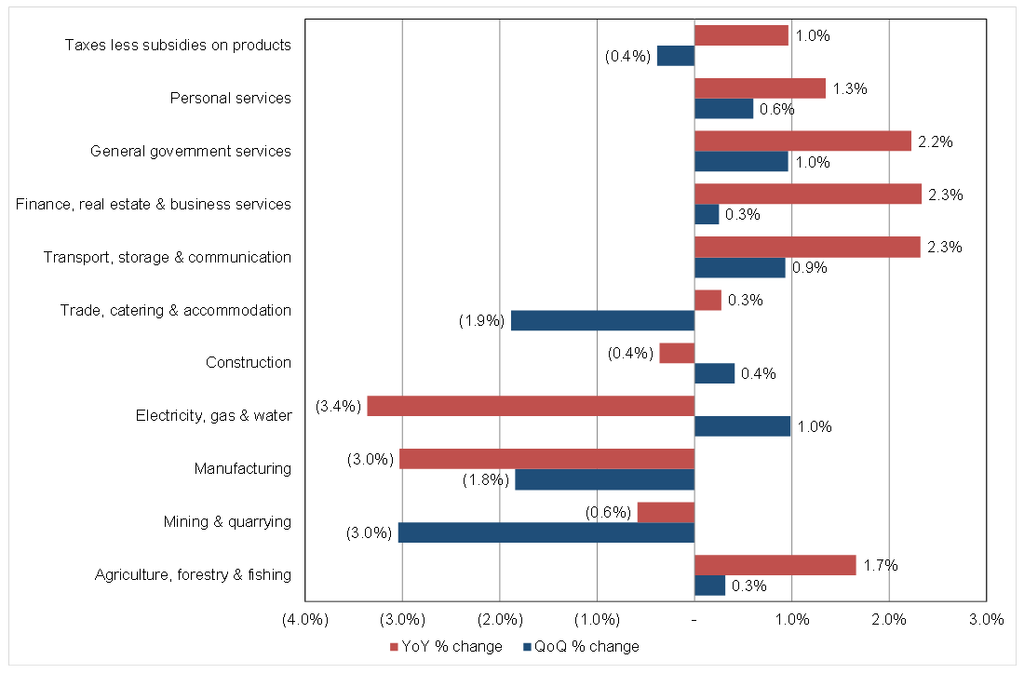
Three of the ten major industries contracted during the quarter, but importantly, these included several of the economy’s largest sectors. Trade, catering and accommodation fell 1.9% QoQ and manufacturing 1.8% QoQ, each shaving 0.2 ppts off overall GDP growth. Mining was an additional drag, declining 3.0% QoQ and subtracting a further 0.1 ppt. Agriculture provided some support, recording a seventh consecutive increase, although growth slowed to only 0.3% QoQ.
Figure 2: Real GDP by production
Source: Anchor Capital, Stats SA
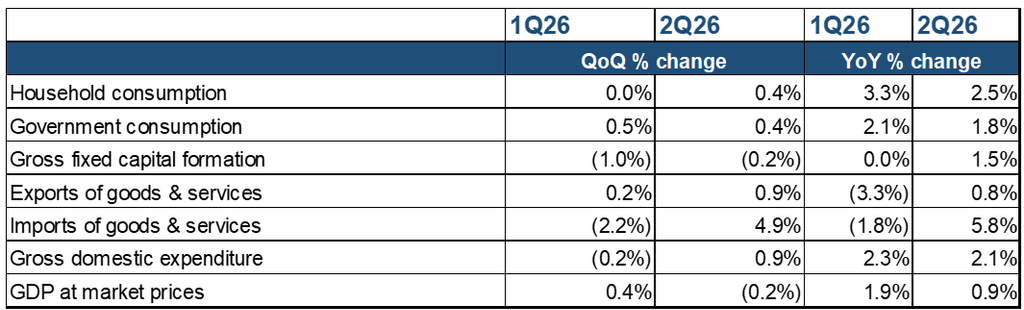
On the expenditure side, the largest drag came from net exports, which subtracted 1.1 ppts as imports rose 4.9% QoQ against export growth of 0.9% QoQ, a swing driven by machinery and electrical equipment, mineral products, chemicals, and plastics. Household consumption remained relatively resilient, increasing by 0.4% QoQ due to higher spending on food and non-alcoholic beverages, recreation and culture, and health and other goods and services. However, this was partly offset by lower spending on transport and on housing, water, electricity, gas and other fuels, as higher fuel and energy costs placed additional pressure on household budgets during the quarter. Gross fixed capital formation (GFCF) edged down by 0.2% QoQ, due to weak private sector investment, along with lower investment in transport equipment.
Figure 3: Real GDP by expenditure
Source: Anchor Capital, Stats SA
Outlook
The 2Q26 contraction reinforces the view that SA’s growth recovery remains vulnerable to external shocks and domestic structural constraints. The oil shock materially impacted input costs in mining and manufacturing and the import bill in net exports, while overall household consumption remained resilient. Oil prices remain elevated, still above US$90/bbl. In September, Petrol (95) increased by ZAc129/litre, and diesel (0.05) by ZAc2.93/litre. The resulting fuel cost pressures are likely to remain in place through 4Q26.
Agricultural output benefitted from favourable weather conditions and improved crop production during 1H26, providing an important source of support to GDP growth. However, this positive boost is expected to fade during the second half of the year.
The agricultural sector remains particularly exposed to rising input costs. Diesel and electricity are largely externally driven costs and have increased significantly alongside higher oil prices. Fuel costs increase the expense of planting, harvesting, irrigation and transporting produce to markets. In addition, fertiliser prices are likely to remain elevated, potentially constraining future production growth.
The mining and manufacturing sector is also expected to be a drag on economic growth, due to elevated operating costs, particularly for fuel, electricity and transportation. The combination of weaker output and rising input costs is likely to weigh on profitability, investment and employment within the sector, limiting mining’s contribution to overall GDP growth.
The broader business environment remains challenging despite a temporary easing in fuel prices during the middle of the year and the SA Reserve Bank’s (SARB) decision to keep interest rates unchanged at its July meeting. The RMB/BER Business Confidence Index (BCI) declined to 38 in 3Q26 from 39 in the previous quarter, remaining below its long-term average of 40. The survey found that businesses continue to face a challenging operating environment characterised by elevated input costs, weak domestic demand and ongoing uncertainty surrounding energy prices.
The SARB currently forecasts that annual real GDP growth will average 1.4% and 1.7% in 2026 and 2027, compared to 1.4% recorded in 2025.
For the SARB’s Monetary Policy Committee (MPC), a contraction in 2Q26 does not veto a hike in the second half of 2026. Although July CPI eased to 4.3% from 5.0%, inflation is expected to remain above 4% into early 2027 and above the SARB’s 3% target. The sharp increase in fuel prices in September is expected to sustain the second-round risk, with inflation risks remaining tilted to the upside. Taking this into consideration, we continue to price in one 25-bpt hike in the second half of 2026.