
Every day, I come across another article proclaiming that the stock market is a bubble and a crash is imminent. This has been true for most of my career, but lately it seems as though the doomer drumbeat is louder than ever. Most investors are in a heightened state of anxiety, given the dizzying pace of change due to AI. Frequent comparisons to the Technology Bubble of the late 1990s add to the feeling of paranoia. Attempts to argue against the analogue are met with legendary investor John Templeton’s quote, “The four most dangerous words in investing are ‘This time it’s different’”. The saying has become an excuse for cynicism and a refusal to think from first principles. The nuances and differences between episodes matter as much, if not more, than the similarities. Historians would all be billionaires if it were as simple as knowing history!
The first bubble argument: Valuations
The two main bubble arguments are made with respect to valuation and earnings. The bears are attempting to have their cake and eat it; if valuations do not indicate a bubble, then earnings do. Nevertheless, starting with valuation, we can see that the S&P 500 trades on a forward multiple of roughly 21x. This is slightly rich vs its 30-year average of 18.8x, but well below the peak of the Tech Bubble.
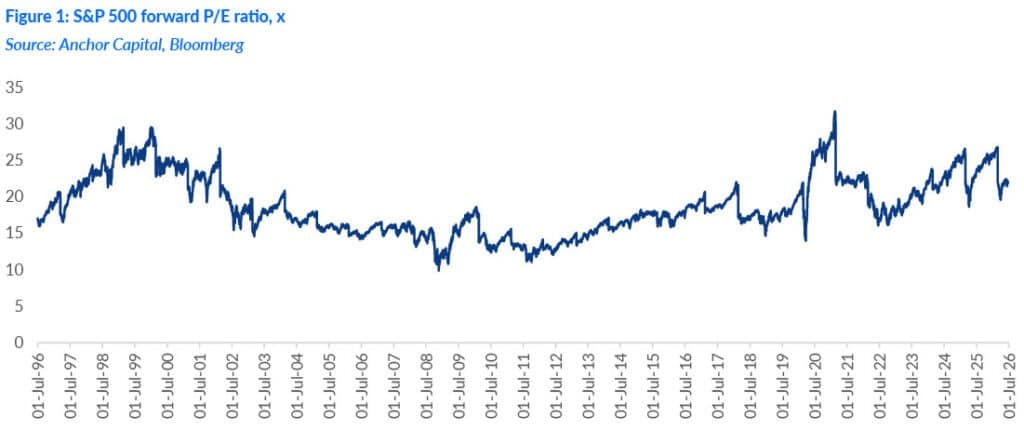
There are several reasons why the S&P 500 should trade at a premium vs the past. The improvement in the quality of the index has helped to drive a re-rating. The market has become increasingly skewed towards companies with stronger balance sheets, higher margins and returns on invested capital (ROIC), as well as lower cyclicality. One can also reason from a flow perspective: with a constant bid from price-insensitive passive buyers (through employer-sponsored retirement accounts and other vehicles), an upward drift in multiples is almost inevitable.
Finally, there is no golden rule regarding the ‘correct’ P/E multiple. Most theories, like Warren Buffett’s total market capitalisation-to-gross domestic product ratio, CAPE (cyclically adjusted price-to-earnings) Shiller, and the Fed model, all fail to produce reliable timing signals. And why should they – nothing in markets is ever that easy!
The second bubble argument: Earnings
The capital expenditures (capex) of the four large hyperscalers (Amazon, Google, Meta and Microsoft) have consistently exceeded investors’ expectations. Hyperscaler capex forms the revenue of the companies building out AI infrastructure (semiconductors, data centres, power, etc.). As such, earnings per share (EPS) have surprised positively this year, with S&P 500 EPS growing by 16% YoY in 1Q26. At the start of the year, analysts expected the S&P 500 to earn US$310/share in 2026. By mid-June, the estimate had already climbed 10% to US$342/share. Much of the upside surprise is a function of the boom in AI spend.
Bears contend that it is incorrect to treat ‘one-off’ spend as recurring, which is fair if the cycle is short-lived. If the AI buildout lasts a decade (or more) and includes both recurring spend (like an iPhone upgrade) and maintenance spend (just as roads need to be re-tarred, potholes filled, etc.), then the bears’ logic holds less water.
The bears also claim that the buildout is unsustainable as these investments allegedly generate poor ROIC. To date, however, the evidence does not support this thesis. The ROIC for the hyperscalers has not diminished materially in the past three to four years, despite explosive growth in capex.
Scaling laws: the ‘why’ behind the capex
The core principle underpinning the entire cycle is that scaling laws will hold, i.e. greater spend on compute (i.e. more powerful chips, etc.) directly translates into AI model improvements. The more powerful and useful the model, the more consumers and corporates will be willing to pay. NVIDIA CEO Jensen Huang put it succinctly: “Compute equals revenues.” Those revenues provide the firepower to finance more capex, reinforcing the cycle. Both the frontier labs, such as Anthropic and OpenAI, and the hyperscalers are incentivised to keep spending as scaling laws remain in full force.
The bears believe that the AI buildout cannot last once the hyperscalers have burnt through their cash reserves. The hyperscalers still have ample room to gear up their balance sheets and have started to raise equity capital to fund incremental spend. Google’s parent company, Alphabet, recently raised US$85bn in equity, including a cornerstone stake of US$10bn from Berkshire Hathaway. Private and institutional investors, including sovereign wealth funds, have sufficient capital to support the bulk of the buildout.
The US is locked in a race with China to achieve Artificial General Intelligence and Artificial Super Intelligence, with long-lasting implications for economic prosperity, national security and global influence. The US government is likely to become a key stakeholder and funding source as victory is deemed non-negotiable. As such, capital is highly unlikely to be a constraint.
The bull case for US equities
If the private and public capital investment cycle is likely to continue for the next decade, S&P 500 EPS could continue to grow in the double digits (perhaps as high as 15% p.a.) for the foreseeable future. As companies deploy AI to improve productivity, margins and ROIC, there is every reason to believe the quality of US corporates will continue to improve. The S&P 500 could maintain the current P/E ratio, or even see it expand significantly. The market could surprise positively with respect to both earnings and valuations for years to come.
Investors continue to underestimate the magnitude of change in society and markets, and who can blame them. Humans think in linear terms, and exponential change is almost impossible for us to fathom. We are in the midst of a generational investment-led boom and secular bull market. That said, painful short-lived corrections and cyclical bear markets are to be expected along the way. It is not supposed to be easy! The victories of the bears are usually short-lived and pyrrhic. Bulls are rewarded for courage, for believing in the triumph of human ingenuity and for staying the course. I remain bullish.