

Artificial intelligence (AI) has evolved far beyond the chatbots (like ChatGPT) that first captured the headlines a few years ago. The next phase of the AI revolution is increasingly defined by the infrastructure required to make it possible: advanced chips, memory, data centres, networking equipment, and power generation.
The scale of investment is significant. The hyperscalers, including giant cloud platforms like Amazon, Microsoft, Alphabet, and Meta, spent approximately US$250bn on capital expenditure in 2024, and forecasts suggest this could climb to above US$700bn in 2026 and over US$1trn in 2027. That scale and cadence point to conviction behind the AI theme, an opportunity set that is more than just software, and a world where compute supply is meaningfully lagging the growing demand.
For investors, however, the opportunity is not simply identifying companies associated with AI. The more important question is where the constraints are in the supply chain, and which businesses are best positioned to benefit from those bottlenecks.
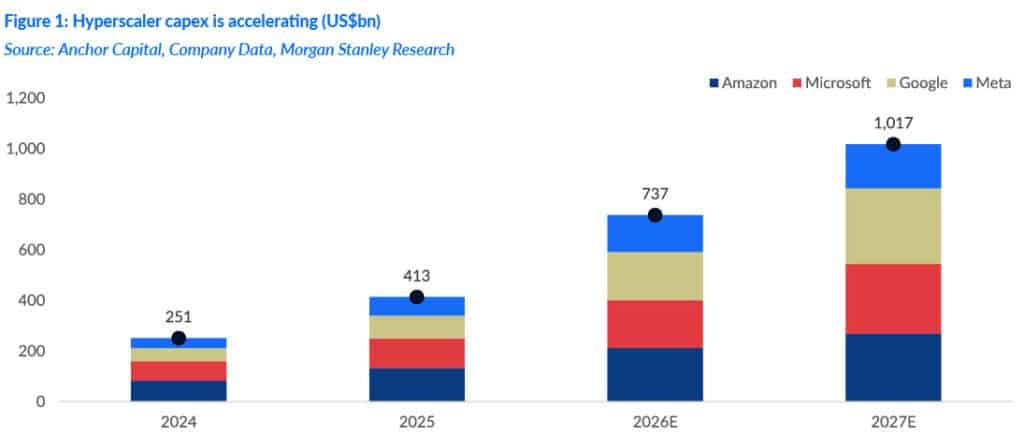
The largest technology companies have become some of the biggest infrastructure investors in the world. Their AI ambitions require enormous amounts of computing power, with demand expanding across both training large models and running AI applications in real time. In the past year, however, they have become capex‑intensive businesses – using almost all operating cash flows and tapping both debt and equity markets to fund their AI endeavours. Even Alphabet recently announced an US$80bn equity raise, which shows how quickly the funding requirements are outgrowing free cash flow (FCF). Demand is running comfortably ahead of supply.
A pipeline with pressure points
To understand where this capital flows, the AI ecosystem/supply chain can be viewed as a pipeline with several gates. Capital enters the pipeline and must pass through several critical stages: compute and memory, packaging and optics, data centres and cooling, and finally the broader power infrastructure.
When one gate narrows, supply backs up behind it, and pricing power accrues to whoever owns that gate.
Demand is compounding
At the top of the pipe, demand is accelerating. AI now powers everyday tools rather than one-off experiments. Deloitte estimates that inference (answering live queries) will account for two‑thirds of all AI compute by the end of 2026. This is a complete reversal from 2023, when training accounted for two-thirds of compute.
In addition, a new class of digital ‘agents’ is emerging. These agents read documents, plan steps, and carry out tasks with little human intervention. Industry leaders believe such agents could require roughly ten times as much compute per user as today’s chatbots. This explains why supply cannot keep pace as demand for computing compounds.
Compute and memory: the first constraint
The semiconductor industry has already experienced shortages in key components. While the graphics processing unit (GPU) shortages of 2023 have eased, we are now experiencing a high‑bandwidth memory (HBM) shortage. Modern AI chips are designed to be fed by stacks of HBM placed right next to the compute core. Analysts estimate that AI data centres alone will consume roughly 70% of all premium dynamic RAM (DRAM) manufactured in 2026, and suppliers say they have already sold out their output for the year. This creates a favourable environment for companies with leading positions in advanced memory manufacturing.
Packaging and optics: connecting the system
Once chips and memory have been secured, they need to be assembled and connected at speed. Advanced packaging houses build multi‑chip modules and stack HBM onto GPUs; this capacity is booked through 2026.
At the same time, data must move between thousands of processors without slowing down. That has triggered a shift from electrical to optical networking, with clusters being upgraded from 400 Gbit/s to 800 Gbit/s and soon to 1.6 Tbit/s.
As AI workloads become larger and more complex, speed and latency become increasingly important. Even if someone offered to pay you to use slow internet, you would probably refuse. Hyperscalers face the same reality: if AI tools are slow, users disengage, which is why billions are being spent to shave milliseconds off the system.
Building the physical layer
The AI build-out requires significant physical infrastructure. McKinsey estimates that global AI data-centre expansion will add around 124 GW of incremental AI data-centre capacity between 2025 and 2030, requiring roughly US$5.2trn of cumulative investment. Importantly, most of this spend is not on the building itself. Around US$3.3trn is expected to go into IT equipment such as servers, storage and networking, with a further US$1.6trn required for data-centre infrastructure.
The cost per gigawatt is substantial. From McKinsey’s numbers, this implies c. US$40bn/GW of incremental AI capacity. Each gigawatt requires years of planning and billions of dollars of equipment, before it becomes usable compute.
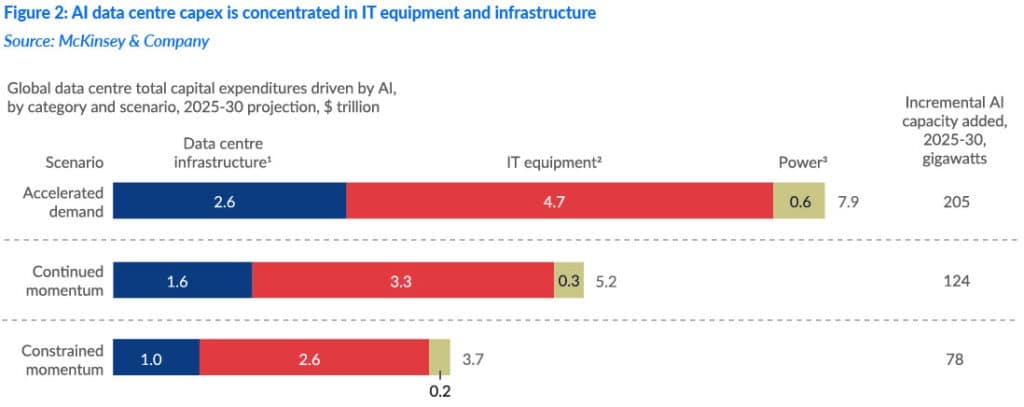
Note: Figures may not sum to totals because of rounding.
- Excludes IT services and software (e.g., operating system, data centre infrastructure management), since they require relatively low capex compared with other components.
- Includes server, storage, and network infrastructure. IT capex also accounts for replacing Al accelerators every 4 years.
- Assumes US$2.2bn-US$3.2bn/gigawatt (including power generation and transmission cost) to account for a range of power generation scenarios (e.g., fully powered by gas, a combination of gas power and storage, and solar) and regional cost differences. Distribution cost is neglected, as most Al centres are expected to be >50-megawatt scale and connected to a transmission grid.
Power and grids remain a limiting factor
In terms of power, the primary issue is not the cost of power infrastructure but its availability. Data centre electricity demand is rising quickly, and grids in some regions are already strained. This is why hyperscalers are pursuing off-grid generation and renewable projects. We see the grid as one of the main constraints, highlighting the need for energy efficiency and innovation across the data centre value chain.
Why supply is struggling to catch up
Building out a physical pipeline takes time – between one and three years for physical construction and up to six years once considering site planning and grid connection. Each stage of the value chain requires specialised equipment, skills, and incremental capacity that cannot be added overnight. Data centre shells require land, permits, and teams that can manage 100-plus MW projects, and there is a finite number of those teams.
History shows that supply eventually overshoots demand, which is why a measure of scepticism is warranted. However, companies that control these scarce capabilities today are likely to enjoy a period of elevated returns.
What this means for investors
The investing edge in AI is not simply about owning companies with an AI narrative. It is about identifying and understanding where scarcity, competitive advantages and execution create durable value and where it may move next. In 2023, the bottleneck was GPUs. Today, that shortage is in HBM and packaging. Rather than simply following momentum, we look for high-quality businesses with durable growth prospects across the value chain.
That means favouring companies with a competitive advantage and not chasing those that rely on hype. Capex numbers by themselves are not a guaranteed signal of future returns. We have lived through and researched enough cycles to know that when supply catches up, pricing power falls away.
This is both an infrastructure build-out and a software revolution. Hyperscalers, sovereign nations, and a growing number of enterprises are spending significant sums of capital on what resembles a new arms race.
In our view, the opportunity is not to chase every company with an AI label, but to understand where the bottlenecks are moving and invest in those companies where scarcity, execution, and discipline can translate into durable returns.