

US inflation has moved back into uncomfortable territory. July personal consumption expenditure (PCE) inflation has risen to 3.7% YoY, reviving debate over a renewed Fed tightening cycle. The headline numbers warrant caution, but the composition of inflation matters. Our assessment is that the recent rebound has been driven primarily by a series of adverse supply shocks rather than a renewed acceleration in domestic demand. More importantly, there is little evidence that these shocks are generating the second-round effects required to sustain inflation.
This distinction is critical for monetary policy. Higher policy rates cannot produce more oil, reverse tariffs or restore lost labour supply. They can, however, prevent a temporary supply shock from becoming embedded by containing demand and keeping inflation expectations anchored. The case for a prolonged tightening cycle therefore depends less on the initial price shock and more on whether it spills over into wages, services inflation and longer-term inflation expectations. So far, that transmission is notably absent.
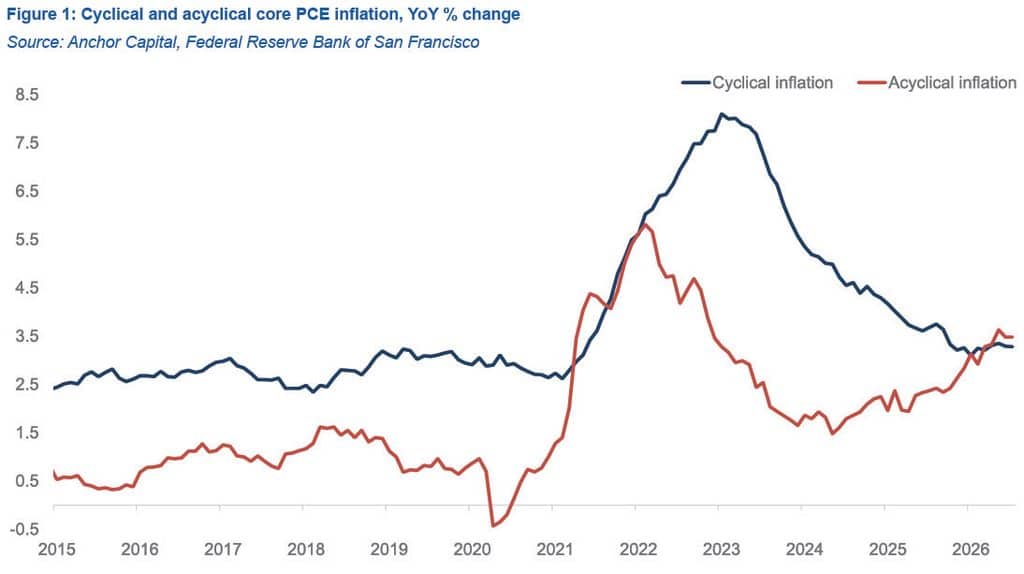
Figure 1 shows the San Francisco Fed’s decomposition of core PCE into cyclical and acyclical components and illustrates the point. The framework helps illustrate the distinction between inflation that is more sensitive to economic conditions and inflation driven by industry-specific or supply-side factors.
Recent firmness has been concentrated in acyclical inflation, which captures price movements less sensitive to monetary policy and more closely associated with supply-side influences. Over the past two years, the US economy has absorbed three negative supply shocks – tariffs, tighter immigration policy and the oil shock – yet cyclical, or demand-driven, inflation has continued to ease.
Searching for signs of persistence
If higher goods and energy prices were becoming embedded in the broader inflation process, we would expect to see evidence of second-round effects. Workers would seek compensation through faster wage growth, while businesses would increasingly pass those higher labour costs through into services prices.
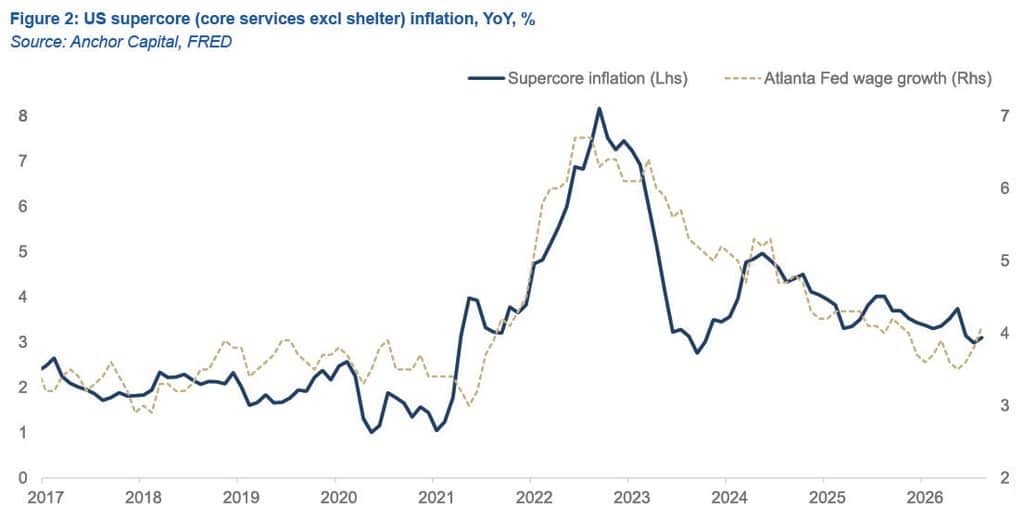
Instead, US wage growth continues to moderate. This matters because supercore inflation (core services excluding shelter, around 35% of core CPI) is closely linked to wage growth, as Figure 2 illustrates. As wage growth cools, the underlying pressure on services inflation should continue to weaken.
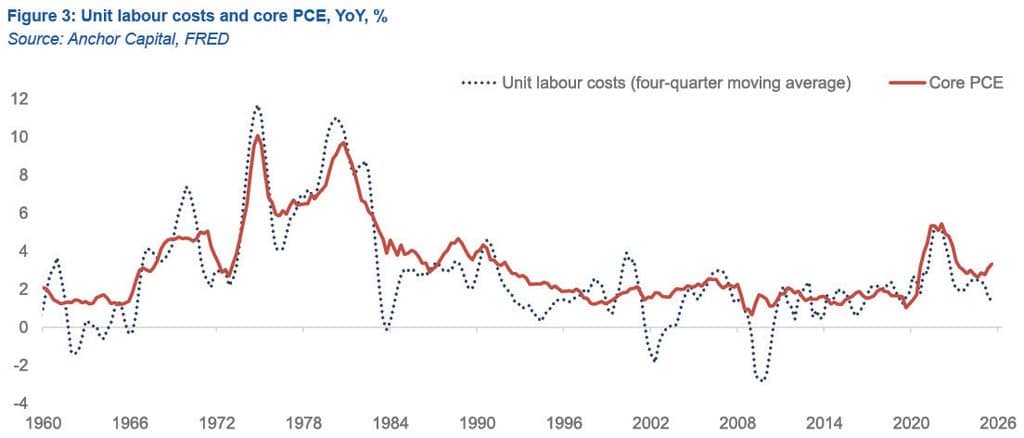
Productivity is another important consideration when assessing wage pressures. The US economy is experiencing strong productivity growth, supported in part by investment in AI and technology, reminiscent of the internet boom in the 1990s. This creates an important distinction: wage growth becomes inflationary when it persistently exceeds productivity growth. Strong productivity gains alongside slower nominal wage growth have pushed unit labour-cost growth down to roughly 1.4% YoY in 2Q26. With labour costs representing a major share of business costs, subdued growth in unit labour costs is inconsistent with a renewed wage-price spiral. It should translate into core PCE moderating, as shown in Figure 3.
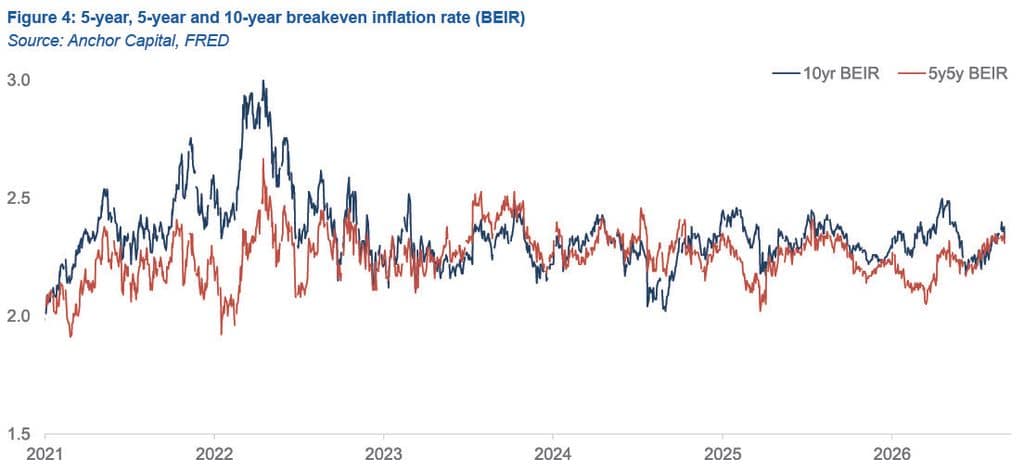
Market-based inflation expectations tell a similar story. Despite repeated adverse supply shocks and higher headline inflation, longer-dated breakeven rates have remained broadly range-bound, as Figure 4 shows. Stable expectations reduce the risk that households and businesses adjust wage- and price-setting behaviour in anticipation of permanently higher inflation. The recent shocks appear to have lifted the price level, without materially altering the market’s view of the longer-run inflation regime.
Taken together, these indicators provide limited evidence that the recent supply shocks are broadening into persistent inflation. Demand-driven inflation is easing, wages are moderating, unit labour costs are contained, services inflation is cooling and long-term inflation expectations remain anchored. Without meaningful second-round effects, the case for using monetary policy to offset what are primarily first-round supply shocks becomes considerably weaker.
Disinflation in the rest of the core basket
The remaining components of core inflation are also moving in a favourable direction. Core goods, around 25% of core CPI, were the principal channel through which tariffs lifted inflation. However, tariffs are primarily a price-level shock: unless tariff rates rise again, their YoY contribution to inflation should fade as the higher price base is absorbed. More than a year after the initial tariff increases, core goods inflation appears to have peaked and is already showing renewed disinflationary pressure.
Shelter inflation, around 40% of core CPI, points in a similar direction. Official shelter inflation remains elevated, but this component responds with a long lag to changes in market rents. Real-time market rental measures such as the Zillow Observed Rent Index are running close to 2%, suggesting further moderation in shelter disinflation as these softer rent increases feed through into CPI.
Together, shelter and supercore services are among the components where inflation persistence matters most. Both are showing signs of losing momentum. With core goods also disinflating, the underlying inflation impulse appears to be becoming progressively softer.
Conclusion
The Fed may need to maintain a restrictive policy bias while near-term inflation remains firm, but the bar for a sustained tightening cycle is high. A durable rate-hiking cycle would require clearer evidence that the initial supply shocks are spilling over into wages, services and longer-term inflation expectations. At present, that evidence is missing. As tariff and energy effects fade, shelter inflation catches down to market rents and labour-cost pressures continue to soften, we expect underlying inflation to resume its downward trend. Our base case is therefore for a shallow and relatively short-lived US tightening cycle, rather than the beginning of a prolonged move to higher policy rates.