
When the stock market becomes preoccupied with a powerful investment theme, good companies in other sectors of the market can easily be overlooked. The current AI boom is a prime example. These ignored shares can sometimes present great buying opportunities. However, it is equally important not to attribute every underperforming share to the theme-of-the-day. Some companies are struggling for reasons that have little to do with AI, while others may ultimately benefit from the technology in ways the market does not yet fully appreciate.
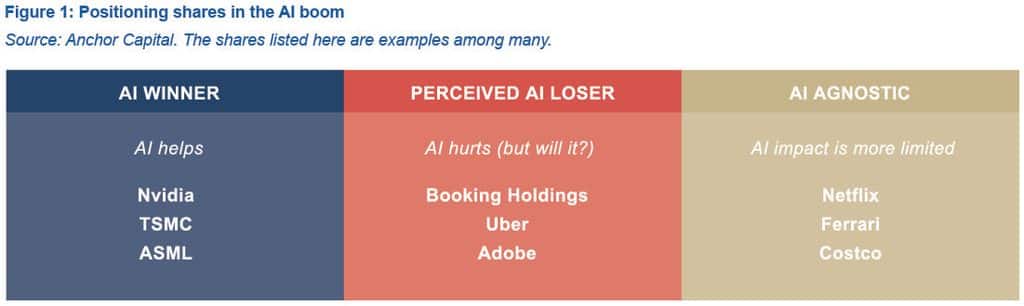
In the context of the current AI debate, we can broadly position shares into one of three categories. The first comprises AI winners. Companies such as NVIDIA, Taiwan Semiconductor Manufacturing Company (TSMC) and ASML are clear beneficiaries of the enormous investment being made in AI infrastructure. This has been reflected in their share price performance.
The second comprises perceived AI losers such as Booking Holdings, Uber and Adobe. These companies are viewed by some investors as being vulnerable to disruption from AI. However, the eventual AI landscape remains highly uncertain and may end up looking completely different to how the world perceives it.
Indeed, some companies that the market currently thinks will be AI losers may ultimately emerge as AI winners. Recent examples of this have been the dramatic positive turnarounds in the share prices of Alphabet (Google parent), Snowflake, Datadog, Palo Alto, Fortinet and CrowdStrike. For all these companies, the AI narrative shifted from being viewed as a headwind to becoming a tailwind.
The third broad category is what we call AI-agnostic shares. These are companies where there is no obvious material impact from AI in either direction. We cannot say with certainty that the AI impact will be zero. However, owning these shares gives investors some breathing space without having to fret every other day about what the AI impact might be. Some of the shares in this category can offer opportunities simply because the market is so preoccupied with the AI theme that it is overlooking these shares. Examples in this AI-agnostic category include Netflix, Ferrari and Costco.
In this article, we focus on three interesting global stocks whose share prices have struggled YTD in 2026 for different reasons. These are Booking Holdings, Uber and Netflix.
Booking’s share price has declined 24% YTD (to 25 September 2026). The overwhelming negative driver has been concerns that AI agents will bypass the Booking platform over time for holiday bookings such as hotels. There are other more minor drivers such as concerns about higher oil prices pushing up travel costs, safety concerns about travelling around the Middle East and higher US interest rates putting further pressure on US consumers.
Concerns about AI agents had started to abate but resurfaced following the recent launch of Meta’s Muse app, which offers users a range of AI agentic services, including travel bookings. The worry is that instead of consumers booking their holidays directly on the Booking platform, these AI agents might book directly on hotel websites or use competitor travel platforms. Interestingly, Muse currently uses Expedia sites for hotel bookings, and Expedia has subsequently announced a formal partnership with Muse. This is partly due to an existing relationship between Meta and Expedia. Booking has not blocked Muse (unlike Amazon), but currently it has no formal agreement in place. The threat to Booking may therefore be lower than feared if these AI agents ultimately continue to use travel platforms over time rather than dealing directly with hotels.
We believe the market is underestimating the complexity of booking travel experiences and the depth of Booking’s offerings in this regard. Humans typically take their travel experiences extremely seriously, especially when travelling to foreign countries. It is unlikely that most people will be happy to delegate this responsibility to an AI agent operating in isolation. It would be a disaster if something went wrong.
Travellers want to know whether their accommodation is clean, safe, suitably located and has their required amenities. They want to be able to speak to someone with the power to rectify things quickly if something goes wrong. Once a suitable venue has been decided on, the actual process of booking the venue is quick and painless on a travel platform like Booking. Therefore, the actual value an AI travel agent offers is debatable.
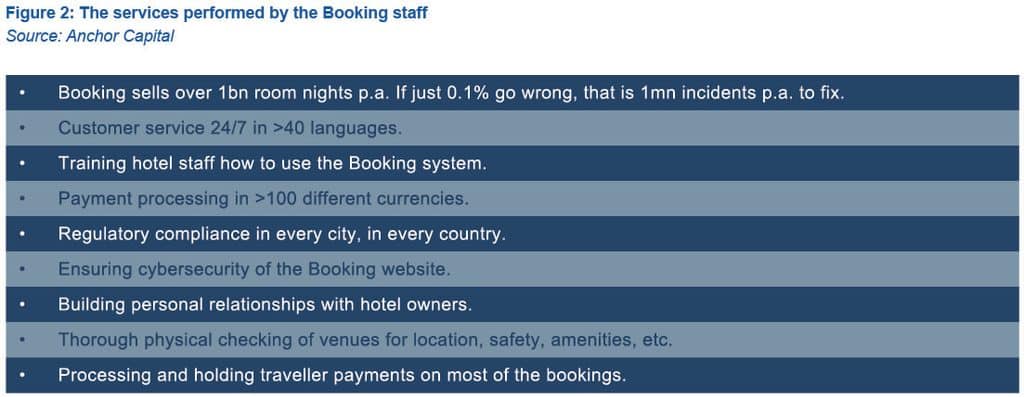
At the end of 2Q26, Booking employed 25,550 people. Behind its website sits a substantial infrastructure that would be difficult for an AI agent to replicate by visiting a multitude of external hotel websites and placing the booking on behalf of travellers. Some small European hotels might not even have websites. About 60% of Booking’s hotel room nights occur in Europe, where the hotel market is considerably more fragmented than in the US. We suspect that in time, many AI agentic travel bookings might end up going through the Booking platform anyway because of the services and safety net it offers travellers.
The table below illustrates some of the range of functions performed by Booking staff. A key one is that c. 73% of Booking’s gross bookings are paid through its own merchant payments platform. This gives the company control over payments, cancellations and refunds across the majority of its bookings. An AI agent acting in isolation would not have access to this kind of infrastructure without trying to replicate what Booking has built over many years. Booking also has its own loyalty programme, which is worth something to its customers.
It is also worth noting that Muse is not a dedicated holiday-booking app and might be spread quite thin, offering a wide range of agentic services. Also, Booking is already using AI itself internally and externally. It will steadily roll out and enhance its agentic offerings over time. This AI battle is Booking’s to lose, in our view.
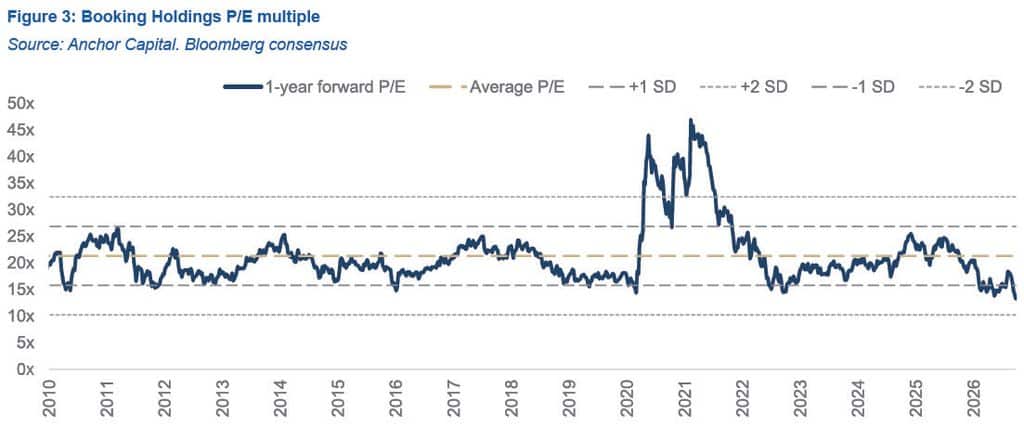
Partly because of the perceived AI risks to Booking’s business model, the share has derated to an all-time-low one-year forward P/E of 13.3x. This is well below its long-term average. Since 2014, Booking has reduced its share count at a compound annual growth rate (CAGR) of 4.4% p.a. through share buybacks. In 2Q26, it reduced its share count by 6% YoY. Based on its current share price and consensus free cash flow (FCF) generation estimates, the company could buy back about 7.6% of its issued share capital over the next 12 months. Assuming its underlying business does not suddenly lose momentum, this means that a low double-digit EPS growth rate is almost assured. There are undoubtedly risks for Booking, but at the current valuation, it seems these risks are mostly priced into the share.
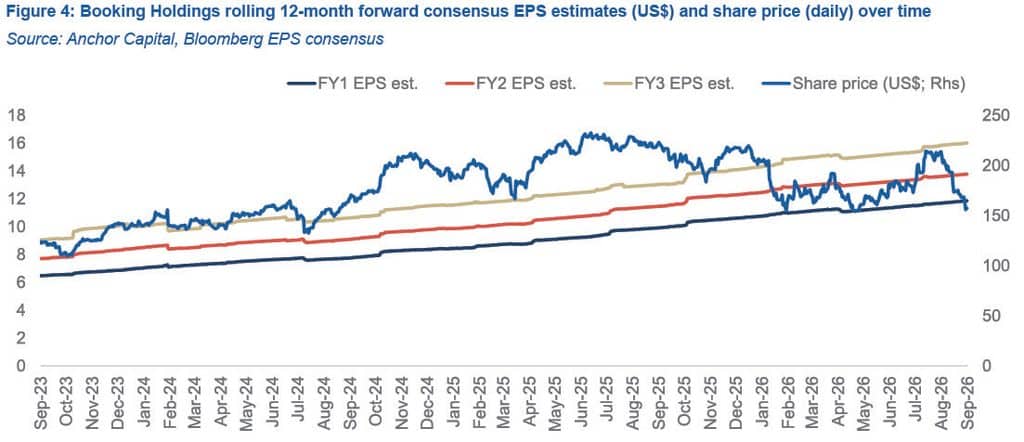
The following chart tracks rolling one-, two- and three-year forward consensus EPS estimates for Booking, with the share price overlaid. This demonstrates that despite concerns about the potential threat from AI over the past few years, there has not yet been a demonstrable impact on the Booking business. Consensus EPS estimates have, in fact, continued to tick up over time.
Uber’s share price is down 15% YTD (to 25 September 2026). Although it is viewed by the market as a potential AI loser, the arguments around this are more nuanced than in Booking’s case. The potential AI headwind for Uber is the vast strides being made at the onset of autonomous ride-hailing. Led by Tesla and Waymo, but with other smaller entrants as well, the bear argument goes, autonomous ride-hailing companies will develop their own ride-hailing apps and platforms, thereby bypassing the Uber platform. The current human-driven taxi market is highly fragmented, and Uber has aggregated it into a single app. The autonomous ride-hailing market could look very different, comprising larger fleets with single owners.
However, our view is that it is not an either/or between Uber and companies such as Tesla, for example. The scale and reach of the Uber platform is so immense that autonomous ride-hailing services are likely to want to be part of the Uber platform as well. In our view, Tesla will be mostly focused on manufacturing its Cybercabs and licensing its Full Self-Driving (FSD) software rather than managing large physical fleets of vehicles day to day, even though it is initially running the Robotaxi fleet itself. Tapping into the Uber platform is likely to offer significant value to the autonomous ride-hailing companies.
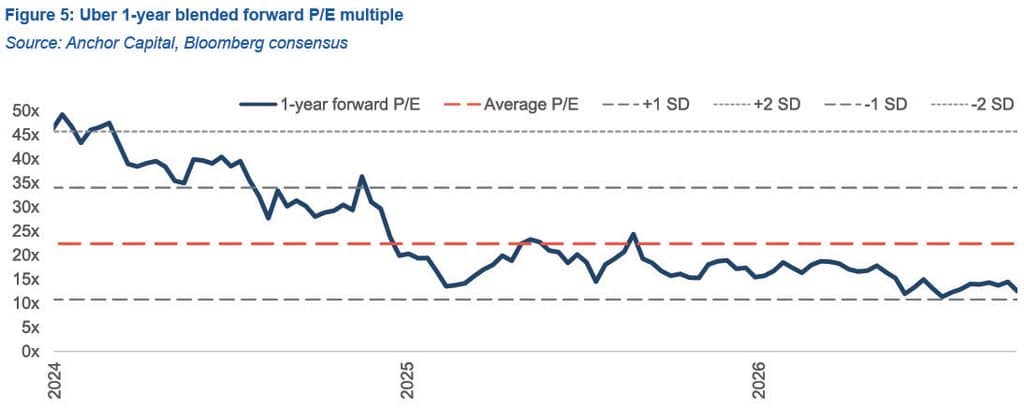
As with any investment thesis, however, there is considerable uncertainty. Things might turn out very differently in the autonomous ride-hailing market than we currently envisage. However, from an investor perspective, there is a large level of risk already priced into Uber’s valuation. As a growth company, its P/E multiple history is arguably not that meaningful. That said, the one-year forward P/E multiple on consensus earnings is optically low at 16.8x. Based on its current share price and consensus FCF generation estimates, Uber could buy back about 6.9% of its issued share capital over the next 12 months.
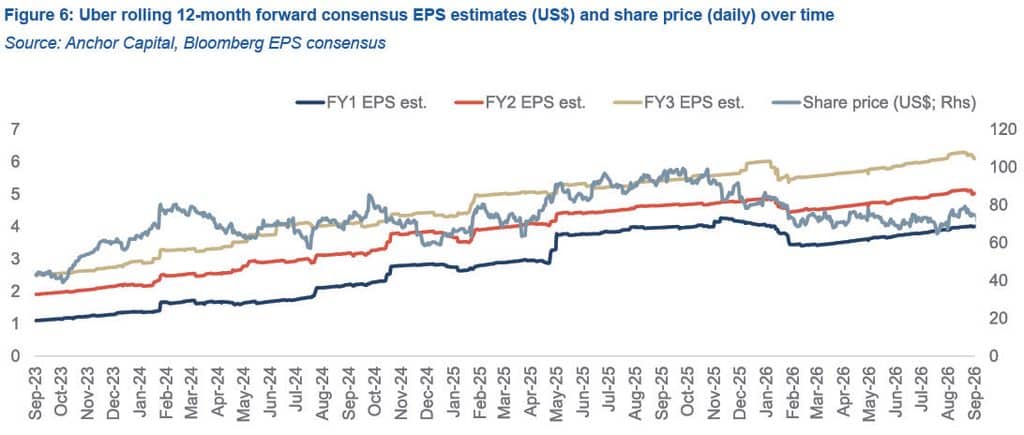
Uber’s rolling consensus EPS forecasts for the next three years have held up relatively well considering the narrative around the threat of autonomous ride-hailing to its business. This is another example of a stock where the market worries about its future while there has not been any demonstrably negative effect on its business so far.
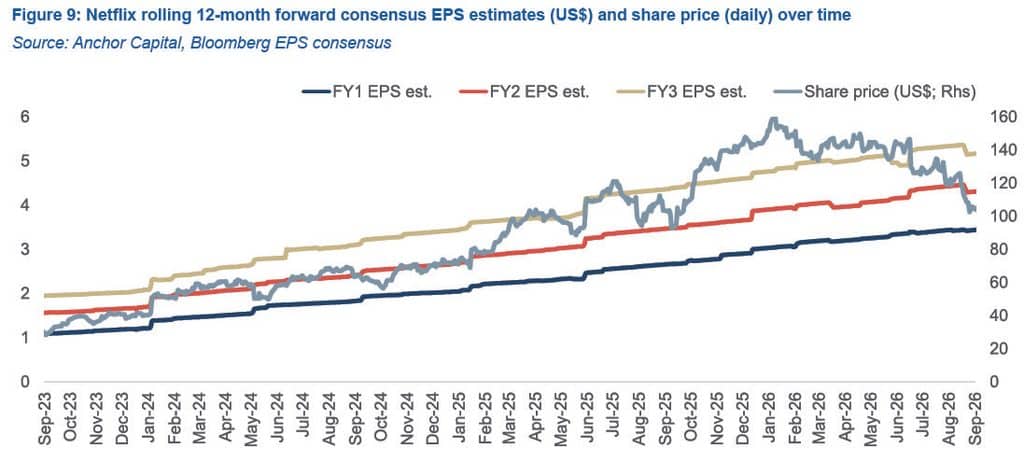
Netflix share price is down 24% YTD (to 25 September 2026). We have placed Netflix in the AI-agnostic category because, while AI-created content could eventually pose a small threat, this is unlikely to create a meaningful headwind to Netflix’s vast repository of visual content. On the creative side, AI will probably be a tailwind for Netflix’s own content in the future. The moves up and down in Netflix’s share price over the past couple of years seem more related to its own idiosyncratic drivers than to a gyrating AI narrative.
Netflix continues to deliver low-double-digit EPS growth, although the pace of its earnings growth may have slowed slightly recently. Also, the market is concerned about the immense competition for eyeballs from the powerhouse YouTube, other streaming competitors, Facebook, Instagram, TikTok and even gaming. There are only 24 hours in a day to watch content. Furthermore, Netflix’s recent slate of content has been in a bit of a lull. The fact that the bid for Warner Bros. Discovery failed in 2026 was perceived as a positive by the market at the time. However, investors worry that Netflix might pursue acquisitions elsewhere.
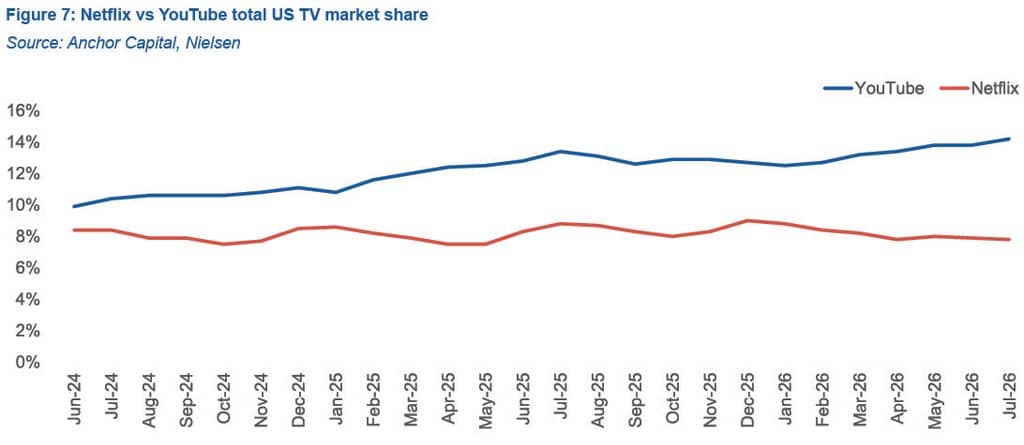
In the US, Netflix’s total TV market share has been holding its own, although YouTube has become the dominant streaming platform. YouTube’s user-created content is proving to be an astounding business model where content creators are only paid according to the actual success of their content.
However, Netflix has been here before. Periodically since its IPO in 2002, it has experienced severe drawdowns on concerns about its future, only to bounce back strongly. We continue to view Netflix as a quality business that we should give the benefit of the doubt given its strong long-term track record. In reality, none of the current concerns seems overly serious. Netflix is not a turnaround story in the traditional sense. Rather, it is a high-calibre company, executing well, but the market is asking some questions.
At 19.4x one-year forward consensus earnings, Netflix’s P/E multiple is close to an all-time low set in 2022 during the massive global tech sell-off. Based on its current share price and consensus FCF generation estimates, Netflix can buy back about 4.2% of its issued share capital over the next 12 months. The company also has an active share buyback programme.
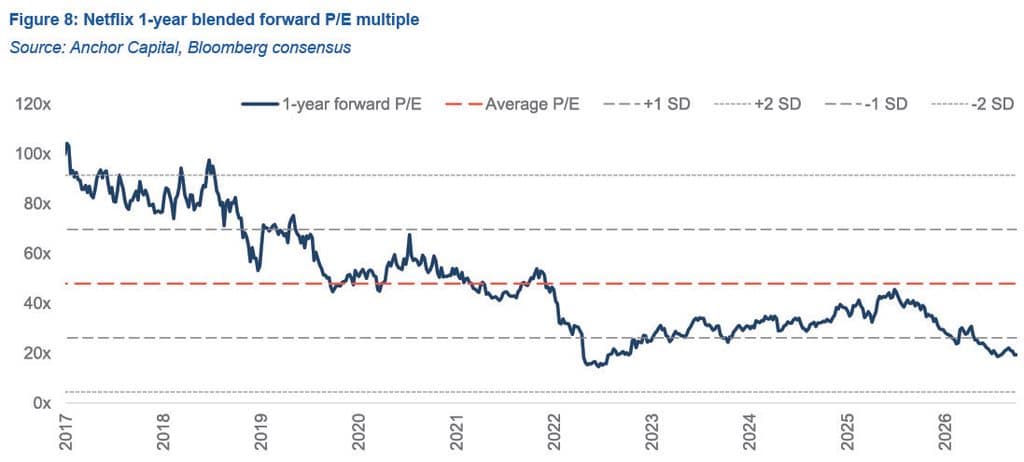
While consensus earnings upgrade momentum has slowed slightly in recent months, Netflix’s share price appears to have been hit by a softening narrative rather than a meaningful business slowdown for now. Netflix’s share price is pricing in a significant degree of risk about its future. We think these concerns are overblown.